|
Forums36
Topics42,113
Posts571,680
Members19,115
| |
Most Online23,413
9 hours ago
|
|
|
1 members (Theo Gallus),
15,475
guests, and
266
robots. |
|
Key:
Admin,
Global Mod,
Mod
|
|
|
|
Joined: Apr 2002
Posts: 242
Lunker
|
|
Lunker
Joined: Apr 2002
Posts: 242 |
Point taken, Eric. There's always a bigger fish, or a faster car/bike or a bigger deer somewhere. Makes life interesting.
I guessed right on 3 out of 4 of Hooksetters examples but didn't (still don't) see the RES in #4. But like you said, it sure is fun.
Mistakes are proof that you are trying.
Dan
|
|
|
|
|
Joined: Nov 2003
Posts: 542
Lunker
|
|
Lunker
Joined: Nov 2003
Posts: 542 |
Ahhhh Yes always a bigger fish with more teeth and nastier attitude!! All in all any fish you put in your pond are the best fish!! Thats the fun of building the eco system and watching the fish grow to their greatest potential.
I was just out at my pond today and I have one SMB that is now around 16 inches. The other interesting thing is that they are now (After 3 yrs) starting to eat the feed at the surface!! Nice to see them jump and splash along the top when I throw stuff in.
---------------------------------
1/10 - 1/4 acre pond plus 16 ft deep/ Plus 40 ft by 20 ft by 6 ft deep koi and fathead minnow pond next to it. Upstate NY
|
|
|
|
|
Joined: Mar 2005
Posts: 22,033 Likes: 483
Moderator Hall of Fame 2014  Lunker
|
|
Moderator Hall of Fame 2014 Lunker
Joined: Mar 2005
Posts: 22,033 Likes: 483 |
Eric and Dan you guys are right. I just wish I could grow a few YP , eyes and SMB etc down here but its to hot. Those real perch are sure tasty. 
|
|
|
|
|
Joined: Apr 2002
Posts: 15,998 Likes: 1497
Moderator
Ambassador
Field Correspondent Lunker
|
|
Moderator
Ambassador
Field Correspondent Lunker
Joined: Apr 2002
Posts: 15,998 Likes: 1497 |
Dan, IMO those that think No4 is a RES are using body coloration or pattern or markings for their identification, which can be very risky in some fish identifications. Note that the body marking pattern on the gill cover of No 4 is not the same as on fish No.1. This is more pronounced when you look at the lower half of the gill cover on both fish. The typical RES body pattern extends on to the gill plate of fish 1 but they do not continue onto the gill of No4. This is another reason fish No 4 is not a RES in my opinion. I think if the gill rakers were exposed in fish No.4 they would be identical to those of a BG not a RES.
Last edited by Bill Cody; 08/31/07 09:50 PM.
aka Pond Doctor & Dr. Perca Read Pond Boss Magazine -
America's Journal of Pond Management
|
|
|
|
|
Joined: Apr 2002
Posts: 242
Lunker
|
|
Lunker
Joined: Apr 2002
Posts: 242 |
Thanks Bill. I jumped from your explnation to the pictures several times and I think I see what you are talking about.
And then, as Eric pointed out, there's Hybrids, crosses, different areas of the country....Yikes! Can be very confusing & intimidating to the amateur.
Dan
Mistakes are proof that you are trying.
Dan
|
|
|
|
|
Joined: Apr 2006
Posts: 3,261
Ambassador Lunker
|
|
Ambassador Lunker
Joined: Apr 2006
Posts: 3,261 |
bill, u r correct that i think #4 has RES genetics based soley on coloration and body markings.
so how does hybridization effect the # of gillrakers in the Fx offspring? and is this a question whose answer is "it depends"?
if more BG genes than it would have # of rakers like BG, and if more RES genes, it would have # of rakers like RES?
what is your experience w/ counting gill rakers in various hybrid combinations of lepomis?
thanks in advance for what i know will be a thoughtful and insightful reply.
dave
GSF are people too!  
|
|
|
|
|
Joined: Mar 2005
Posts: 22,033 Likes: 483
Moderator Hall of Fame 2014 Lunker
|
|
Moderator Hall of Fame 2014 Lunker
Joined: Mar 2005
Posts: 22,033 Likes: 483 |
Dave take a look at Wisc Fish (see archives under id sources). They show lots of pics of X rakers and provide that they are intermediate of the two parental species. They have no RES morphology info and that is in short supply elsewhere. Get a copy of Peterson's Field Guide to Freshwater Fish it has very good morphology info. I think 4 is a RES by looks and morph. I learned a long time ago that pics on here can look very different depending on the computer and screen. On my screen no 4's pectoral fin looks almost exactly like no 1's shape, size and length on Bill's I assume it looks different. I note that the 2 BG ear flaps look much more different than the 2 RES do. On my screen the scale pattern goes almost up to the eye on both RES and their head shape is similar as are the 2 BGs but they are different from the RES. Faint black spot on dorsal of BG not on fish 1 or 4 (this is noted as a major morph difference between BG and RES). The difference in size of the 2 RES could be from a # of factors like actual age ( in the south RES often spawn more than once and/or the period is spread out), aggressiveness or male/female , or parents genes. Because the spawn can be spread out the early stage food supply can be very different for 2 birth dates 60 days apart thus there growth rate/size. RES have short stubby gill rakers while BG are long and thin and Xs are medium length and width. As both Bill and I stated this type of id can be hard/problematical sometimes especially in small fish. All of this and a dollar will get you a cup of coffee.
.gif) 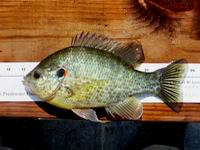
|
|
|
Moderated by Bill Cody, Bruce Condello, catmandoo, Chris Steelman, Dave Davidson1, esshup, ewest, FireIsHot, Omaha, Sunil, teehjaeh57 |
|







