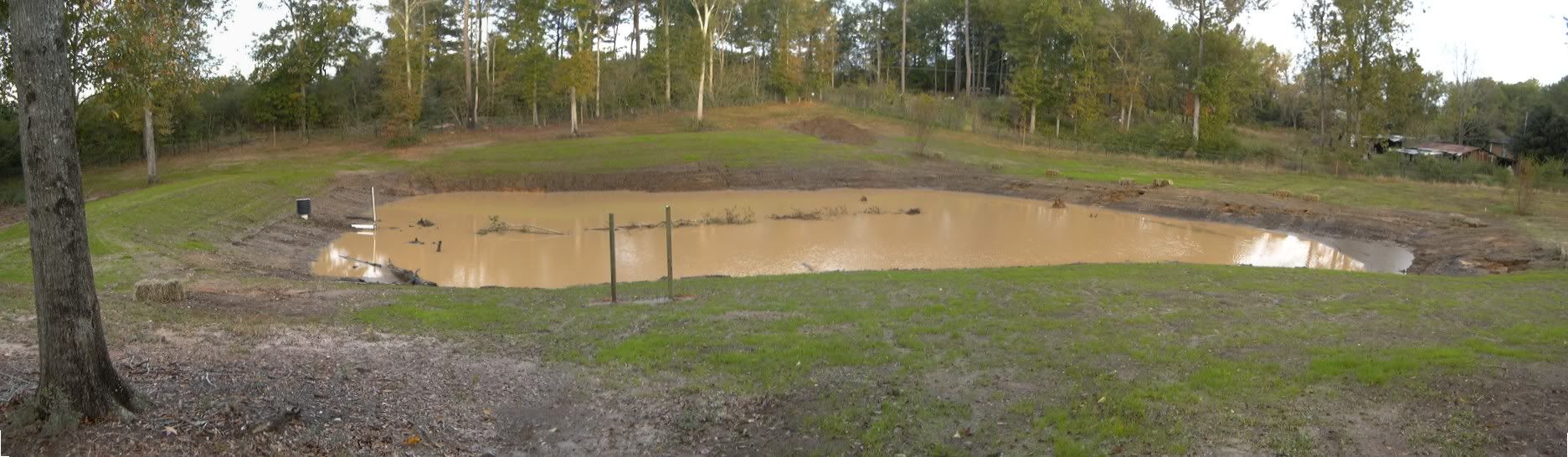
thinking a little about zkhent and bills posts (i'll call it "new pond wetting"), it really would all depend on the site geology. you could estimate the wetting based on the properties of endmember soils (sand, silt clay) and then consider your own soils (for ex. sandy silt loams or silt with clay loams....or any combination thereof)......you'd have to know yer site.
i've heard various things like it takes a year for a new pond to "settle in", but bill brought up good points on the other page......if its built right, it shouldnt do that at all.
in my case right after renovation (Nov 05) and first filling (Jan 06) i didnt notice a thing until about May 06. it was dropping slightly faster than the evaporation rate, but by late summer, it was all evaporation.....there might have been some degree of "new pond wetting" but in a properly built pond it's really difficult to quantify if its not what you'd call a leak or seep, and as robinson mentioned, why count on it sealing itself?, seal it to begin with, and if thats not possible, at least cross yer fingers with your eyes open.
I'll just wait and see what happens. My contractor has done a lot of ponds in the area and I'll have to trust that he did it right. I'll do what he said...wait and see. What I need is RAIN. We get a little and then nothing for a week or more. What we get fills the pond 6" to a foot and then over the next week or so it slowly goes down. I'm not getting anywhere!
I have a "slight" valley with the dam across it. Most of the pond was dug out due to the slightness of the valley. There was a LOT of "topsoil", nice dark dirt that had (I guess) slowly filled in the valley, flattening it out, over thousands of years.
We hit water at about 6-8ft. The contractor called it "lateral water". The dam was dug down to about 12ft below the accumulated "topsoil" and a bunch of old tree trunks that were buried there during the land clearing. He dug until he hit clay. Both sides of the valley are clay. That is where he got the clay for the dam. He did mix some of the darker dirt with the clay to make about a 5:1 mix (?) of clay and topsoil.
Everything I've heard here makes me believe that he did the right things. So, I guess we'll just have to wait and see. He said give it at least 6 months or more before I panic and they'll come back to rework the dam.
Did I mention that the SE and lower Alabama has been in a very bad drought that we're just coming out of. So, I'm hoping that he's right. That this is lateral water from upstream that has always been flowing through this "draw" and with the dam istalled it will keep it dammed up. The WAS water flowing very slowly where the dam is located when we bought the property. That natural water level was about at about 1/2 the pond depth level. I'm hoping that the "topsoil" surrounding the pond just needs to saturate again and then 'll be good to go.
Joe, I have about the same situation. We recently got some nice rains and the water level came up about a foot. Within 2 weeks it had gone back down. My pond isn't new and I assume that the dry soils just suck it out from the sides. I need extended rains to catch up. We are into an 8 year drought.
It's not about the fish. It's about the pond. Take care of the pond and the fish will be fine. PB subscriber since before it was in color.
Without a sense of urgency, Nothing ever gets done.
Boy, if I say "sic em", you'd better look for something to bite. Sam Shelley Rancher and Farmer Muleshoe Texas 1892-1985 RIP Grandpa
Man...a BUNCH of rain today. The pond went from nothing but a few puddles to about 3ft deep!!!
And...it's STILL raining! I may be about 1/3-1/2 full by tomorrow.
So, what everyone is saying is: The pond will fill a bit and then go down some taking anywhere from 6 months to a year to fully fill and keep water?
I'll mark the edge tomorrow and see how fast it falls. What would be an acceptable rate? Remember, this is a new pond and it's never had nearly this much water before. I've had a foot before that slowly disappeared.
I dug a .40 acre pond on my property 8 months ago. For the first several months (Spring) we got a lot of rain but the pond seemed to lose quite a bit of water to seepage. It was roughly half full in May. Then we had a Summer drought and the pond lost a lot of water to evaporation and probably some to seepage. It started to rain regularly again in July, and last week the pond was at roughly the same level it was last Spring. (half full)
In the last 2 days we've gotten heavy rains so the pond should have more water in it now than ever. Since the weather has cooled off this Fall the water level is not dropping any between rains, so I guess the pond has sealed itself. I'm expecting it to completely fill this winter. I dug the pond myself and it might have sealed faster if the soil were properly compacted by someone who knew what they were doing. It's taking a while to fill because it doesn't have as much watershed as it should. It seems like it's taken 6 months or so to seal and quit seeping.
Nice looking pond, mine is a different shape but looks roughly the same size. Have you measured it and the watershed? Looks like all your watershed may be above the pond and that the spillway may be the bottom right. What are the posts on the lower end of the pond?
We got 1.86" yesterday and it's still raining. If you don't have a rain gauge TVA has gauges online at http://www.tva.gov. Click "Reservoir info" and then "Valley Precipitation" to get a list of local rain gauges for the Southeast.
Last weekend the water was almost touching my lower dock posts which are the upper and most shallow end of the pond. It's rained 3 times in the last week and I bet the water is covering the dock posts for the first time. We live 7 miles away and I need to run over there and check it out.
No, I haven't measured the pond yet but I'd guess around 1/2 acre. My watershead is at least 20 acres. Most of the water comes in from the right. You can see the bales of hay and the "canyons" caused by the water coming in FAST.
Those posts are where my fence is going. Those are the small gate posts.
It's gone down some, maybe 2" since yesterdays rain. I walked downstream, past the dam today and I don't see any running water so I'm guessing it's just water being sucked up by the several feet of "topsoil" that extends towards the right, where the water comes from.
I'm standing on a clay hill and the other side (across) is also a clay hill. Towards the right it flattens out and it's about 6+ feet of a topsoil type dirt.
I know its been a few years... Hows the pond? Did it settle and fill up? Curious how it worked out for ya, and if you did anything to fix along the way. Or if you just gave it time.
New member to the forum and looking for some insight. My 1/2 -3/4 acre pond was finished around July 5th from what I can tell from pics on my phone. We got a ton of rain in the first few weeks and the run off filled it to 1/3 full. Then it went into about a 4-6 week dry spell. Lost lots of water and it’s been yo-yo ing for since then all the way to now September 1st. Hadn’t rained a lot but seems to be losing quite a bit. The guy that dug it seemed to know what he was doing and has dug many ponds. This area has lots of spring water and ground water. I did notice some damp mud about 50 ft behind the damn but no where immediately behind the dam, should I be concerned about a leak? The area that is moist behind the pond is the natural runoff for the land as well. I have lots of pics including the build process if needed.
Sorry to hear you may be having some leaks in your new pond.
A pond sealed with clay-bearing materials should be mostly sealed immediately after construction. However, the clay minerals themselves do incorporate some actual water into their structure, so they will take up some of the free water from the pond and swell a little bit.
There is also some wicking, where the topsoil around your pond draws up some water above the pond level that is either used by your plants or gets evaporated from the soil surface.
You also will have some actual evaporation losses directly from your pond surface, especially on hot, windy days with low humidity.
After you take out all of that, then you may have a leak if you believe your water losses are greater than what I listed. Water or damp soil on the back side of the dam is usually a bad sign. However, as you said, some surface water can also run into that same low spot. You probably need to watch how that spot dries out for several days after a rain. If the other low spots on your property dry out in three days, and that one stays wet for 10 days, then you probably have a pond leak.
If that is the case, you should probably come back to the forum and start a new thread. You can then post more info about your pond situation and people can help you with possible solutions.
Yeah I wanted to go ahead and get an account going and ask the question. I agree, my neighbor basically said the same thing, I’m concerned about that spot because it was soft even when nothing else was but my neighbor said got to give it some time. I’ll try and post a pic but it keeps giving me an error on the file size even though it’s under 2 mb.
I have attached some pictures of my pond, it rained last night and a little today.
It "looks" like good clay-bearing material in the photos. However, "looks" is absolutely the worst way to evaluate clay content.
Can you go down to the water's edge and grab some of the pond bottom material that is a foot or so above the water line? When it is a little damp, you should be able to roll a nice ball in your hands with good clay. (Try for about the size of a golf ball.)
If you can do that, throw about half away, and try to roll a clay "pencil" or "worm" in your palms. That would indicate an even higher clay content.
You might feel some sand grains in your palms. Do NOT worry about that. Well-mixed sand in your clay-bearing material is just fine.
If you determine you have good clay, then how it was compacted might be the problem. How did they compact your dam? (Running the dozer over it is NOT enough compaction in most situations.) Did they make a core trench?
A bulldozer is not a soil compaction tool/device. The tracks on the dozer are designed to spread out the weight so the dozer can better float over the dirt. Soil compaction tools are sheepsfoot rollers as pull behind or vibratory, and loaded pans. That is why these devices are sold as compaction tools. IMO and knowledge sheepsfoot devices are best because they knit the soil layers together as the layers are compacted. Packing clay layers with a dozer creates sheet layers that allows water to work it way through the soil layers. This is more pronounced when the soil lift layers are thick. From your description I think your pond has leakage due to poor clay compaction techniques. A good pond builder should know how to soil is best compacted especially for pond construction. .
aka Pond Doctor & Dr. Perca Read Pond Boss Magazine - America's Journal of Pond Management
I have seen them before, I don’t know that I’ve seen one used in this area before. So will the clay settle into those groves and close up or will I continue to lose water? I know no one can be sure but wondering what your thoughts were.
Suspended clay particulate colloids will get pulled into the seepage areas, however this unconsolidated material will not be compacted. It will remain soft and fluffy. To form a good seal, clay has to be compressed as relatively thin damp layers of material that are well compacted and the layers knitted together to form a thick liner layer not as thin soggy material pulled into or between a crack layer or loose material zone / area.
All good larger construction companies have special machines for efficient, best, engineer, quality compaction of material at commercial or road building construction sites. Any bulldozer guy who does not have or use high quality compaction machines is a hole digging dirt mover and not a real pro pond builder. You dig a hole however you BUILD and construct ponds. Dug holes leak and well built ponds hold water well.
For your leakage problem while the pond is full, you could look into the polymer pond sealer products. Some are better than others,,,, similar to pond builders. One brand name product often discussed here on the Forum is SoilFloc that has gotten good customer reviews. Polymer type products cause a catalytic bonding process that can create a stratum or layer that resists water penetration. Do your good homework for this method of trying to seal pond seepage. The degree of leakage and type of soil round the leak are important features for the success of the method. IMO these products are best used and applied while the pond is being built as insurance to minimize leaks. To correctly fix a leaky pond it can cost as much as it did to build the pond.
Last edited by Bill Cody; 09/02/2411:01 AM.
aka Pond Doctor & Dr. Perca Read Pond Boss Magazine - America's Journal of Pond Management
A clay particle in water is ALREADY hydrated and swelled to its maximum size. They are very unlikely to reduce an existing leak pathway.
In fact, the opposite is true. Leaks due to poor compaction usually get worse over time. Every time the water slowly moving through the leak manages to pluck out a clay particle or sand particle from the walls of the pathway, the leak rate slightly increases. Every time the leak rate increases, it becomes more likely to pluck out the NEXT particle.
The polymer products discussed above by Bill, work by getting into the leak fairly rapidly, and then continuing to swell or continuing to cross-link and build more resistance to shear (water flow).
Here is a good thread about fixing leaky ponds. You can find the contact information to reach TJ on the second page of the thread. If he is not swamped at work, he can usually give you some free guidance about possible solutions for your particular situation. (He is also a supplier of one of the highest rated products.)
Also, when you are getting rain in your area, do you have a way to pump water to your pond from a nearby source? If so, you might fill your pond and then monitor the daily drop rate and stabilization point. That will give you some more important data about the nature of your leak.
A clay particle in water is ALREADY hydrated and swelled to its maximum size. They are very unlikely to reduce an existing leak pathway.
In fact, the opposite is true. Leaks due to poor compaction usually get worse over time. Every time the water slowly moving through the leak manages to pluck out a clay particle or sand particle from the walls of the pathway, the leak rate slightly increases. Every time the leak rate increases, it becomes more likely to pluck out the NEXT particle.
The polymer products discussed above by Bill, work by getting into the leak fairly rapidly, and then continuing to swell or continuing to cross-link and build more resistance to shear (water flow).
Here is a good thread about fixing leaky ponds. You can find the contact information to reach TJ on the second page of the thread. If he is not swamped at work, he can usually give you some free guidance about possible solutions for your particular situation. (He is also a supplier of one of the highest rated products.)
Also, when you are getting rain in your area, do you have a way to pump water to your pond from a nearby source? If so, you might fill your pond and then monitor the daily drop rate and stabilization point. That will give you some more important data about the nature of your leak.
Very interesting info, what a great place of knowledge. On compaction...can't the weight of the clay compact itself? I guess it would only until a certain depth but when my clay dam blew out the clay at the bottom was so hard I could barely drive a spade shovel into it - I mean really hard to the point that water wasnt eroding it anymore. It was marine clay from the best of my knowlegde.
There are many different clay minerals. The "expansive clays" are the ones that swell or shrink depending on the water content. It is NOT like water added to a jar of sand particles or silt particles. For these clay minerals, the water becomes part of the actual mineral structure.
All of the ancient pottery is made from these types of clays. As a clay vessel dries, it also shrinks - making it stronger. If it dries very slowly and evenly with no cracks it can be placed in a kiln and become MUCH stronger when fired.
Clay layers in your soil or your dam get very hard when they dry out very slowly. I tried to dig some test pits for a pond on my farm during our extended drought. When I tried to dig in the areas with a clay layer just below the topsoil, I couldn't even get the teeth on the mini-excavator bucket to bite - that crap was so hard. Lesson learned!
Just want to bump the question back to the top, can the pond be drained and then a sheep’s foot be used? Or would have the sheep foot had to be used when creating the pond from the beginning?