|
Forums36
Topics42,113
Posts571,676
Members19,115
| |
Most Online13,561
18 hours ago
|
|
|
|
Joined: Mar 2004
Posts: 3,075
Lunker
|
|
Lunker
Joined: Mar 2004
Posts: 3,075 |
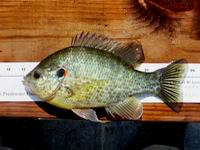
The TGG pond continues to improve in visibility going from zero in late June to now about 6 inches visibility. With cooler weather coming, I expect it to clear very nicely in the next couple of months. During this period of low visibility, I suspended artificial feeding and fish activity really slowed to a crawl...now its really picking up again. Here is Oct.'s report by the three factors being measured: Growth: The average length is now 8.8 inches. For those not familar, this length is determined from 5 fish, with the high and low thrown out and the remainig three averaged. Hence, you will see a 9 inch fish in the pictures but the overall average is 8.8 inches. Likewise, weight is based on average of the same three fish and the weight ave. is 8 ounces. Aggressiveness: I use a 10 cast system with identical flies and identical times fishing three ponds within sight of each other. I score 10 points for a catch and 5 points for a hit. The cumulative average for the 10 month experiment is as follows: TGG=33, CNBG=24, and native BG=23. Sustainability: In past reports, I have noted the virtual complete absense of Fx offspring...that has now changed. There are clearly two classes of Fx now in the pond...a 4 inch class and a 2 inch class. I'm able to trap both classes now. I will try to keep some measure of the numbers of these Fx trapped as a function of time, but it will be less than presise. Comment: I have started removing the HSB for stocking in a larger pond. I have to say that the HSB spinoff has been a most positive result of this experiment. Every one of them has grown from 3-4 inch stockers to at least 12 inches and at least one pound. I'm simply overjoyed to have such a great fish to move into a larger pond for finishing growth...a result totally unexpected. Next update in Dec. will be the one year point for the experiment and I plan to go to quarterly updates after that time. For pictures and complete tabular data see this link: http://www.meadowlarkponds.com/TGG.htm
|
|
|
|
|
Joined: Mar 2005
Posts: 22,033 Likes: 483
Moderator Hall of Fame 2014  Lunker
|
|
Moderator Hall of Fame 2014 Lunker
Joined: Mar 2005
Posts: 22,033 Likes: 483 |
ML a collective thanks from all of us for doing all the considerable work that keeping up with the kids pond data involves.  I think one point is very telling and worth emphasizing to all us pond nuts, from the report. The difficulty of really knowing about what has spawned and is in there. Often we think one thing and find out something different. Small fish can really hide. Unless you see them swarm (school) soon after swim up it can be tough to know about them. Cages/trapping and limited seine surveys can help with that but are only an indicator (unless one seines the entire pond).
|
|
|
|
|
Joined: Mar 2004
Posts: 3,075
Lunker
|
|
Lunker
Joined: Mar 2004
Posts: 3,075 |
Perhaps some of you would be interested to see the Fx in real life. The photo below shows the results from this morning's trapping. You can clearly see the two distinct sizes of Fx and their appearance, which may be somewhat less ominous than the predator that died trying to eat them. Now we will see if the HSB can do their job. I'm very confident that I'll be able to determine the extent to which the Fx survive and whether or not it poses a sustainability problem down the road. The journey continues. 
|
|
|
|
|
Joined: Mar 2005
Posts: 22,033 Likes: 483
Moderator Hall of Fame 2014 Lunker
|
|
Moderator Hall of Fame 2014 Lunker
Joined: Mar 2005
Posts: 22,033 Likes: 483 |
ML Did Deb ever say what % of your GG might be male and any expected fecundity rates? I would assume that with not many females (if that is the case) someone might make an WAG at the total possible potential # of Fxs.
|
|
|
|
|
Joined: Mar 2004
Posts: 3,075
Lunker
|
|
Lunker
Joined: Mar 2004
Posts: 3,075 |
The data I have seen says GG are 70% male unlike "regular" HBG which are about 90% male. More data to support Theo's backcross theory?
I'm not concerned at all about the potential # of Fxs that are spawned...only that the HSB are able to keep them in check to allow the continued growth of the target fish.
|
|
|
|
|
Joined: Mar 2005
Posts: 22,033 Likes: 483
Moderator Hall of Fame 2014 Lunker
|
|
Moderator Hall of Fame 2014 Lunker
Joined: Mar 2005
Posts: 22,033 Likes: 483 |
If one could formulate a guess at the total # of FXs spawned and the results of , if, and how many survive with X # of HSB and or adult GG (and trapping)then you would have a better guess at how many new HSB to add to suppress the FXs.
I think the adult GG will be the main source of yoy FX suppression. I think the GG will eat more small FXs this year than last especially if the gam. #s do not go up. You may well need a few (more than the 3-5 I suggested) of the current HSB crop to take care of the 4in GG class plus some new smaller ones to deal with new yoy FXs.
|
|
|
|
|
Joined: Mar 2004
Posts: 3,075
Lunker
|
|
Lunker
Joined: Mar 2004
Posts: 3,075 |
An interesting thing along those lines...
I figured the easiest way to remove the HSB would be with fathead minnows on a hook. Toward that end, I picked up some FH this weekend from the fish truck at the feed store. Turned out that I couldn't keep the GG's off the fatheads...hard to catch the HSB because the GG's always beat them to the minnow.
The GG's, as I've reported previously, really like, prefer in fact, live minnows. So, it stands to reason that they will also be a source of Fx suppression.
Just for fun, I'm watching a couple of Fx growth rates in the small micro-pond. No indication of hybrid growth depression there. I wonder if the complaints of many about lack of Fx growth, stunting, GSF take-over, etc. is in fact due primarily to overpopulation rather than outbreeding depression. I kind of suspect that is the case, but can't prove it.
I'll be adding some more small HSB as time goes by. I fully intend to keep the 5 to 1 ratio in tact as best I can. Another year from now will tell us a lot more about this little experiment, but I've already learned a great deal and look forward to learning more.
|
|
|
|
|
Joined: Apr 2002
Posts: 15,998 Likes: 1497
Moderator
Ambassador
Field Correspondent Lunker
|
|
Moderator
Ambassador
Field Correspondent Lunker
Joined: Apr 2002
Posts: 15,998 Likes: 1497 |
Good job ML, I like your project. I have a similar experience with HBG and fishing with minnows. I went to a pond tonight to catch some LMB for transfer to a GSF pond. For bait I used dead minnows and my brother used live minnows. Minnows ranged from 1.7"-3.5". One hour of fishing produced 5 HBG for me and 3 for my borther and one LMB. Yep, HBG like minnows, dead or alive. We quit fishing when the HSB moved in and started biting because it wasted too much time landing them.
aka Pond Doctor & Dr. Perca Read Pond Boss Magazine -
America's Journal of Pond Management
|
|
|
|
|
Joined: Sep 2003
Posts: 14,300 Likes: 450
Moderator Ambassador Field Correspondent Hall of Fame 2014 Lunker
|
|
Moderator Ambassador Field Correspondent Hall of Fame 2014 Lunker
Joined: Sep 2003
Posts: 14,300 Likes: 450 |
ML, do you think that your muddy or turbid water may have prevented the HSB from effectively controlling the GG's offspring?
Excerpt from Robert Crais' "The Monkey's Raincoat:"
"She took another microscopic bite of her sandwich, then pushed it away. Maybe she absorbed nutrients from her surroundings."
|
|
|
|
|
Joined: Mar 2004
Posts: 3,075
Lunker
|
|
Lunker
Joined: Mar 2004
Posts: 3,075 |
Yes, Sunil, I do. Very good observation. I didn't see virtually any Fx until just recently. Also, you might have noticed how the growth rate of the TGG's really slowed in the recent months with the turbid water. A related fact...the Gam's have full run of the turbid water and are reproducing like crazy and fearlessly swiming out in deeper water...something they would not dare do in clear water. Their days are numbered, however, as the water is clearing now with declining temps.
I've about concluded that aeration is the principle cause of the turbid water. Very shallow pond, recently renovated. It was a "catch 22". I wanted to turn off the aeration to get clear water, but was afraid to turn it off during the high temps and no rain summer for fear of losing the HSB. In hindsight, I probably should have turned it off. Regardless, things are getting back to normal now.
|
|
|
Moderated by Bill Cody, Bruce Condello, catmandoo, Chris Steelman, Dave Davidson1, esshup, ewest, FireIsHot, Omaha, Sunil, teehjaeh57 |
|


.gif)