|
Forums36
Topics42,115
Posts571,695
Members19,116
| |
Most Online45,564
Yesterday at 03:05 AM
|
|
|
|
Joined: May 2005
Posts: 844
Lunker
|
|
Lunker
Joined: May 2005
Posts: 844 |
Just another intesting color variation. Had a blast today catching a few fish for dinner. Went out and caught 11 fish for supper. The ones I kept ranged from 10 to 15 ounces. Let about 4 smaller ones go. Was fishing during mid afternoon when really big ones don't bite much but I still did OK. Here is two pics. First one is a fish I caught in May, second is the color of several I caught today. I still have never cleaned a female from my pond after eating 200 fish. 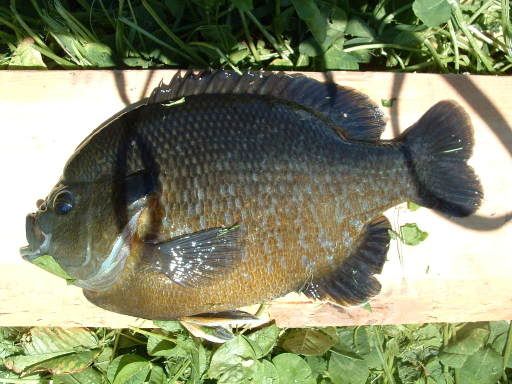 
Gotta get back to fishin!
|
|
|
|
|
Joined: Apr 2002
Posts: 1,011
Lunker
|
|
Lunker
Joined: Apr 2002
Posts: 1,011 |
Nice fish BZ. Do you have any lengths to go with those weights?
|
|
|
|
|
Joined: Mar 2005
Posts: 22,033 Likes: 483
Moderator Hall of Fame 2014  Lunker
|
|
Moderator Hall of Fame 2014 Lunker
Joined: Mar 2005
Posts: 22,033 Likes: 483 |
Thanks bz I will add those to the other thread. Nice HBG ! Those BG genes sure provide for an array of colors and quick changes between them.
|
|
|
|
|
Joined: Jul 2005
Posts: 4,598 Likes: 37
Lunker
|
|
Lunker
Joined: Jul 2005
Posts: 4,598 Likes: 37 |
Could the color variations between the May and August pictures be due to the influence of the spawn and nesting behavior?
I have noticed a change in the coloration of the male BG's at our pond here lately which I assume is due to an end of the nesting/spawn behavior. The other possiblilty is that the change in coloration is due to a change in the water clarity which has gone down due to some recent good rains.
|
|
|
|
|
Joined: Mar 2005
Posts: 22,033 Likes: 483
Moderator Hall of Fame 2014 Lunker
|
|
Moderator Hall of Fame 2014 Lunker
Joined: Mar 2005
Posts: 22,033 Likes: 483 |
Shorty : BG are the original quick change artists.  I have observed them changing color for a bunch of reasons including spawning , water clarity, pond bottom color ,light intensity, dominance signals , and a whole host of stress factors. Their genes must provide for active and sensitive chromatophores. Fish Coloration http://www.clarku.edu/departments/biology/biol201/2002/CSantos/index.htm Physiological Color Changes http://www.clarku.edu/departments/biology/biol201/2002/CSantos/Physiological.htm Morphological Color Changes http://www.clarku.edu/departments/biology/biol201/2002/CSantos/Morphological.htm "Types of chromatophore are characterized by the color they carry. Erythrophores contain reddish pigments found in carotenoids and pteridines. Melanophores contain black and brown pigments called melanin. Xanthophores produce yellow pigments in the form of carotenoids. Fish are capable of producing some pigments, but others must be supplied in the diet. For example, they cannot produce carotenoids naturally. They accumulate carotenoids from their diet and transfer them into pigment cells to produce red, yellow, and orange colors. The intensity of the pigment is reliant on the quantity and types of carotenoids supplied in their food. The carotenoid pigment found in most marine invertebrates is astaxanthin. Another pigment that is derived from a food source is phycocyanin. This pigment is blue and is readily found in blue-green algae. Additionally, the ability of fish to store pigments they have acquired from their diet will greatly affect their appearance. Various hues are made possible by the combinations of different layers of chromatophores. Cells carrying more than one pigment are called compound chromatophores. Most fish that appear to have green coloration on their scales actually have a layer with yellow pigment and another layer on top that scatters light and reflects a blue color. There are other types of chromatophores that do not retain pigments . "
.gif) 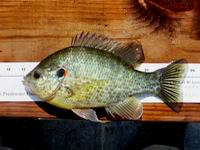
|
|
|
|
|
Joined: May 2004
Posts: 14,676 Likes: 509
Moderator Lunker
|
|
Moderator Lunker
Joined: May 2004
Posts: 14,676 Likes: 509 |
The HBG in the 2nd pic has interesting SMB-ish coloration; I've never seen that hue in a BG/HBG before.
"Live like you'll die tomorrow, but manage your grass like you'll live forever." -S. M. Stirling ![[Linked Image from i.pinimg.com]](https://i.pinimg.com/736x/ed/b5/e7/edb5e7f935843b996cf52be593c9ebd2--smoothie-smooth-collie.jpg)
|
|
|
|
|
Joined: May 2005
Posts: 844
Lunker
|
|
Lunker
Joined: May 2005
Posts: 844 |
An interesting point is that about 1/3 of the fish I caught that day were colored like the second picture. The rest were like the first picture.
Russ, yes I do have length data on these fish. They were all between 8.5 and 9.5 inches ranging from 10 to 15 ounces. The average weight of 11 fish was 13.25 ounces. I had one standout fish that was only 8.5 inches long but weighed 13.5 ounces. The 15 ounce fish was 9.5 inches. Earlier this year I caught a few 10 inch fish that weighed from 16 to 17 ounces.
Gotta get back to fishin!
|
|
|
Moderated by Bill Cody, Bruce Condello, catmandoo, Chris Steelman, Dave Davidson1, esshup, ewest, FireIsHot, Omaha, Sunil, teehjaeh57 |
|







