|
Forums36
Topics42,113
Posts571,674
Members19,115
| |
Most Online13,561
|
|
|
|
Joined: Apr 2004
Posts: 123
Member
|
|
Member
Joined: Apr 2004
Posts: 123 |
My 13.5 acre pond has a very irregular shoreline with a circumference of about a mile. I hand feed along about 800 feet of shoreline. I find that when I fish for bluegill this time of year, there is a remarkable difference in the size of the fish where I feed and those elsewhere. Literally every fish caught in the feeding area is very large and very fat, with the circular profile and dwarfed-head with the �helmet� shown previously by Bruce (I think). Elsewhere, there is a full range of fish sizes, with most in the 3-5" range. During the spawn, the large fish caught are just as prevalent over beds where I don�t feed during the warm months as over those where I do. I would appreciate any opinions you might have on the following:
Are bluegill so territorial that they do not migrate around a lake much at all except at spawning time?
Are the big�uns running off all the younger bream from the feeding area?
Is feeding in only part of the water defeating the purpose of increasing the population of �bite-sized� bass food while producing great fish for me to catch?
Would it be helpful to feed part of the food in an area where the water shoals enough so that only small fish can get the food that floats near the shore?
Thanks in advance for any advice or opinions,
Lou
|
|
|
|
|
Joined: Aug 2004
Posts: 8,854 Likes: 3
Moderator Ambassador Field Correspondent  Lunker
|
|
Moderator Ambassador Field Correspondent Lunker
Joined: Aug 2004
Posts: 8,854 Likes: 3 |
I believe that bluegill are not particularly territorial at this time of year. I believe that they move to wherever the forage is, in particular if the forage is pellets. The big'uns probably aren't running off the smaller fish, but more likely their presence is intimidating to smaller fish that will probably lurk nearby to see if there are any leftover scraps. As long as you have representatives of the helmet-head club and half-dollar club available, it sounds like what you're doing is paying off. No need to change what's working, eh?  I've found that I can get the smaller fish to get more food if I buy a bag of slow sinking feed at the beginning of the year. If you're hand feeding, the big fish will dominate the bigger floating pellets and you can distribute some slow sink near the edges. If the little guys catch on you can get them some of the feed as well. It's probably easier to control the size distribution of your bluegill by manipulating bass populations than it is by specialized feeding techniques.
Holding a redear sunfish is like running with scissors.
|
|
|
|
|
Joined: Sep 2003
Posts: 14,300 Likes: 450
Moderator Ambassador Field Correspondent Hall of Fame 2014 Lunker
|
|
Moderator Ambassador Field Correspondent Hall of Fame 2014 Lunker
Joined: Sep 2003
Posts: 14,300 Likes: 450 |
I don't know the terrain or presence of good BG spawning grounds for Lou's pond, but might it be possible that if the pond has "X" amount of individual spawning sites and "3X" or "4X' the amount of breeding sized BG, that the larger BG are dominating the available spawning sites. If the thought held water, than could it explain why Lou sees larger BG up on the beds during spawning, but outside of spawn he catchs bigger ones in the areas of feeding activity?
Excerpt from Robert Crais' "The Monkey's Raincoat:"
"She took another microscopic bite of her sandwich, then pushed it away. Maybe she absorbed nutrients from her surroundings."
|
|
|
|
|
Joined: Mar 2005
Posts: 22,033 Likes: 483
Moderator Hall of Fame 2014 Lunker
|
|
Moderator Hall of Fame 2014 Lunker
Joined: Mar 2005
Posts: 22,033 Likes: 483 |
I agree with Bruce's comments. The BG will not travel far for food. That is why one feeder covers about 3 acres max. Your pond is like ours in its shape and size. That is one reason you probably have BG beds scattered around the pond where shallow. There are in essence separate BG populations around the pond with some movement between them. Somewhere I saw info on how far BG will travel it seems like it was about 200 yards. I will check on that.
One way to help in getting all size BG to feed is to use different size pellets. I use Game Fish Chow (has multi-sized pellets) and mix it with high protein fingerling food (3/16th size pellets). I have had no trouble with all sizes of BG feeding at the same time. The big BG take the big pellets first while the small BG eat the small ones. Try feeding in a small (2000+- sq ft) cove with shallow water on 3 sides and some 4 ft water in the middle. I have done that and put brush in the middle for BG protection/hiding.
In any event I think what you are doing is helping more than you may think. By feeding the big fish you are getting more reproduction (higher spawning #s) from them because they are in better condition. In addition the small fish , even if they don't get as much food, are getting some extra nutrients for 2 reasons. One -- they are eating some pellets and 2-- there is less competition among the BG for the natural food sources which means the small ones get more of it.
.gif) 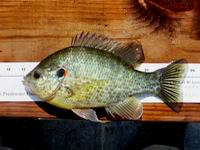
|
|
|
|
|
Joined: Apr 2002
Posts: 15,997 Likes: 1497
Moderator
Ambassador
Field Correspondent Lunker
|
|
Moderator
Ambassador
Field Correspondent Lunker
Joined: Apr 2002
Posts: 15,997 Likes: 1497 |
I think Sunil has a good explanation for the distribution of large bluegill during spawning season. Bluegill social hierarchy is important during spawning season. Largest bgill are dominating the prime or best spawning areas regardless where they are located in a large pond. Smaller bgill have to use secondary sites or perimeter spawning sites. A pond this large may also contain sneaker and satellite bgill who are sexually mature but do not display normal sexual characters.
aka Pond Doctor & Dr. Perca Read Pond Boss Magazine -
America's Journal of Pond Management
|
|
|
|
|
Joined: Apr 2004
Posts: 123
Member
|
|
Member
Joined: Apr 2004
Posts: 123 |
Thanks for the very helpful answers. Bruce, your suggestion that the large �gills are intimidating the small ones was borne out when I fed them this evening and watched for a while. Where the water shoals, the large bream were rolling in the deeper water and smaller splashes were common near the shore. Where I feed along the dam and there is little shallow water, I only see big splashes. (I almost never see the T. nilotica taking the fish food at the surface. Maybe I am not recognizing them because I do fertilize, and when I do the �Auburn hand test� my hand disappears at about 18".)
I have been feeding entirely with Aquafeed because I get it pretty cheaply at a convenient location. Their standard pellet size is smaller than it was in previous years. Minnows can only peck at it, but small bluegill seem to be able to swallow it when they can get to it. I will have to check to see if I can get some slow-sink and/or fingerling food. (I do mix in whole kernel feed corn at about 1 part in 20 or so, mainly for the Tilapia.)
Sunil, you may have a point about breeding spot availability. I have plenty of scattered shallow water coves, but the bottom is mostly mud.
Ewest, I do have a cove such as you describe where I haven�t been feeding, but I will have to give it a try. Every 5 years or so, I cut the lower limbs on the buttonwoods (essentially my only aquatic higher plants) high enough so that I can roll a fly under them when spring comes around and low enough so that there is still a challenge. This winter is time, and I will bring the brush to the middle of that cove and see what happens when I feed there next year.
Bill, I looked for "girlie men" when fishing the beds this spring and did find several, I think. I had noticed them in previous years but didn't know what they were in the past.
Again, thanks to all of you for the willingness to help, and thanks to Bob Lusk for a great magazine and a fantastic discussion site.
Lou
|
|
|
|
|
Joined: May 2004
Posts: 14,676 Likes: 509
Moderator Lunker
|
|
Moderator Lunker
Joined: May 2004
Posts: 14,676 Likes: 509 |
Very interesting thread for us BG enthusiasts.
"Live like you'll die tomorrow, but manage your grass like you'll live forever." -S. M. Stirling ![[Linked Image from i.pinimg.com]](https://i.pinimg.com/736x/ed/b5/e7/edb5e7f935843b996cf52be593c9ebd2--smoothie-smooth-collie.jpg)
|
|
|
|
|
Joined: Mar 2005
Posts: 22,033 Likes: 483
Moderator Hall of Fame 2014 Lunker
|
|
Moderator Hall of Fame 2014 Lunker
Joined: Mar 2005
Posts: 22,033 Likes: 483 |
Here is some info to factor into this discussion.
Movement, Home Range, and Site Fidelity of
Bluegills in a Great Plains Lake
CRAIG P. PAUKERT, DAVID W. WILLIS, AND MICHELLE A. BOUCHARD
Bluegill home ranges may be influenced by fish size (Minns 1995), food density (Fish and Savitz
1983), and social hierarchies (Fish and Savitz 1983). In addition, sexual and seasonal differences can affect home range; for example, male bluegills will guard nests after spawning, thus reducing home range size during this period. Larger bluegills may exhibit site fidelity, remaining in the same area for an extended period of time (Ball 1943). Fish and Savitz (1983) found bluegill home ranges of 0.15�0.75 ha lasting for 1�3 months and a negative relation between bluegill size and home
range size for fish ,190 mm total length (TL). To our knowledge, no one has investigated seasonal home ranges or home range size of bluegills in lentic habitats over a longer periods (e.g., 6 months)
Our home range estimates for bluegills were larger than the few estimates we found in the literature. Fish and Savitz (1983) reported that bluegill home ranges were less than 1 ha, whereas only 8.5% of the home ranges in Pelican Lake were less than 1 ha. Our estimates of the mean core area home range was about 4.5 times larger than the mean primary occupation area reported by Fish and Savitz (1983). However, minimum convex polygon home ranges tend to overestimate home range size with few observations (Schoener 1981), which may have occurred in our study.
|
|
|
|
|
Joined: Aug 2004
Posts: 8,854 Likes: 3
Moderator Ambassador Field Correspondent Lunker
|
|
Moderator Ambassador Field Correspondent Lunker
Joined: Aug 2004
Posts: 8,854 Likes: 3 |
For general information...
1 ha is one hectare.
Metric unit of area equal to 10,000 square metres (2.47 acres).
Trafalgar Square, London's only metric square, was laid out as one hectare.
Also, a "lentic" habitat is one which is stagnant or very slow moving like a swamp, pond or lake, as opposed to a "lotic" habitat which would be riverine or moving, such as streams, rivers, creeks, etc.
Holding a redear sunfish is like running with scissors.
|
|
|
|
|
Joined: May 2004
Posts: 14,676 Likes: 509
Moderator Lunker
|
|
Moderator Lunker
Joined: May 2004
Posts: 14,676 Likes: 509 |
So, converting hectares to acres is yet another example of the "double it and add 30" rule in the Metric System. :rolleyes:
"Live like you'll die tomorrow, but manage your grass like you'll live forever." -S. M. Stirling
|
|
|
|
|
Joined: May 2005
Posts: 844
Lunker
|
|
Lunker
Joined: May 2005
Posts: 844 |
Here is where you can get the best little unit conversion program I've ever seen to avoid this type of mess. http://joshmadison.net/software/convert/
Gotta get back to fishin!
|
|
|
Moderated by Bill Cody, Bruce Condello, catmandoo, Chris Steelman, Dave Davidson1, esshup, ewest, FireIsHot, Omaha, Sunil, teehjaeh57 |
|







