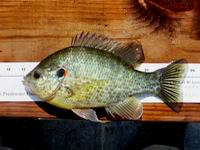
If you have or are interested in tilapia you should read this link for facts.
From ---
http://srac.tamu.edu/tmppdfs/11830457-283fs.pdf Tilapia
Life History and Biology
Reproduction
In all Oreochromis species the male excavates a nest in the pond bottom (generally in water shallower than 3 feet) and mates with several females. After a short mating ritual the female spawns in the nest (about two to four eggs per gram of brood female), the male fertilizes the eggs, and she then holds and incubates the eggs in her mouth (buccal cavity) until they hatch. Fry remain in the female's mouth through yolk sac absorption and often seek refuge in her mouth for several days after they begin to feed. Sexual maturity in tilapia is a function of age, size and environmental conditions. The Mozambique tilapia reaches sexual maturity at a smaller size and younger age than the Nile and Blue tilapias. Tilapia populations in large lakes mature at a later age and larger size than the same species raised in small farm ponds. For example, the Nile tilapia matures at about 10 to 12 months and 3/4 to 1 pound (350 to 500 grams) in several East African lakes. Under good growth conditions this same species will reach sexual maturity in farm ponds at an age of 5 to 6 months and 5 to 7 ounces (150 to 200 grams). When growth is slow, sexual maturity in Nile tilapia is delayed a month or two but stunted fish may spawn at a weight of less than 1 ounce (20 grams). Under good growing conditions in ponds, the Mozambique tilapia may reach sexual maturity in as little as 3 months of age, when they seldom weigh more than 2 to 4 ounces (60 to 100 grams). In poorly fertilized ponds sexually mature Mozambique tilapia may be as small as 1/2 ounce(15 grams).
Here are all of the SRAC tilapia fact sheets:
Tilapia Production
SRAC 280 Pond Culture of Tilapia
SRAC 281 Cage Culture of Tilapia
SRAC 282 Tank Culture of Tilapia
SRAC 283 Tilapia: Life History and Biology
http://srac.tamu.edu/index.cfm?catid=11


.gif)