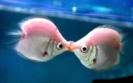
I see I am quickly turning from the �fish lady� to the �frog lady�, but I don�t mind at all. Like I said before I am really into frogs (good thing I don�t have webbed feet though).

As far as the 5 minute delay in heartbeat during hibernation I can�t say that I am familiar with that one. In the deep south we don�t have enough cold weather for a heck of a lot of animals to go into deep hibernation. Also we keep our frogs in a climate controlled facility year round.
Frog 101: (Rana catesbeiana )
Tadpoles can turn into frogs anywhere from 4 months to two years. It depends on several factors. One is the temperature as you all have mentioned above. Second is the way nature designed it. As I mentioned earlier nature has it designed so that only a certain percentage of tads actually hatch out in the beginning. Further hatch-outs are meant solely for food for the original hatch. Keep in mind that frogs ARE cannibals. Even into adulthood they will quickly consume another frog of smaller size. In captivity you are able to prevent most of this cannibalism by sorting the sizes and keeping everyone �housed� according to age/size. This aids greatly in overall survival. One thing to keep in mind if you plan to do this is the fact that a tadpole can drown the instant he grows his fourth leg. If I am getting ahead of myself here let me remind everyone of the heart/lung valve that babies have. The moment a human child is born a �hole� closes between the heart and lung. This is to allow the child to breath air versus liquid (it is a lot more complicated than what I typed, but I am trying to give a crash course). The same basic concept is applied to tadpoles. If kept in captivity (tanks, raceways, or even ponds with deep banks) a tadpole will die if it is unable to �reach land� when that 4th leg evolves. That is why we float simple Styrofoam coolers with slits cut in the bottom in every tank of tadpoles we have. When that 4th leg arrives, the tadpole is now a frog and can no longer survive completely underwater. It is also interesting, to me at least, that the frog can now use his deteriorating tail as a food source for quite some time.
When stocking tadpoles into a non-controlled/pond environment you need to expect a 50% mortality. Tads have a multitude of predators ranging from house cats, to snakes, to fish, to gators, etc.
Giant American Bullfrogs (what I �specialize� in) are absolutely the best in my opinion. Starting out small enough to fit in the palm of your hand they can grow large enough to encompass both of your hands with their legs hanging over the side. Touching on the side of redundancy let me remind you that they are cannibals. Most of you have no interest in keeping them in captivity so I won�t go into much detail (I could almost write a book on that). I will say however that if you are interested in doing this you MUST keep the different sizes compartmentalized to avoid a loss.
On the nature side of things a female frog becomes a true breeder at age two. At age three she becomes what I term a �selected breeder� meaning she is capable of maximum egg production.
Sadly enough we (meaning humans) have severely reduced the number of frogs in the wild by our use of pesticides and other chemicals. That is why you no longer see the vast amount of giant bullfrogs in the wild that you did decades ago. Chemical applications lead to mutations in the young which lead to infertility, stunting, and death. Restocking pure bullfrogs into the wild is a necessity for I fear what the future would hold without them. I sound dramatic here, but anyone who has rocked on the back porch on a warm summer�s night knows what I mean. Even now I like to wander through our Ranaculture facility just to listen to the frogs �talk�.
Frogs will wander between ponds to some degree, but they are also similar to humans in that they will hang around an area that makes them happy. A good environment, good food, and good mating will keep most of them at home.
As you can see I could easily take up most of Bob�s newly purchased bandwidth with this subject (not to mention the fact that I tend to rattle on anyway), so I will hush for now. Thanks though for your interest in one of my favorite topics.
Deb