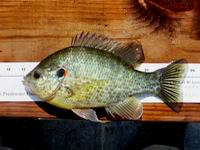
Thought I would add some info from a 2006 study from Ohio. More interesting points.
Predicting Crappie Recruitment in Ohio Reservoirs with
Spawning Stock Size, Larval Density,
and Chlorophyll Concentrations
DAVID B. BUNNELL*1
R. SCOTT HALE
MICHAEL J. VANNI
ROY A. STEIN
Abstract.�Stock�recruit models typically use only spawning stock size as a predictor of recruitment to
a fishery. In this paper, however, we used spawning stock size as well as larval density and key environmental
variables to predict recruitment of white crappies Pomoxis annularis and black crappies P. nigromaculatus,
a genus notorious for variable recruitment. We sampled adults and recruits from 11 Ohio reservoirs and larvae
from 9 reservoirs during 1998�2001. We sampled chlorophyll as an index of reservoir productivity and
obtained daily estimates of water elevation to determine the impact of hydrology on recruitment. Akaike�s
information criterion (AIC) revealed that Ricker and Beverton�Holt stock�recruit models that included
chlorophyll best explained the variation in larval density and age-2 recruits. Specifically, spawning stock
catch per effort (CPE) and chlorophyll explained 63�64% of the variation in larval density. In turn, larval
density and chlorophyll explained 43�49% of the variation in age-2 recruit CPE. Finally, spawning stock CPE
and chlorophyll were the best predictors of recruit CPE (i.e., 74�86%). Although larval density and
recruitment increased with chlorophyll, neither was related to seasonal water elevation. Also, the AIC
generally did not distinguish between Ricker and Beverton�Holt models. From these relationships, we
concluded that crappie recruitment can be limited by spawning stock CPE and larval production when
spawning stock sizes are low (i.e., CPE , 5 crappies/net-night). At higher levels of spawning stock sizes,
spawning stock CPE and recruitment were less clearly related. To predict recruitment in Ohio reservoirs,
managers should assess spawning stock CPE with trap nets and estimate chlorophyll concentrations. To
increase crappie recruitment in reservoirs where recruitment is consistently poor, managers should use
regulations to increase spawning stock size, which, in turn, should increase larval production and recruits to
the fishery.


.gif)