Pond Boss Magazine
https://www.pondboss.com/images/userfiles/image/20130301193901_6_150by50orangewhyshouldsubscribejpeg.jpg
Advertisment
Newest Members
Kirk78, Rgv, Kalispel, TokyoTim, Mustelid
19,113 Registered Users
Forum Statistics
Forums36
Topics42,113
Posts571,659
Members19,114
Most Online13,012
Jun 7th, 2026
Top Posters
esshup 29,788
ewest 22,032
Cecil Baird1 20,043
Bill Cody 15,993
Who's Online Now
2 members (DrLuke, Theo Gallus), 951 guests, and 71 robots.
Key: Admin, Global Mod, Mod
Previous Thread
Next Thread
Print Thread
Page 4 of 6 1 2 3 4 5 6
#62545 01/12/06 01:26 PM
Joined: Aug 2004
Posts: 8,854
Likes: 3
Moderator
Ambassador
Field Correspondent
Lunker
Moderator
Ambassador
Field Correspondent
Lunker
Joined: Aug 2004
Posts: 8,854
Likes: 3
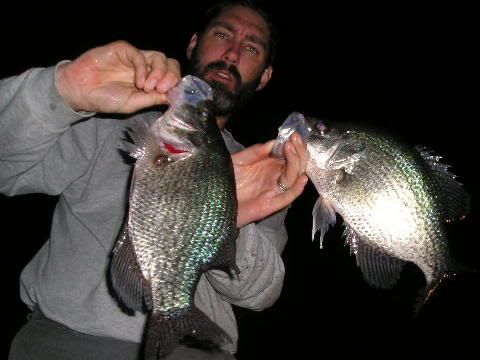
Greg Grimes knows crappie.


Holding a redear sunfish is like running with scissors.
#62546 01/12/06 02:41 PM
Joined: May 2002
Posts: 3,973
Likes: 1
G
Ambassador
Field Correspondent
Lunker
Ambassador
Field Correspondent
Lunker
G Offline
Joined: May 2002
Posts: 3,973
Likes: 1
Thanks Bruce. If anyone makes it out to Atlanta you can see them in person, those two are now swimming in the world's largest aquarium.


Greg Grimes
www.lakework.com
#62547 04/28/06 08:20 AM
Joined: Oct 2003
Posts: 764
N
Lunker
Lunker
N Offline
Joined: Oct 2003
Posts: 764
Since I throughly dislike the idea of "it can't be done", I want to continue this subject.

In areas where yellow perch are present, they spawn before crappie. Certainly, in larger lakes, northern pike also spawn before crappie. Are there any species that spawn before crappie in southern waters? What about chain or grass pickerel? Any other species?

From what I understand, spawning of crappie is NOT unpredicatable, it is sporatic. Is this correct? We get a spawn of crappie. As they grow, they eat all of the fry from subsequent spawns. When the big year class dies out, we get reduced predation on the crappie fry leading to another big year class. It is this year class that stunts. Is this correct?

We brought up this subject before, but why are crappie successful in large lakes but not in small lakes? We have the same predators in both lakes and same conditions. What is different?

These are all just questions that might lead us to some useful information.


Norm Kopecky
#62548 04/28/06 08:25 AM
Joined: Oct 2003
Posts: 764
N
Lunker
Lunker
N Offline
Joined: Oct 2003
Posts: 764
One more question, has anyone been able to get crappie to eat pellets?


Norm Kopecky
#62549 04/28/06 08:32 AM
Joined: Jun 2005
Posts: 2,365
B
Lunker
Lunker
B Offline
Joined: Jun 2005
Posts: 2,365
 Quote:
Originally posted by Norm Kopecky:
Since I throughly dislike the idea of "it can'tWe brought up this subject before, but why are crappie successful in large lakes but not in small lakes? We have the same predators in both lakes and same conditions. What is different?

These are all just questions that might lead us to some useful information.
Norm, I've fished in many ponds and lakes, and wondered the same thing. I've caught many slab-sized crappie in small ponds that you would never suspect would support them. It seems that wherever I would catch large crappie in a large pond, there were always lots of large bass.

But gnereally, larger bodies of water have larger crappie, and I suspect that is because the crappie can forage far and wide to get enough food.

#62550 04/28/06 09:05 AM
Joined: Mar 2004
Posts: 3,075
M
Lunker
Lunker
M Offline
Joined: Mar 2004
Posts: 3,075
 Quote:
Originally posted by Norm Kopecky:
Since I throughly dislike the idea of "it can't be done", I want to continue this subject.
Norm, Kudos to you! I totally embrace your dislike of that concept also.

However, don't understand what you consider the difference between "unpredictable" and "sporadic" in terms of the management impacts on the small pond. Not arguing, just don't understand the implications of the difference to pond management...and if by discussing this topic more we can find some solutions, then that would be great, simply great!

#62551 04/28/06 10:12 AM
Joined: Mar 2005
Posts: 22,032
Likes: 483
E
Moderator
Hall of Fame 2014
Lunker
Moderator
Hall of Fame 2014
Lunker
E Offline
Joined: Mar 2005
Posts: 22,032
Likes: 483
Norm :

There are southern species that spawn before or with crappie but they are rare in ponds. For example chain pickerel and gar. YP are not a warmwater fish and while they can make it in some big southern lakes they would have great difficulty in southern ponds. All the major southern pond predators and forage fish spawn after crappie.

There is some but not a lot of info about crappie in ponds. There is a lot of info on crappie in lakes . The large lake data indicate that in addition to normal factors that make a spawn unpredictable like weather , food chain, fish condition, floods , and water conditions etc ,they are also cyclical in their spawning. Large lakes go through this cycle with some years having good fishing ( good supply of big fish) to poor fishing years (many small fish)as a result of large population swings from spawning. Large lakes can better withstand the cycle because they are not monolithic environments like ponds. The smaller the body of water the harder it is to keep in balance (small changes have a greater effect) and the easier it is to manage (restore balance). For example 10 extra pounds of LMB in a 1/2 acre pond can put it out of balance and taking out 10 extra lbs of LMB can put it back in balance. Another one - you can add 1 ton of lime to a 1/2 acre pond to increase fertility if required but that is not a practical option on a 5000 acre public lake. As a water body gets larger practical management steps get harder to carry out and harder to identify as the cause and effect relationships change as the environment gets more complex (less monolithic). In addition to this there is some evidence that crappie like gizzard shad can suppress reproduction of fish in a water body and as a result take up a large % of the waters carrying capacity.

I hope this rambling adds some to the thought process. It is sure worth thinking about the ideas and options. Maybe we can get some others to explore this with us.


#62552 04/28/06 02:51 PM
Joined: Oct 2005
Posts: 1,285
Likes: 1
R
Lunker
Lunker
R Offline
Joined: Oct 2005
Posts: 1,285
Likes: 1
Since this is the Q&O section here's my observations as a fisherman of 3 ponds here in Ohio with white crappie.
Pond 1: 1/2 acre excavated, clay bottom in a field with little structure and grass banks. Stocked with BG, CC, and LMB Crappie were added 15 years ago. 10 years ago to present all you can catch is 6-7" crappie, 10" bass, 8lb catfish occasionally, and 4-5" bluegills.

Pond 2: 5 acre deep earthen and mortared stone dam fed by small creek/waterfall surrounded on 3 sides by large trees. Public fishing allowed. 1 bass a day limit until last year, now none are to be removed, no panfish limit. Lots of structure in the form of fallen trees, boulders, and a couple small patches of lily pads. Stocked with almost every kind of fish except walleye, pike etc. Bass in this lake are plentiful and the largest I have seen in Ohio, some appear to be 8lbs. but are uncatchable. 10 to 15 years ago crappie fishing was good. 12" fish were common. Today all you catch is 4-6" crappie by the bucketfull. They will even hit bass lures as large as themselves.

Pond 3: Eastern Ohio hill country. 20 year old 1.5 acre dammed hillside. A few fallen trees, shallow muddy pond with a lot of water flow. CC, BG, LMB stocked in the beginning but almost non-existent. Tons of 4-6" crappie with an occasional 12-14". One near state record was caught there two years ago.

I have fished a small river nearby and have caught over 50 crappies 13" to 15" in a day. I have fished many large lakes and caught buckets full of 9" to 14" fish. The large lakes have lots of gizzard shad and good predator populations. I have never caught keeper size crappies from small impoundments but would love the opportunity to.


"The greatest enemy of knowledge is not ignorance, it is the illusion of knowledge." Stephen W. Hawking
#62553 04/28/06 06:27 PM
Joined: Oct 2003
Posts: 764
N
Lunker
Lunker
N Offline
Joined: Oct 2003
Posts: 764
Meadowlark, I should have used the word cyclical. The system I described is a cycle of boom and bust similar to lemmings and snowshoe hares. This is as ewest described.

As ewest said above, there are many environmental factors. However, I wonder if the controlling factor is the amount of predation by the previous large year class. Does anyone have an opinion about this?

Neither I or Jim Mannerud (Dave Willis will have to comment about Jim's lake) have any problem with stunting of crappie. I have both black and white crappie. Both of our lakes are extremely predator heavy.

If crappie can be pellet trained, then we should be able to raise them exactly the same way Bruce Condello does bluegills.

Does anyone have an opinion of what would happen if we had not only LMB, BG and crappie but also HSB? What would happen if we added another predator? It seems like part of the problem is that we don't have constant predation on the crappie. The crappie make the bass population cyclical also. But if we make the predator population steady by constantly adding fish (which we must with HSB), we might control the cyclical nature of the crappie. Just thinking.


Norm Kopecky
#62554 04/28/06 06:50 PM
Joined: Mar 2004
Posts: 3,075
M
Lunker
Lunker
M Offline
Joined: Mar 2004
Posts: 3,075
Ryan,

Good post and exactly what locals in this area report...except one pond. It is about 4 acres and has tremendous crappie fishing. Large fish. Good LMB fishing also. I'm trying to trade some hog hunting rights with the owner, who happens to also be named Ryan, in return for the chance to study his pond. He is doing something right that no one else around here is doing, it seems, as related to crappie.

Is it possible that some fish don't have the unpredictable spawn or cyclic spawn or whatever you want to call it? Why is it we occasionally hear about and actually see good small pond crappie?

It seems statistically unlikely but it certainly is statistically possible that most of the females stocked in one pond could have the same characteristics as related to spawning...if the spawn was well behaved, I have no doubt that a great crappie pond could be had.

This makes me wonder if I took some crappie from my friend Ryans pond, perhaps, just perhaps they would be manageable. I wonder if its somehow in the genetics as related to spawning behavior? There is some reason for why every once in a great while, we can find a great small crappie pond. Someone needs to find that reason.

#62555 04/28/06 07:24 PM
Joined: Sep 2003
Posts: 14,300
Likes: 450
Moderator
Ambassador
Field Correspondent
Hall of Fame 2014
Lunker
Moderator
Ambassador
Field Correspondent
Hall of Fame 2014
Lunker
Joined: Sep 2003
Posts: 14,300
Likes: 450
Norm, In my 6-7 acre lake, I have a population of Black Crappie. They were already in the lake when we purchased the lake, so we inhertited them. At that time, there were LMB, Yellow Perch, Black Crappie, Blue Gill, Brown Bullheads, and various other creek type minnows, chubs, & suckers.

In my opinion, things seemed balanced overall as far as my LMB population. The biggest LMB in my pond at that time was maybe 5-6lbs. The crappie that we would catch would be from 5-7", so they were not thriving, yet they were not at all overpopulating the lake.

In the past few years, I've added new predators in the form of Smallmouth, more LMB, CC, and twelve HSB (total weight of the twelve HSB was 26 lbs.). I had added (5) HSB, and (15) Trout about two years ago, but have never seen them since.

I have also been adding large quantities of baitfish, usually 150-200 lbs. at a time each for the past two to three years.

In addition to the new predator base, I also culled about 35-40 Crappie.

Now we are catching Crappie in the 10-12" range.

I must state that my goals are for diversity, with hopefully healthy fish accross all species. If I had a goal of trophy fish of one species or another, I would have taken different steps.


Excerpt from Robert Crais' "The Monkey's Raincoat:"
"She took another microscopic bite of her sandwich, then pushed it away. Maybe she absorbed nutrients from her surroundings."

#62556 04/28/06 07:28 PM
Joined: Sep 2003
Posts: 14,300
Likes: 450
Moderator
Ambassador
Field Correspondent
Hall of Fame 2014
Lunker
Moderator
Ambassador
Field Correspondent
Hall of Fame 2014
Lunker
Joined: Sep 2003
Posts: 14,300
Likes: 450
ML, I had been typing my post and took a break to eat dinner so I didn't see your post.

I think you should give it a try with Black Crappie. I think the situations where Black Crappie take over a pond reflect a pond owner who is not actively managing the pond, or at least not fully aware of potential downsides.

As far as pellet-feed-trained Crappie, I don't know.


Excerpt from Robert Crais' "The Monkey's Raincoat:"
"She took another microscopic bite of her sandwich, then pushed it away. Maybe she absorbed nutrients from her surroundings."

#62557 04/28/06 08:25 PM
Joined: Mar 2004
Posts: 3,075
M
Lunker
Lunker
M Offline
Joined: Mar 2004
Posts: 3,075
Sunil,

I think I'll study the pond I spoke of for a while. It has black crappie, according to Ryan, but he may not be able to identify for sure. I'm still chicken, but after watching that pond for awhile may take some sample brood fish for stocking next spring.

#62558 04/28/06 09:24 PM
Joined: Apr 2003
Posts: 1,097
Likes: 18
E
Lunker
Lunker
E Offline
Joined: Apr 2003
Posts: 1,097
Likes: 18
Controlling smaller fish with larger fish isn't as hard as this thread suggests. It also shouldn't take more management time than an excellent LBM environment. The A-B-C's book on successfully raising Large Black Crappie is in the 2nd year of fact gathering. I only have a few pages so far, but I'm documenting what I hope to be a cookie-cutter model. The body includes stocking numbers, forage base sampling, growth expectations, and predator controls. I realize every pond is different, but the controlling factors to limit overpopulation should be similar. At the end of the first 2 year cycle in August, I will post it as "work in progress".

#62559 04/29/06 08:56 AM
Joined: Oct 2003
Posts: 764
N
Lunker
Lunker
N Offline
Joined: Oct 2003
Posts: 764
Eastland, that is great news. We'll try to provide you with as much info as possible.

Sunil, you seem to be doing something right. Yellow perch certainly spawn before crappie and so the young perch should eat lots of crappie fry. The problem I have is that even a 10 inch yellow perch can be eaten by our LMB and CC.

The secret seems to be having multiple predator species. That way, if the population of one predator falls, another predator can pick up the slack. We seldom see a crappie under 10 inches in our lake.


Norm Kopecky
#62560 04/29/06 02:33 PM
Joined: Mar 2005
Posts: 22,032
Likes: 483
E
Moderator
Hall of Fame 2014
Lunker
Moderator
Hall of Fame 2014
Lunker
E Offline
Joined: Mar 2005
Posts: 22,032
Likes: 483
AFS is a good source of info like books , papers and fisheries topics. Here is the link.

http://www.fisheries.org/html/index.shtml

You should take a look and consider its benefits.

As the organization for fisheries professionals it leads the way on topics of interests. One way it does so is to have symposia on large topics. For example it has held a symposia on Black Bass and published a book of some 60 papers on it which is 725 pages. A list of the symposia can be seen at its home page.

So why post this on this thread. Because AFS has had 3 symposia on Crappie covering many years of research. Here is a historical of the papers which will show you the ideas that have come up and a glimpse of the results. I have included some parts and omited others including the list of authorities.


Challenges of Crappie Management Continuing into the
21st Century
JEFF BOXRUCKER*
ELISE IRWIN

White crappie Pomoxis annularis and black
crappie P. nigromaculatus are among the principle
species sought by anglers in the midwestern and
southeastern United States. The focus of management
activities aimed at improving crappie fisheries
has shifted over the years, and the published
literature reflects this shift. Three symposia on
crappies sponsored by the American Fisheries Society
have been significant contributors to the body
of knowledge on crappie ecology and management.
The third in this series, entitled ��Challenges
of Crappie Management Continuing into the 21st
Century,�� was held at the society�s 130th Annual
Meeting in St. Louis, Missouri, in 2000. The organizers�
objective was to compile the most current
work on crappie ecology and management and
help set the direction for research in the next decade.
This
introduction will try to show how the focus of
research has shifted and the role that these symposia
have played in that shift.

Mitzner (1984) identified the ��small-crappie
syndrome�� as a common theme in papers from the
first crappie symposium, ��Crappie Management:
Problems and Solutions,�� which was held at the
44th Midwest Fish and Wildlife Conference in
1982. As early as the 1940s, management activities
centered on reducing abundance through mechanical
or chemical removal. These techniques have
been used sparingly over the past 30 years because
of their high costs and short-term benefits. Investigations
of the interactions within crappie trophic
communities (O�Brien et al. 1984; Ellison 1984)
published in the first symposium led Mitzner
(1984) to conclude that management activities
were moving toward prey management. Published
accounts of the effects of prey stockings on crappie
population structure range from beneficial effects
on community food webs (Bartholomew 1966; Li
et al. 1976; Mosher 1984) to neutral effects (Boxrucker
1986; Boxrucker 1993; Hale 1996) and potentially
negative effects (Crowl and Boxrucker
1989; DeVries and Stein 1990; Guest et al. 1990;
DeVries et al. 1991). Mitzner (1984) also set the
stage for another shift in management strategies
by pointing out that managing angler harvest has
the potential to rectify the small-crappie syndrome.
A second crappie symposium, entitled ��Crappie
Biology and Management,�� was held
in 1990. Many of the papers published in connection
with this symposium were descriptive in nature,
with the topics including culture (Smeltzer
and Flickinger 1991), aging (Hammers and Miranda
1991; Sweatman and Kohler 1991), movements
and habitat use (Markham et al. 1991), relative
weight (Neumann and Murphy 1991), and
population characteristics (McDonough and Buchanan
1991; McInerny and Degan 1991; Colvin
1991a). The first accounts of the effects of minimum
length limits on crappie population structure
were published in the proceedings of this symposium
(Colvin 1991b; Webb and Ott 1991). Reed
and Davies (1991) and Larson et al. (1991), also
participants in this symposium, cautioned against
the use of restrictive harvest regulations due to the
high levels of natural mortality seen in some crappie
populations in Alabama and Georgia. Published
accounts of the use of length limits to manage
crappie fisheries increased following this symposium
(Allen and Miranda 1995; Allen et al.
1998; Maceina et al. 1998; Hale et al. 1999; Boxrucker
2001). The use of length limits in crappie
fisheries has been refined, with either a 229-mm
or a 254-mm limit being used depending on the
population�s growth rate. Equilibrium yield models
have assisted in refining the use of length limits
(Maceina et al. 1998; Slipke and Maceina 2001).
Currently, 15 of 27 states in the Northcentral and
Southern Divisions of the American Fisheries Society
manage crappie fisheries with length limits.
Crappie recruitment was historically thought to
be cyclic, with strong year-classes being produced
every 2 to 5 years (Swingle and Swingle 1967).
However, despite the importance of crappies as
sport fish, little research into the factors affecting
their recruitment has been published. Environmental
variables were identified as possible influences
on year-class strength (Jenkins 1955; Goodson
1966; Mathur et al. 1979), yet little cause-andeffect
data were presented. In the first crappie symposium,
O�Brien et al. (1984) discussed the effects
of abiotic factors on the survival of early life stages.
In the second crappie symposium, Mitzner
(1991) presented the relationships between crappie
year-class strength and various environmental variables,
including water level, turbidity, substratum,
and wind.
Crappie recruitment dynamics were the focus of
an increasing amount of research in the 1990s.
Water temperature influences spawning times and
subsequent growth and survival, with later-hatching
cohorts experiencing higher temperatures,
growth, and survival (Pine and Allen 2001). Dubuc
and DeVries (2002) failed to identify consistent
relationships between reservoir productivity and
larval crappie density. Guy and Willis (1995)
found differences in the recruitment variability of
crappies in South Dakota based on landscape characteristics.
Recruitment was less variable in systems
with high shoreline development indices (i.e.,
more embayments). The recruitment of black crappies
in South Dakota was also less variable in systems
with high watershed : water body surface area
ratios (Guy and Willis 1995). Water level fluctuations
have increasingly been suggested as a primary
influence on crappie recruitment. High inflows
and subsequent water releases in spring and
summer can lead to the reduced recruitment of
crappies (Pope et al. 1996; Maceina and Stimpert
1998). High winter water levels had a positive influence
on crappie year-class strength in Alabama
tributary impoundments (Maceina and Stimpert
1998), yet the mechanisms underlying this relationship
are not clear. Allen and Miranda (2001)
used a population model to conclude that crappie
recruitment was quasi-cyclic due to random fluctuations
in the environmental variables and density-
dependent mechanisms. Allen and Miranda
(1998) developed an age-structured model to help
explain the effects of erratic recruitment on crappie
management alternatives, particularly the use of
length limits.
Information from the two previous symposia on
crappies set the stage for the papers from this symposium.
Whereas the majority of manuscripts from
the 1990 symposium were descriptive, most of
those that follow evaluate management strategies.
Six of the papers deal with exploitation. Estimates
of exploitation were typically made from tagreturn
data and were subsequently used in conjunction
with catch curves to estimate natural mortality
rates. This information was then used to
model the potential effects of length limits on crappie
fisheries (Boxrucker 2002a, this issue; Isermann
et al. 2002a, this issue). Miranda et al. (2002,
this issue) found that the uncertainty surrounding
estimates of tagging mortality, tag loss, and particularly
reporting rate led to imprecise estimates
of exploitation in spite of the high costs of data
collection. These authors suggested that indirect
measures of exploitation (i.e., condition, total mortality
estimates, length and age distributions, and
increased recruitment variability) be used rather
than expensive tag-and-reward programs. Isermann
et al. (2002a) used equilibrium yield models
to evaluate Tennessee�s statewide 254-mm minimum
length limit on the yield of crappie fisheries.
The authors grouped the study reservoirs into three
categories: those in which 229-mm or 254-mm
length limits would increase yield, albeit at the
expense of the number of crappies harvested; those
in which length limits had no impact on yield; and
those that were negatively impacted by length limits.
The authors suggested that applying length
limits to fisheries using a categorical approach was
preferable to using a single, areawide regulation.
Bister et al. (2002, this issue) and Hurley and Jackson
(2002, this issue) reported decreased growth
rates in crappie populations in South Dakota and
Nebraska, respectively, as a result of length limit
regulations. The 229-mm length limit was removed
from Lake Alvin, South Dakota (Bister et
al. 2002), while Hurley and Jackson (2002) recommended
removing the 254-mm length limit
from two small Nebraska impoundments for only
a portion of the year to help maintain crappie densities.
Boxrucker (2002a) detailed population and
angler creel characteristics prior to, during, and
after the removal of a 254-mm length limit at an
Oklahoma reservoir. Even though the abundance
of quality- and preferred-size crappies and angler
catch rates improved as a result of the length limit,
angler dissatisfaction with the regulation led to its
removal. This is in contrast to the positive angler
sentiment in regards to harvest restrictions in the
Sardis Lake, Mississippi, crappie fishery (Dorr et
al. 2002, this issue).
Recruitment has been a common theme in all
three crappie symposia. McKeown and Mooradian
(2002, this issue) found that neither the low
density of adult stocks nor the overwinter mortality
of age-0 crappies was the cause of reduced
recruitment (relative to historical levels) in Chautauqua
Lake, New York. The authors concluded
that management efforts aimed at increasing adult
density would have little effect on recruitment
and the subsequent recovery of the fishery to historical
levels. Sammons et al. (2002, this issue)
found that crappie recruitment in Tennessee tributary
impoundments was positively related to
high water levels during the prespawning period
(January through March). Maciena and Stimpert
(1998) found a similar relationship in Alabama
tributary impoundments.
Two papers in this symposium dealt with supplemental
stocking, a little-used technique to improve
crappie recruitment. The results of stocking
black-nosed crappies (a morphological variant of
the black crappie) in Tennessee impoundments
were mixed, with contributions to year-class
strength ranging from 0% to 93% (Isermann et al.
2002b, this issue). Racey and Lochmann (2002,
this issue) determined that the year-class contribution
of white crappies stocked into Lake Chicot,
Arkansas, ranged from 0% to 3.1% and concluded
that other management options to improve adult
abundance should be considered.
Stocking predators to reduce the abundance of
slowly growing populations of crappies was the
topic of two papers in this symposium. The concept
was introduced by Willis et al. (1984) in the
first crappie symposium. Saugeyes (walleye Stizostedion
vitreum 3 sauger S. canadense) were
stocked into Richmond Lake, South Dakota, to improve
the size structure of a black crappie population
(Galinat et al. 2002, this issue) and into
Thunderbird Reservoir, Oklahoma, to improve that
of a slowly growing white crappie population
(Boxrucker 2002b, this issue). The growth rates
and size structure of both crappie populations improved
following the introduction of the saugeyes.
Boxrucker (2002b) cautioned that consideration
must be given to the effects of such biomanipulation
on all trophic levels and that thorough evaluations
need to be conducted both before and after
implementing it.
Spier and Heidinger (2002, this issue) investigated
the effects of turbidity on the growth of juvenile
and adult black and white crappies. No differences
were found in the growth of juveniles,
but the weight gain of adult black crappies was
higher than that of adult white crappies at low
turbidity.
The importance of crappies as sport fish ensures
that research into their ecology and management
will continue. Recruitment dynamics appear to be
the focus of current work, with water level manipulation
having the potential to significantly impact
year-class strength. The expanded use of
population models will assist managers in selectively
applying harvest regulations. Many crappie
populations have a high rate of natural mortality
that negates the potential benefits of length limits,
even when there is fast growth and high exploitation.
Research into the causative mechanisms in
populations exhibiting high natural mortality will
broaden management alternatives.
Acknowledgments
This symposium was sponsored by the Fisheries
Management Section of the American Fisheries
Society.





#62561 04/29/06 03:49 PM
Joined: Apr 2003
Posts: 1,097
Likes: 18
E
Lunker
Lunker
E Offline
Joined: Apr 2003
Posts: 1,097
Likes: 18
ewest, good reading, I always appreciate your threads & input. While years of research yields clues to reproduction, growth rates, and catch limits, I'm looking for an equation that provides a natural balance. Today's pond owners have access to mighty open water predators like HSB and prolific breeders like Tilapia. I believe times have changed, my aim is to predict crappie behavior, not sporatic spawn numbers. Impossible...maybe, but I'll try anyway.

It's kind of like a Man bites Dog concept. Historically, crappie spawn first and eat everything in sight causing overcrowded conditions. In reverse, a forage population that remains intact (due to Tilapia being the primary forage fish) jump the jouvenile crappie early Spring.

Crappie have a weak spot like everything else, Their early spawn will be met head on by gambusia, shiners, and a massive bgill population. HSB will take advantage of their deep water migration pattern in the summer.

LMB are my wildcard, and until I see signs of threatening crappie numbers, I will cull them to keep relative weights at or around 100%.

#62562 04/29/06 04:53 PM
Joined: Mar 2005
Posts: 22,032
Likes: 483
E
Moderator
Hall of Fame 2014
Lunker
Moderator
Hall of Fame 2014
Lunker
E Offline
Joined: Mar 2005
Posts: 22,032
Likes: 483
Thanks Eastland. The more you know the better chance you have to succeed. Other than the fact (and it is a big one) that a pond is monolithic while big lakes may not be, what you describe is what was present in those big lakes. Multi- predator and forage types with natural populations in a natural state (whether balanced or not) with little effect from fishing. If I find info I think would help I will post it.


#62563 04/30/06 11:31 AM
Joined: Oct 2003
Posts: 764
N
Lunker
Lunker
N Offline
Joined: Oct 2003
Posts: 764
Eric, what a great post! Eastland, I think you are on the right track and will be the one to solve this problem.

Most of us can't control the environmental conditions of our lakes. The solution, I think is to have consistant predation on the crappie every year. LMB alone can't do this and yet this is what most people depend on.


Norm Kopecky
#62564 04/30/06 11:40 AM
Joined: Sep 2003
Posts: 14,300
Likes: 450
Moderator
Ambassador
Field Correspondent
Hall of Fame 2014
Lunker
Moderator
Ambassador
Field Correspondent
Hall of Fame 2014
Lunker
Joined: Sep 2003
Posts: 14,300
Likes: 450
I was at my pond yesterday, and saw several hundred small juveniles around some sunken pallets(or frye, they were maybe 1/2" to 3/4" long).

I couldn't tell what they were exactly, but they had the shape of a Bluegill or Panfish.

I am fairly certain they were Black Crappie babies. My water temp was 64 degrees, and my Bluegill have not formed beds yet. Some LMB look like they may be creating beds. I did not see any Yellow Perch egg masses, but I could have missed it as I haven't been up to the pond much over the last 5 weeks.


Excerpt from Robert Crais' "The Monkey's Raincoat:"
"She took another microscopic bite of her sandwich, then pushed it away. Maybe she absorbed nutrients from her surroundings."

#62565 05/01/06 10:04 AM
Joined: Oct 2003
Posts: 764
N
Lunker
Lunker
N Offline
Joined: Oct 2003
Posts: 764
We have a theory going that stunting in crappie can be prevented by using more species of predators than just LMB. Is there anyone out there than is willing and able to try this out and let us know how it goes?


Norm Kopecky
#62566 05/01/06 11:57 PM
Joined: Dec 2003
Posts: 19
C
CLB Offline
Member
Member
C Offline
Joined: Dec 2003
Posts: 19
Norm,
I have a pond that is a little over an acre that I stocked in april of 04 with largemouth bass, smallmouth bass, walleye, black crappie, bluegill, redear sunfish, channel catfish and yellow perch. I wasn't really concerned about raising trophy fish. I was more interested in a diverse fishery. In spring of 05 I caught 14 small white bass "sand bass" out of a creek and added them also but believe that they were to small and became part of the food chain. This past january a few friends and I caught some rainbow trout out of public lake that the state stocks in the winter. I'm going to see if the trout make it through the summer since I run a 50gpm well all summer that comes in at 56 degees.

Anyway back to the crappie. I know last spring that the crappie had a successful spawn. I had a minnow trap out last summer and nearly every time I pulled it in there were atleast a couple 2 or 3 inch crappie in it. The original crappie are 10 to 12 inches this spring and are on their nests right now. Anyways I know this doesn't help your theory out because my pond hasn't been stocked long enough to say wether or not a diverse predator base impacts young crappie but I might know more in a year or two.

#62567 05/02/06 07:56 AM
Joined: Oct 2003
Posts: 764
N
Lunker
Lunker
N Offline
Joined: Oct 2003
Posts: 764
CLB, congratulations on your lake! Actually, your lake provides a good test site. It is small and southern. Many people would be pleased with 10-12 inch crappie.

Is there anyone else out there that has a similar situation?


Norm Kopecky
#62568 05/02/06 08:01 AM
Joined: Apr 2003
Posts: 823
M
Lunker
Lunker
M Offline
Joined: Apr 2003
Posts: 823
Brother's BIL's pond flooded in '93 with 2 giant gully washers that also happened to blow bunches of fish out of a local golf course pond into the roadside ditch.

Within one weekend, we stocked 10 lbs of FH's, then probably a couple hundred BG from 3" to 8" as well as a few bass from 6" to 10". Over the next few months, bought bass from 4" to maybe 1.5 lbs ($0.50 EACH!) and put in about 75 or so. We also trapped 100 CC from a stunted pond (1 lb max).

Randy (owner) bought 100 crappie and 100 HBG that same month and tossed them in...most crappie immediately eaten (tried to told him), but HBG managed to avoid this fate.

End product, 13 yrs later...you can catch 14-18" bass once in a while and they seem fairly healthy, although I've never done RW study. They're spooky, but present. Channel cats are tough to catch, but if you ever find catalpa worms, you can clean up on 'em. They seem a bit on the skinny side, but that's OK...means they gotta work for a living. Some are near 8 lbs or so. Taste mossy, so we rarely eat them.

BG are dandies (but not quite as meaty as my own, heh, heh). Ice fishing, you get a couple, two-tree dozen on a good day, along with half a dozen 14-16" crappies. Summer fishing is great when you hit it right...Tom and I took 20 of these slabs last August on jigs. We try to never "hog" em, and keep "meat fishers" out.

Here's the kicker...you rarely, if ever catch a crappie less than 8". They must be spawning, but must REALLY have to work for it. We did something right, just wish I knew exactly what that was. I'm trying to duplicate the effort myself. That pond's less than an acre, but you cannot get to about 1/3 of it due to multiflora rose and steep banks...probably a good thing, as that's the spawning area, I believe.

It's CC heavy, and will stay that way...as will mine. If I could get hold of a "narthern" I'd put that in, too. Got half dozen eyes, and will try for another 6 or so for each pond. I truly believe that there's just so many predators in that pond that the crappies don't have a chance to stunt...they're a top-line fish, as far as I'm concerned, and I want 'em in my pond!


In a lifetime, the average driver will honk 15,250 times. My wife figures I'm due to die any day now...


#62569 05/02/06 08:50 AM
Joined: Jun 2005
Posts: 2,365
B
Lunker
Lunker
B Offline
Joined: Jun 2005
Posts: 2,365
 Quote:
Originally posted by Matt Clark:
I truly believe that there's just so many predators in that pond that the crappies don't have a chance to stunt...they're a top-line fish, as far as I'm concerned, and I want 'em in my pond!
You're so right! I will try to approach the crappie population from both ends. I will keep the pond very predator-heavy, always releasing the large bass. I will make a concerted effort to keep plenty of hiding places for favorite crappie forage. (gambusia, shrimp, fathead). What few crappie that survive predation should be nice and plump. I hope!

Page 4 of 6 1 2 3 4 5 6

Link Copied to Clipboard
Today's Birthdays
Chint77, MDHendon, Ponds.org
Recent Posts
Stop Feeding- Will Bass Return to Foraging ?
by Pond Star - 09/15/26 11:42 AM
Gravel Pit Lake - Aeration ?
by WindowRock - 09/15/26 09:49 AM
Field and Stream Feeds?
by Bill Cody - 09/14/26 07:37 PM
Newbie from Colorado
by ewest - 09/14/26 03:34 PM
New Pond Update...
by ewest - 09/14/26 03:27 PM
Too much forage?
by Jst4Fun - 09/14/26 01:09 PM
Lotus variety of nice color
by gehajake - 09/13/26 02:07 PM
Billboard Tarp Pond
by jason7858 - 09/11/26 05:21 PM
LMB in 1 ac pond
by Terry Battisti - 09/11/26 04:10 PM
Previous lurker from Dayton, Ohio!
by ewest - 09/10/26 10:03 AM
Chestnut other trees for wildlife
by Scooter_Trash - 09/09/26 09:54 PM
Introduction
by Terry Battisti - 09/09/26 09:52 PM
Newly Uploaded Images
Uninvited crappie pictures
by fishwife, June 16
Chestnuts this afternoon
by Rangersedge, May 21
Trackhoe
Trackhoe
by Rangersedge, January 24
Thanksgiving RES
Thanksgiving RES
by Shorty, November 27
Nice 12 Inch BGxRES
Nice 12 Inch BGxRES
by Theo Gallus, June 1
F1 Bass stocked 6/24 caught 3/30/25
by lafarmpondguy, March 31

� 2014 POND BOSS INC. all rights reserved USA and Worldwide

Powered by UBB.threads™ PHP Forum Software 8.0.1