|
Forums36
Topics42,113
Posts571,677
Members19,115
| |
Most Online23,413
2 hours ago
|
|
|
1 members (10x),
2,752
guests, and
279
robots. |
|
Key:
Admin,
Global Mod,
Mod
|
|
|
|
Joined: Dec 2005
Posts: 75
Lunker
|
|
Lunker
Joined: Dec 2005
Posts: 75 |
Hello all....been reading this site for the past few days and my head is now officially about to explode. A wealth of knowledge and you should all be commended for your willingness to provide this information. Now for my first question and most likely not my last.
I will be adding on to an existing pond and whenever finished my calculations come up to approximately 18300 square feet which equates to .42 acres. For the inevitable question that you most likely knew was coming, what can I safely stock??? This pond will be 10 feet at its deepest and should have no problems maintaining at least an 8' level during the summer going by neighboring ponds. It will fill primarily by runoff and I may use an existing water well to help sustain this level if needed. Thanks for your time and please excuse my "rookie" question. Maybe in time I will learn enough to contribute meaningfully.
|
|
|
|
|
Joined: Apr 2003
Posts: 1,902
Lunker
|
|
Lunker
Joined: Apr 2003
Posts: 1,902 |
Keith,
You'll need to answer some questions before yours can be answered. Let us know a little more about your pond.
What fish were present in the pond before the addition or was it drained & all fish removed?
Will you be aerating or feeding? Fertilizing?
Are there many trees close to the pond?
In your previous pond did you have good blooms, ie: green water?
Finally what are your goals for the pond?
Welcome to Pond Boss!
Pond Boss Subscriber & Books Owner
If you can read this ... thank a teacher. Since it's in english ... thank our military!
Ric
|
|
|
|
|
Joined: Aug 2004
Posts: 8,854 Likes: 3
Moderator Ambassador Field Correspondent  Lunker
|
|
Moderator Ambassador Field Correspondent Lunker
Joined: Aug 2004
Posts: 8,854 Likes: 3 |
Welcome from Nebraska! I think Ric hits on the most important question. If you can identify what you like to fish for and what goals you have for fish and fishing it would help pinpoint some possible options. There are some options that are basic and predictable, and there are options that are crazy and fun, but a little less predictable. Glad you're on board.
Holding a redear sunfish is like running with scissors.
|
|
|
|
|
Joined: Apr 2003
Posts: 1,097 Likes: 18
Lunker
|
|
Lunker
Joined: Apr 2003
Posts: 1,097 Likes: 18 |
Welcome Keith, I would like a shot at helping you answer your own question. When we had the DFW meeting of Pond Boss members, just about every answer from the experts started with "why". That will help you narrow down your own choices. Why do you want to have fish in your pond ? ...to eat, or to catch ? Do you like diversity, or a more simple combination that is easier to manage ? The guys on this board are brilliant, give more info, and you'll get scenarios that will make your head spin !
|
|
|
|
|
Joined: Dec 2005
Posts: 75
Lunker
|
|
Lunker
Joined: Dec 2005
Posts: 75 |
Ok...Pond was completely drained and all fish removed last month. Would love to put bass, bluegill, and catfish in the pond but I'm not so sure they would coexist very well in a half acre pond. Obviously bass of trophy quality are out of the question but 2-3 pound fish should definately be within the realm of possibility. Before draining the pond, water stayed muddy. It was only 6' deep at the deepest and had numerous yellow catfish(i'm assuming this is what is being referred to as bullheads?) Never really tried to clear the muddy water (Ag Lime) due to the fact that I knew I was going to be draining and extending. After draining, there was absolutely no grass or any plant life whatsoever in the pond. I will probably be feeding as my wife enjoys sitting at the pond and watching them feed. There are some trees that surround the pond but none are within 15 yards of the edge. Hope this message wasn't too hard to decipher and thanks for the advice.
|
|
|
|
|
Joined: Apr 2002
Posts: 15,998 Likes: 1497
Moderator
Ambassador
Field Correspondent Lunker
|
|
Moderator
Ambassador
Field Correspondent Lunker
Joined: Apr 2002
Posts: 15,998 Likes: 1497 |
Keith - There are numerous topics here with discussions of how to stock new smaller ponds. Meadowlark posted this earlier for another small pond owner. The advice is applicable to your sitation. The first part discusses the option to initially stock large bass.
Welcome to the Forum. By your dimensions, your pond is less than .2 of an acre. It will be difficult for a pond that size to support very many LMB. The generally accepted rule of thumb for a pond's LMB carrying capacity is about 100 pounds per acre. In your case that means about 16 or 17 pounds of LMB max. You indicated you wished to stock large LMB...let's say you stocked 4 LMB of 4 pounds each. That means those 4 bass have maxed out your carrying capacity. You can probably expect to catch those 4 bass maybe once or twice a year on lures, perhaps more often on live bait, but not much more often. If you are satisfied with catching 4 fish once or twice a year, then maybe this is the way for you to go.
Many people would not be happy with that. Then you must also consider that LMB are very prolific and you would need to remove virtually all LMB under 4 pounds or your remaining fish will loose weight, become stunted, and even perhaps die.
I'd like to encourage you to carefully think about your objectives for this pond. If you still wish to stock large LMB, then you must pay very careful attention to the forage base. Get your BG in first along with some fathead minnows. It would be a waste of money to stock fingerlings later as they will all be consumed by the LMB.
A couple of options that you might consider, if you are still intent on LMB. One is to carefully stock only female LMB. That way you will eliminate the reproduction worries...but you have to be sure to only stock female LMB. The other option to consider is stocking pellet trained LMB and artificially feeding them. There are mixed reports of large LMB continuing to eat pellet feed as they mature, generally they do not.
If you want to consider other approaches rather than the LMB route, there are several open to you which have been tried by folks on the Forum.
Theo added this for a new pond owner-
As far as stocking numbers, it partly depends on what your goals are. 500-1000 BG/RES per acre is the range usually recommended. If you're putting in Fat Head minnows months before any other fish and a year before the LMB, 5 lbs per acre is probably enough.
Want a big Bass pond? Then hold down the LMB numbers, maybe 50 per acre. Want a balanced fishery? Maybe 100 LMB/acre. You can try & decide what your goals are before you stock the bass (I changed my mind after I stocked when I started fishing the pond, now I am concentrating on managing for large BG).
If you have forage fish in for a year or more when the LMB are stocked, I would go with Bass bigger than 1"-2". You should have enough forage to support LMB up to 6" or so easily, I would think (but I'm no expert). I suggest seeing what sizes are available and how they match up with your budget when you get close to putting in the Bass.
Kevin, Since you are in LOUSIANA, the regular bluegill, the coppernose bluegill and redear sunfish are all possible "bluegill type" panfish fish for you to stock. IMPORTANT NOTE: for those who live where ice forms on the pond for several weeks during winter coppernose bluegill are not very well adapted for your location. Thus you should not expect "normal" results from cnosebgill.
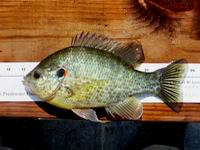
ADDITIONAL Theo's info on Redear sunfish - The Redear Sunfish (Lepomis microlophus) is a close relative of the Bluegill. They get a little longer than BG, but are not quite as tall as a BG of the same length. They do not reproduce as prolifically as BG. In addition to providing alternative forage and fishing opportunities, they are equipped with pharyngeal teeth which let them eat snails. They are often stocked to lower snail numbers and hence the incidence of snail-born parasites such as yellow and black grubs in fish flesh.
Meadowlark made some comments about redears, regular bluegill, and copernose bluegill:
I stocked copper nose and red ear....red ears disappeared completely and the copper nose flourished and somehow native BG are also now present although never stocked. I can't tell any appreciable difference in growth between natives and cooper nose, but that is certainly an unscientific finding.
Bob Lusk comments about coppernose bluegills:
I have seen coppernose bluegill larger than 1 1/2 pounds regularly in ponds that meet certain criteria.
Ponds where fish are fed, where large bass live, and management is above average, expect to see larger coppernose bluegill.
In ponds with little or no management (no feeding, no culling of bass, no fertilization), native strains of bluegill may be a better choice.
In the south, coppernose bluegill are definitely my first choice to accomplish two things. Growing huge sunfish, and long term food supplies for largemouth bass.
Ewest added this-
I would add RE to the mix as suggested. I would not include crappie nor cats. The amount of fish will depend on the ponds carrying capicity. That will depend in part on water quality {if you need or intend on fertlizing} and or feeding , both or neither.
I would point out that there are studies and reports that question if Florida strain bass can survive well long term in north Ark. and Okla. They are not cold tolerant. The limited info I have seen indicates that F-1s would do better and probably a mix of F-1s and northern strain would be even better.
On your remaining question on stocking rates you are right. You can have your first bass stocking at less than the normal rate as a method of growing larger bass faster. In Theo's post above he covers that point very well. The part about taking bass out applies as they get to their second and subsequent years and their offspring. All things being equal bass tend to over populate in ponds. If you reduce the #s the remaining bass do better. The key is having good water quality and a good forage base. You may want to get Pondboss editor Bob Lusk's book on raising trophy bass. As a general rule to get large bass stock fewer bass and have a larger forage base . I like Theo's suggestion of using larger bass if your forage base is over a year old . You would of course put in fewer in # if you do that. If you are going to use larger bass [6-8 in.} contact your supplier early and be sure they reserve them for you. Sometimes larger bass are hard to find.
A newbee posted these helpful results of researching old posts for stocking a new small pond-
This is my plan. I am only a novice, but I have researched this site very thoroughly for recommendations.
800 BG/acre, 200 RES/acre, 5-7lbs fathead minnows/acres and 100 predator/acre (the predators being LMB or Channel Cats). These figures are based on 1-2inch fingerlings.
Stock the BG, RES and minnows now. Next spring stock your predators. If you like catching an occasional cat, maybe stock 85 LMB, and 15 CC per acre. The CC won't generally reproduce, so plan on restocking them annually with larger sizes than fingerlings to maintain your population.
Cody commented to someone who wanted several differernt types of predators:
Be carefull not to add too many different kinds of reproducing predators (fish that eat fish) in a pond that only has bluegill /redear sunfish as a forage fish. From reading other posts here I hope you realize that your fathead minnows will only last a short while after you stock the bass. The minnows are around just long enough to get your bass a "jump start" on growth the first year. It is very doubtful if bluegill/redears alone can produce enough forage to feed bass, crappie and some hybrid striped bass and expect all those predators to grow well or grow at normal rates unless you keep the numbers of predators heavily thinned out or culled.
Bob Lusk also provides these comments regarding catchability of regular bass versus Flordia bass:
Years ago, when clients began telling me tales of hard to catch Florida strain bass, I blew them off. Here was my thinking. A bass doesn't grow to double digit size because they don't eat. So, in my mind, it was a "fishing" problem, not a fish production issue. Then, a profoundly simple event occurred that enlightened this fish guy.
I had my broodfish bass separated, as usual, one spring. Florida's in one vat, native's in another. Probably had 150 pounds of bass swimming in 1,000 gallons of fresh well water in each vat.
My intention was to separate them, (each fish was tagged), then pair them off in small hatchery ponds.
Well, we had a cold snap, long enough for me to get nervous keeping those bass up in concrete vats much longer without food.
So, I fed them. Bought small goldfish from a bait dealer, and tossed 50 pounds of the glimmering little orange creatures into each vat.
The native bass went into a frenzy, immediately. The Florida bass were more cautious, and if they were human, more dignified.
Goldfish in the native bass vat lasted about four days. After the same period, only half the goldfish were gone from the Florida vat.
Subsequently, I have tried to study Florida vs Native bass as much as possible, and I have come to the conclusion that Florida bass are more finicky, and tend to eat "larger" and less frequently than native bass. Keep in mind native bass don't grow as large, or live quite as long as Florida bass, all other things being equal. So, it makes sense they could feed differently than their cousins.
Where Florida bass may be wily and wary, natives often act like teenagers, chasing everything that comes by.
In a lake like Fork, genetics of individual bass don't affect fishermen nearly as much as a well defined population of different gene pools in a smaller private lake. Fork bass have Florida genetics. Those fish are dominant. But, in smaller lakes or ponds with natives, Florida's and F1's together, fishermen can definitely tell the difference in feeding styles of the different strains of bass.
Chasing big Florida bass amongst a population that includes mucho smaller natives? Fish bigger, in cover most likely to hold bigger fish.
Kevin - Cody recommends stocking the regular strain of bass for your small pond situation. I I do not recommend stocking catfish unless you plan to catch and eat them on a regular basis. A few Catfish in a small pond that have been caught and released several times become very diffciult to catch a second or third time. This general rule of thumb will also apply to largemoth bass, especially in the smaller ponds. To help reduce this problem see the upcoming article in PBoss magazine by Willis and Cody about catchability of bass. I hope some of this is helpful. Copy and save this info and ask some more questions if there are things you do not understand.
aka Pond Doctor & Dr. Perca Read Pond Boss Magazine -
America's Journal of Pond Management
|
|
|
|
|
Joined: Apr 2003
Posts: 1,902
Lunker
|
|
Lunker
Joined: Apr 2003
Posts: 1,902 |
Keith,
Bill has provided for you a montage of perspectives & a wealth of info on stocking your pond.
Bill can answer pretty much any question you might have on ponds.
I sense you won't be actively managing your pond & if this is true suggest not pushing the envelope with stocking numbers.
Pond Boss Subscriber & Books Owner
If you can read this ... thank a teacher. Since it's in english ... thank our military!
Ric
|
|
|
|
|
Joined: Mar 2005
Posts: 22,033 Likes: 483
Moderator Hall of Fame 2014 Lunker
|
|
Moderator Hall of Fame 2014 Lunker
Joined: Mar 2005
Posts: 22,033 Likes: 483 |
Bill : That was great and was a lot of work to pull all those points together.  I am looking forward to You and Dave's article on catchability. I have done a fair amount of study on the subject and talked to a few of the people who wrote some of the AFS articles and others. I am also in the middle of a non-scientific ( can't isolate factors) attempt to improve LMB catchability in our ponds. Thanks for your efforts on both this post and the article.
|
|
|
|
|
Joined: Apr 2002
Posts: 15,998 Likes: 1497
Moderator
Ambassador
Field Correspondent Lunker
|
|
Moderator
Ambassador
Field Correspondent Lunker
Joined: Apr 2002
Posts: 15,998 Likes: 1497 |
ewest - Dr.Dave an I did not provide any "earth shakng" new information about how to solve the lock jaw problem with big, old, fish lure shy, LMB. We just pointed out several common sense approches of how one might better deal with this common problem. Those that want bass ponds where numerous, easily caught big bass prevail, will find the suggestions not good enough.
aka Pond Doctor & Dr. Perca Read Pond Boss Magazine -
America's Journal of Pond Management
|
|
|
|
|
Joined: Apr 2002
Posts: 3,355 Likes: 118
Editor, Pond Boss Magazine Lunker
|
|
Editor, Pond Boss Magazine Lunker
Joined: Apr 2002
Posts: 3,355 Likes: 118 |
Geez, Cody, you are a virtual librarian, to keep all that info at your beck and call. Impressive. Keith, Bill has supplied you with plenty of info to make an educated decision. Here's the backbone of what he put together. Habitat, first. Gotta have habitat for each species, in order for them to thrive. Next, create a food chain for your game fish. No food, no grow. Next, if you want superior fish, think about genetics, and supply your pond with such. Last, be sure to understand every pond has its limits, so harvest becomes an issue as a pond matures.
Teach a man to grow fish...
He can teach to catch fish...
|
|
|
|
|
Joined: Oct 2005
Posts: 6,934 Likes: 2
Ambassador
Field Correspondent Lunker
|
|
Ambassador
Field Correspondent Lunker
Joined: Oct 2005
Posts: 6,934 Likes: 2 |
Hey Keith, welcome to the forum from another rookie. In your defense, I calc 18300 sq ft at about .42 ac. also.
"Smokin' post", Bill! I'm takin' Mr Lusk's advice and tucking it into MY library....gonna come in handy in a year or so.
|
|
|
Moderated by Bill Cody, Bruce Condello, catmandoo, Chris Steelman, Dave Davidson1, esshup, ewest, FireIsHot, Omaha, Sunil, teehjaeh57 |
|


.gif)