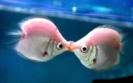
One of the many fascinating and mysterious features of any hybrid is the fact that no two are identical. In fact, if this were the case, they would indeed be considered clones. The GG are without a doubt a mixed pool of several bream. We have an inclosed hatchery on site (with more than 300 troughs) that is dedicated strictly for the rearing (babysitting) of the fry. In fact, we won�t even sell a GG under 1-2". Much time, effort, and money are put into this �babysitting.� Water temps, water quality, and water flow are but a few of the many rules that come into play with these babies.
As far as the theory on reverting or back breeding, Bob Lusk posted the perfect explanation just a few months back.
And I quote:
�Here are a few facts for everyone to understand.
When you cross species, a hybrid is created. In most scenarios, hybrids can't reproduce. (donkey x horse = mule)
In the case of hybrid sunfish, some of them can reproduce (not all). Their sex ratios are not normal...approximately 95% are males. That also has an impact on reproduction.
Know this...they cannot reproduce to what they are, it's genetically impossible. They also cannot reproduce to what they were. That's impossible, too. Each offspring carries the genes for both parents, which is a mixed pool. Some genetic traits are dominant, others aren't. When fish have a mixed pool, they reproduce and only give a mixed pool, they can't be anything 'pure', ever. They can't become their parents. It's akin to unbaking a cake. That cake will never be the ingredients. It is now a cake.
Hybrid vigor degrades after the first generation. When hybrids cross, dominant traits change. Hybrids cannot reproduce and become what they were. They become a second generation cross with a mixed bag of genes from the parents. Where the second generation crosses, things become confusing, genetically speaking. Those generations are called 'Fx'. Take a bag of red and green confetti, and mix it with a bag of blue and yellow confetti. The 'hybrid' bag is a pretty, even mix of all colors. Take the hybrid bag and mix it with another bag of totally different colors. What do you get? A completely mixed bag of different colors, none of which is the original. It has traits of the original, but isn't. With hybrid sunfish some of those colors are dominant, some of the behaviors are dominant.
Fisheries biologists who recommend hybrid sunfish also recommend stocking no other sunfish with them. That's because the hybrids which do reproduce tend to go at it with other species, such as bluegill, etc.
Typical hybrid sunfish sold in the U.S. are crosses between male bluegill and female green sunfish.
Deb tells us that the Georgia Giant is a proprietary blend of genes. She has no idea what it is. Two people know that blend, and they aren't talking. They have a trademark, a product and loyal base of followers. They have a system they like.
Other companies have programs and systems that they like.
It's pretty funny, traveling the country and meeting different biologists and pond management people. The business is a hybrid. We live in different regions, doing what we do. And, most of us think we invented the business. I'll never forget about ten years ago, when I found out about a pond management guy in South Carolina. I called him. We both were a bit shocked. He pretty much did what I did, and as we compared notes, we were similar. Throw some testosterone into the mix, and we could have been like two roosters, taking credit for all the chicks. Pond management, as a business, is a cottage industry. But, the biological principles are the same.
We all operate under these scientific principles, with different opinions. That fact makes pond management an art.
As consumers, you get to pick.
Much of this thread is based on hearsay, with a limited understanding exactly how genetics work, bolstered by other hearsay as evidence.
Deb has explained it well.
If someone has green sunfish, they didn't come from the hybrids. It can't happen. Hybrids are hybrids, cake is cake�. Bob Lusk October 7th, 2005 9:31 A.M.
As for revealing the secret recipe for the GG, I certainly understand where you are coming from. In fact I myself do not have this recipe. But I respect what Ken has done much in the same way I respect what KFC has done with their original recipe and with what Red Lobster has done with their biscuits (bad analogies I know, but we have all eaten at these places so I am sure we can relate). Many have tried to duplicate these above-mentioned products but have fallen short. Ask yourself what would happen if those recipes �got out� into the general public. The fact is that competition might actually push them out of business (or at minimum cut their profit margin). As a sole proprietorship Ken can�t afford (literally) for that to happen.
So you ask �Isn�t it only fair for a customer to know what an Fx will be?� Herein lies the reason behind a large predator stocking base. A GG pond is not intended to grow out WR predators, but instead it is designed to grow a large original stock (maybe a few offspring) with the majority of offspring becoming forage for the predator.
In ML�s case he stocked HSB on a 1 to 5 ratio with the GG. If he notices an increase in GG offspring, he can add more predators if he so chooses. It is all about goals.
So to make a long post short (yeah right for me to actually do that

) ML will see a wide variety of feature characteristics displayed with his F-1 GG stock. Just as we see a wide variety of feature characteristics displayed on the Americans we pass daily on the street.