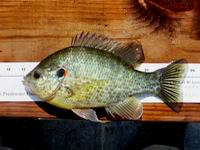
Glad to provide some back up for Bill and Daves points ( but they don't need any back up) .Interesting that the YP were feeding in winter on the BG . I wonder if Bruce is up on this before the YP go in one of his ponds with BG.

-------------------------------------------------
Winter Feeding Habits of Bluegills, Lepomis Macrochirus Rafinesque, and Yellow Perch, Perca Flavescens (Mitchill), in Cedar Lake, Washtenaw County, Michigan
James W. Moffett
U. S. Department of the Interior, Fish and Wildlife Service, Stanford University, California
Burton P. Hunt
Michigan Institute for Fisheries Research, Ann Arbor, Michigan
Abstract.�During the winter of 1940-41, 1,128 bluegills and 211 yellow perch were collected from the rather productive Cedar Lake, Washtenaw County, Michigan. Analyses were made of the contents of the stomachs of these fish.
Bluegills consumed very little food during the winter. The average stomach contained 133 organisms of which 124 were plankton. The average volumetric content of these stomachs was 0.036 cubic centimeters. Foods consumed were predominantly aquatic insects (mayfly nymphs) in early winter; changed to plankton (Cladocera) in midwinter; and tended again toward aquatic insects as spring approached. There was some correlation noted between prolonged periods of warm weather and an increased rate of food consumption.
Yellow perch ate much more food than did bluegills during the winter. The average volume per stomach was 0.26 cubic centimeters. Young bluegills constituted the great bulk of the perch diet. They formed over 60 per cent of the total volume throughout the winter. Ostracoda were eaten in great numbers in midwinter.
Winter predation by perch on young bluegills certainly must be an important factor in regulating the bluegill population.
-----------------------------------------------
Here is the southern info below. These just verify that Bill is on the money.

------------------------------------------------
WINTER AND SUMMER GROWTH OF BLUEGILLS IN
FERTILIZED PONDS �
E. V. S�TH AND H. S. SWINGLE
Alabama Agricultural Experiment Station, Auburn, Alabama
ABSTRACT
The use of fertilizers to increase the production of lqsh in ponds has become
widespread in recent years. Since fish are cold-blooded animals, their
metabolic activities are slowed by cold weather and accelerated by hot
weather. Experiments were conducted to study the winter and summer
growth of bluegill bream. In December, small fertilized ponds were stocked
with bluegill fingerlings at the rate of 1,750 per acre, individuals averaging
3.8 grams in weight. Three months later their average weight had increased
to 11.4 grams, a gain of 200 per cent. The water temperature during this
period varied from 3 � C. in January to 15 � C. in March. Another fertilized
pond was stocked in March at the rate of 1,500 fingerlings per acre, individuals
averaging 4.5 grams in weight. Samples of bream taken from this
pond in June averaged 80 grams, a gain of 1,700 per cent. The water temperature
during the latter period ranged from 19 � C. to 24 � C.
Thus, bream do grow during the winter in the South, but the growth is so
slow that winter fertilization of ponds generally is not practical. Ponds
stocked in the fall or winter should be fertilized lightly during this period
to produce sufficient food to support the fish until spring.
INTRODUCTION
Fish are cold-blooded animals, and therefore their body temperature
is about the same as that of the surrounding medium. They grow
very slowly or cease growth entirely during the winter when the water
is sufilcient]y co]d, and the various life processes of the animal are at
a low ebb..... Hathaway
(]927) found that bluegills (Lepomis macrochirus) and largemouth
black bass (Micropterus salmoides)c onsumeda bout one-third as much
food at 10 � C. (50 � F.) as at 20 � C. (68 � F.). Markus (]932) studied
the feeding habits, rate of .digestion and growth of largemouth black
bass at different temperatures during a 3-month period. He found
that the bass fed voluntarily at temperatures of ]6 � C. (60.8 � F.) and
above but not at ]0 � C. and 4 � C. (50 � and 39.2 � F., respectively).
Even when force-fed, the bass did not increase in length at the lower
temperatures and most of them lost weight. They gained in weight
and length at temperatures of ]2 � to 20 � C. (53.6 � to 68 � F.).
The scales of crappie (Pomoxis nigro-maculatus and P. annular�is),
black bass, and bluegill bream collected in Alabama show well-defined
annuli, indicating that growth is retarded during the relatively mild
winters of this region.


.gif)