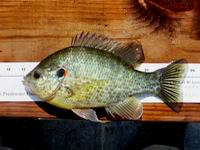
In my part of the country, it is incredibly difficult to find a fish farm with anything besides trout species. Although I love trout, I chose YP and SMB as my primary fishery with maybe some BT added at a later date. That left me with angling as the best option for acquiring YP and SMB. I was a bit disappointed that I wouldn't be able to get feed trained fish, but had to accept that.
I set about my slow and steady stocking process and after a while, I thought it would be fun to see them eat so I hand threw some Endurance Advanced Juvenile Blend 3mm floating food. I expected to see some FHM or shiners come to the feed and hoped that the YP and SMB would take it as an easy opportunity to get the distracted forage.
To my surprise, after a week or two I started seeing larger splashes taking the pellets. At first I thought it might be large GSH, but ultimately confirmed that they were YP that were wild caught earlier in the year! I get the sense that this is uncommon, but I'm sure I'm not the only one to achieve it. As I've learned from here, the pellet eating fish tend to train the others to take pellets, so the number of fish coming to the surface each night has slowly increased over time.
Although it is less common, I'm seeing some minnows (likely FHM) being attacked in the shallows when they are coming up to nibble on pellets that have floated close to shore. I suspect this is from SMB, but it could be a different YP tactic too I suppose.
I have never soaked the pellets as I've heard others suggest. Maybe their small size doesn't require it as much. I simply hand feed about the same amount at about the same time from the same place each evening at roughly an hour before sunset. Consistency seems to help, and having a high quality food likely matters as well. On a couple of the hottest days of summer, I've seen very little activity. When that happens, I stop feeding until the temps cool down.
On a side note, one of my YP has 12 stripes! I've never seen one like this before. I'm hoping it is a heritable trait that gets passed along to its offspring. It should be big enough to spawn in the Spring.
IME, 1) hungry fish are more likely to eat pellets, and 2) predators who eat prey that is eating pellets can learn it is easier just to eat the pellets.
"Live like you'll die tomorrow, but manage your grass like you'll live forever." -S. M. Stirling
Hydrating the pellets for just around 5 minutes will help more fish get 'hooked' on the feed. Once they're hooked on feed, hydrating is not needed.
Excerpt from Robert Crais' "The Monkey's Raincoat:" "She took another microscopic bite of her sandwich, then pushed it away. Maybe she absorbed nutrients from her surroundings."
My experience is wild caught YP do not learn to eat pellets as easily as bluegill. Consider yourself lucky if you can get wild perch from lakes to eat pellets. YP from a fish farm IMO will learn to eat pellets easier than lake caught perch.
One thing that can make it more successful to get YP to eat pellets is to have some type of teacher fish such as pellet eating minnows or sunfish "show" perch the location of the pellet feeding area. The perch are attracted to the activity of the pellet feeding fish and some perch could then try and eat pellets and thus become pellet trained. This happens because YP will eat some forms of snails. The hard body of a snail is similar to texture of a pellet thus the YP accepts the hard pellet especially true when the pellets are high quality protein with additives such as flavor enhancers. I think this same type of natural feed training behavior happens with the occasional largemouth bass.
Last edited by Bill Cody; 08/24/2603:50 PM.
aka Pond Doctor & Dr. Perca Read Pond Boss Magazine - America's Journal of Pond Management


![[Linked Image from i.imgur.com]](https://i.imgur.com/WSV2JEI.jpeg)


![[Linked Image from i.pinimg.com]](https://i.pinimg.com/736x/ed/b5/e7/edb5e7f935843b996cf52be593c9ebd2--smoothie-smooth-collie.jpg)


.gif)