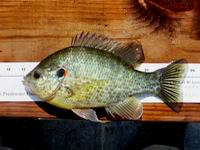
I want to again overemphasize largemouth bass harvest for anyone who is new to this pond ownership game.
Our goal is healthy largemouth bass that have relative weights near or exceeding 100%. We're not expecting(or spending the $ for) exceptional trophy fish, but we want to have a good time catching quality fish up to 5lbs or beyond!! I think it's very doable for our little body of water that is around 2ish acres.
That being said, I am up to 62 bass removed this year!!
This past catch(the 26th of June) yielded 19 bass in 2 hours of fishing time. Of the 19 cleaned for frying, ONLY ONE had a bluegill in his belly!! Crazy, being I see bluegill everywhere in the pond right? 18 empty stomachs....
I will keep harvesting these small bass between 8-12 inches until the RW of all bass shows progress! Who knows how many that will take, but it is certainly MORE than you may imagine.
ML10 - Do you have any indication of how many bluegill are present that are last year's hatch being actual measure of 1.5"-2.5" long?? Do you set fish traps to get ideas of what the actual bluegill measured sizes and percentages are in the various BG size groups?
aka Pond Doctor & Dr. Perca Read Pond Boss Magazine - America's Journal of Pond Management
ML10 - Do you have any indication of how many bluegill are present that are last year's hatch being actual measure of 1.5"-2.5" long?? Do you set fish traps to get ideas of what the actual bluegill measured sizes and percentages are in the various BG size groups?
Bill, FWIW, I love this question. The sizes of BG you mention are ideal (IMHO) for LMB of the size ML10 removing.
IMO, it would be a great exercise to monitor BG size distribution and and LMB RW. RW probably lags peaks of ideally sized prey by 2 to 4 weeks but these kinds of metrics could be beneficial for understanding that dynamic.
It isn't what we don't know that gives us trouble, it's what we know that ain't so - Will Rogers
Cataloging stomach contents seems like it could be a fruitful field for analyzing our ponds. However, I am not sure if it represents an "unbiased" sample?
I do not recall EVER catching a large LMB that had a significantly sized BG, bass, gizzard shad, etc. in its stomach contents when I cleaned it. (Although we usually returned the large bass to the lake. I have cleaned a fair number of medium-sized bass.)
How long would a large meal be recognizable within the stomach of a healthy LMB?
Is a LMB that just ate a large meal just as likely to strike a lure as a hungry LMB?
[I know literally zero on this topic. Is there a good thread in the archives, or does someone have a link to a good academic article?]
I fished in a customers pond that hasn't harvested a bass in years just to check the RW on the bass. 3 casts with a whopper plopper got 3 bass. 10, 12 and 15 inches. All RW's 90-92. Biggest bass had the highest RW. Not a bluegill to be seen. He's going to take out 30 pounds of bass this year and we will add BG after he hits that number.
I believe ML10's observation about the stomach contents provides useful information. Less than 6% of those caught and cleaned had prey in their stomachs.
To be sure, his LMB in the 8" to 12" sizes are not consuming daily. If they were, the observation rate of prey in the stomach contents would be higher. But these LMB were being maintained and probably growing slowly. What is happening in conditions like this is that the LMB are feeding every second, third, or possibly even 4th day (on average). Most of the LMB had already evacuated their infrequently consumed meals. How often they feed depends on how large the prey is and how difficult it is to consume that size prey. But obviously, the prey is predominately larger than can be consumed daily at the current density. Also in part it depends on their needs to grow at potential. They will consume more to a limit (max individual growth) if prey is abundant and easy to consume.
So two things are going to go into the realized number of prey consumed for a given density of LMB ... First, the density of prey. Second, difficulty of the prey to be captured. So the first determines how many opportunities an LMB will have daily to capture prey ... the second determines the success rate of those opportunities. When the product of those two falls below 1 ... it takes more than one day to consume 1 prey.
So consider the energy needs of one average cull ... a 10" LMB. This need can be looked at two ways. One is maintenance ... the other is the satiation ration (what it takes to support that LMB's individual potential for growth). That 10" LMB needs to consume 2.5% of its body weight daily to maintain it's weight today in nearby Tylertown, MS. The same 10" LMB needs to consume 6.1% of its body weight daily to grow at average potential (NLMB). If that 10" LMB were consuming the maintenance ration daily in 1 prey item ... The length of the BG Consumed would be right at 2.68" ... Or ... just a little over 1/4 the Length of the LMB. If those sizes of BG were abundant enough to maintain the 10" LMB ... at least 30% or perhaps a little over 50% of the LMB would have prey evident in the stomachs. If they were consuming 1/4 length prey and growing at average potential ... it would be very uncommon to remove an LMB without prey evident in the stomach contents.
Clearly, the poor conditioned LMB that are being culled are consuming prey that are larger than 1/4 the length of the LMB.
Back to Bill's question. The 1.5" to 2.5" BG must be in very short supply. I think ML could confirm this. I mentioned it last Fall and I know it was unwelcome then ... but I assure everyone ... my heart is in the right place and my intention is to help ... even if I don't currently have a pond.
Last edited by Bill Cody; 08/02/2603:57 PM. Reason: enhanced an important point
It isn't what we don't know that gives us trouble, it's what we know that ain't so - Will Rogers
ML10 - Do you have any indication of how many bluegill are present that are last year's hatch being actual measure of 1.5"-2.5" long?? Do you set fish traps to get ideas of what the actual bluegill measured sizes and percentages are in the various BG size groups?
I have not trapped any Bill, but maybe I should. I do have a trap that I use for other bodies of water.
I can only go by what I see in the water... each brush pile / brick pile / rock pile i've created is holding BG of various sizes. Bluegill are active at the feeder and my bluegill beds are active, especially around the full moon each month.
My thoughts currently are: 1.) remove bass 8-12 inches 2.) create more brush piles for young of year to grow out
On the time it takes to evacuate consumed prey ... Google provides a synopsis. You could follow links below that search for scientific papers on the subject. The google synopsis mentions that regurgitation can skew stomach contents. There is a Youtube video from which that information is sourced. The link below should open where that is discussed ... at least it did for me. FWIW, the bass in that video had a prey item in its stomach ... so ... if regurgitation is the rule ... as opposed to the exception ... this single sample beat the odds.
Also, there are papers that use stomach contents to estimate consumption. To my knowledge, there are no adjustments to estimates to account for regurgitation and the estimates of consumption imply that regurgitation is not the rule but rather an exception that will skew the consumption estimate down but not to zero or some minor fraction of the maintenance ration.
I did the same thing by removing those 8-12" LMB when I started managing my pond but I wasn't seeing a big improvement. I did start noticing the RW of those 8-12" bass started improving but not the larger bass.
I've heard Bob talk about it and others that once a bass is stunted that is weight that he can't make up. When I started tagging my bass I started seeing larger bass that I recaptured with very little weight gain, some maybe growing only .5" and 5 or 6 oz. in a two year period.. That's when I started adding larger 14-16" fish to my culls and then I started seeing those RWs for those size fish start to improve.
There were other variables involved for sure but I believe those larger fish were stunted and not going to reach their potential. I believe that gave the 8-12" fish that I did not cull a chance to continue to grow once they reached the 14" range and they did not lose that growing season... therefore they had a much better chance of reaching their full potential.
Trap and seine surveys to provide more info on BG size distribution. Stomach contents are for experts and are time critical - often little info and hard to id contents.


![[Linked Image from lh6.ggpht.com]](http://lh6.ggpht.com/_6_-SgakQ9co/S3Nx1jGAJWI/AAAAAAAABKU/DJIy4ZnF1t0/s800/I_subscribe.jpg)
![[Linked Image]](https://forums.pondboss.com/ubbthreads.php?ubb=download&Number=21655&filename=Digestion%20Rates.jpg)
.gif)