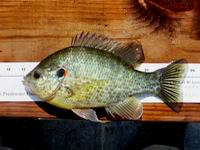
My son caught this fish yesterday. it's the first fish we have caught since the cormorants wiped out all of our bluegills after stocking last year. My thoughts are that it's a green ear sunfish which is something we didn't stock. We do have 7 very small ponds up stream of us and we did inherit a bunch of mosquito fish from them. My thoughts were that we were only getting mosquito fish but unfortunately after our last big rain I noticed a bunch of baby bluegill had gotten trapped and died while trying to flow into our pond. So, we definitely are subject to whatever fish are upstream of us. First question is what do you all think this is? Second is, if it is a green ear sunfish, are there any ways to manage for them?
Really kicking myself for not just pulling it out. I saw another thread that just states to fish for them and pull them out when you can to try and reduce their population?
They're really easy to catch in minnow traps. I catch them all the time, clip a side fin off, and hand feed them to largemouth bass in the shallows. I toss them on the bass' heads and they crush them. In the case, that one escapes the clipped fin ensures it doesn't escape for long!
Get a minnow trap(the funnel kind) and put some feed in it. Leave it overnight. Bingo!
I agree with ML10. Hopefully, you can either eliminate them with the traps (if you only have a few), or sample them accurately if it turns out you have a lot.
If you don't have fish food, I catch them in the traps by putting a little dry cat food in a mesh bag inside the trap.
Just curious but what is the likelihood these days of accidentally getting this fish from a fish farm? Only reason why I ask is that I just stocked the lake with another 500 jumbo bluegills and this fish is pretty much identical in size to those. I purchased the fish from a large management company in Texas who own their own fish trucks, they told me they got them from a fish farm in Arkansas. Were green ear sunfish ever a recommended or desirable species to put in ponds? I know whoever stocked the original stock tank on my property put in crappie (1/2 acre tank) and today that wouldn't be advised, especially on that size body of water. We have been actively removing the bass and crappie from that pond by angling them out. During a heavy rain it would technically be possible for fish to wash into my larger tank but it would also be a difficult journey. The end goal of the original tank is to make it into a catfish pond.
We did put in 3 minnow traps (funnel kind) when trying to sample the bluegill population earlier this year to figure out what was left after the cormorant invasion. We caught a few 1" bluegills but didn't see any larger fish coming to the feeders. This is why it was decided to stock jumbo bluegill so that portion of the food chain could be replenished before adding bass fingerlings. Didn't catch any green ears.
We are very close to the Colorado river, I have caught several green ear sunfish there when collecting catfish bait. My guess is one of these other land owners likely went and bucket stocked from the Colorado and ended up with green ears in his pond. They probably then made their way into my pond during our heavy rains last year and managed to avoid being eaten by the cormorants.
I'm going to head out this evening with a buddy, and we are going to fish the pond pretty hard with light tackle to see if we can catch anymore.
I'm not sure what you mean by green ear? is it a local thing in texas to call Green Sunfish, Green ears?
You might ask the fish supplier what they mean by a 'jumbo bluegill' and whether these were hybrid. A hybrid bluegill is commonly sold as it is advertised as having better growth and hardiness features. However as a hybrid it can (and does) reproduce and the offspring of a hybrid or 'jumbo' bluegill will produce green sunfish. So it may just be that you were given hybrid bluegill that produced in the next generation the green sunfish that you are seeing.
Hybrids which can breed cannot produce pure specimens of either species they derive from. Subsequent generations from hybrids (which are termed "Fx", as opposed to the original "F1" hybrids) carry a plethora of mixtures of the two parent species' genes (as opposed to the 50/50 mix of the original F1 hybrids). BGxGSF out generations have individuals that vary from "almost" BG to "almost" GSF, but the odds are astronomical against getting actual BG or GSF.
If you manage your pond to allow GSF traits to predominate, your Fx generations may likely resemble GSF more than BG; conversely, if you manage to encourage BG, including having sufficient bass predation to eliminate the smaller GSF-type bodies, Fx fish will likely tend to be more BG-ish.
But you're not going to get Green Sunfish.
"Live like you'll die tomorrow, but manage your grass like you'll live forever." -S. M. Stirling
Unfortunately, that happens all too often. If you have some pure BG then over time, they will out reproduce the GSF assuming the numbers are not to skewed.
So, I fished the lake for two hours yesterday with light tackle. When I got to the spot where we caught the suspected green sunfish last time, I managed to catch one that looked identical on the first cast, only difference was it didn't look like its belly was as fat (bottom fish in the photo). I was feeling pretty good that maybe this was just a one off, maybe it accidentally came in on the stocking truck until I caught what I thought might be another (top fish in photo). I caught a good number of the copper nose bluegill; most are still too small to grab the hook but managed to land about 15 of them. I guess the only way for me to tell the difference is that both of these fish have that electric green around their mouths on their head. None of the other fish had that. Their bodies also seem a bit more elongated than all the others and their mouths were slightly larger (mostly noticeable when removing the jig). How often do these guys hybridize with other bluegill and will they do that if just tossed into a pond with other bluegill? Is it possible that the top fish might be more of a hybrid?
Also I realize now I should have taken the photo when the fish were more alive and could see their colors. I was just trying to make my way all the way around the pond before daylight ran out.
both of these fish have that electric green around their mouths on their head. None of the other fish had that. Their bodies also seem a bit more elongated than all the others and their mouths were slightly larger (mostly noticeable when removing the jig). How often do these guys hybridize with other bluegill and will they do that if just tossed into a pond with other bluegill?
Lots of greensunfish genetics in those two specimens due to what you say above: a.bodies also seem a bit more elongated, b. their mouths were slightly larger. You ask - "How often do these guys hybridize with other bluegill?" I depends on numerous variables, but it does happen probably more often than one thinks.
"and will they do that if just tossed into a pond with other bluegill?" yes - they will do that probably at least one nest a year - depending. Survival success of fry is also a "crap shoot"..
aka Pond Doctor & Dr. Perca Read Pond Boss Magazine - America's Journal of Pond Management
Some years back (17), I had only yellow perch YP, largemouth bass LMB, and 2 grass carp TGP, in our pond. No sunfish of any sort, although the gal that sold us the property said that there were bluegill BG and crappie BCP in there, too. As I understood that sunfish are great fodder for LMB and also desireable for panfishing, I bucket stocked a handful of GSF and BG. These all fizzled out. I had no commercial source for the sunfish.
Several years later I found a pond loaded with "bluegills". I was doubtful, and sure enough, my fishing that pond got me 2 dozen more GSF for my water. The next year a source of mature BG appeared, so I bought 2 dozen 7'' fish from him. Roll forward all these years, and you'll see and catch all sizes of HBG, BG, and GSF. Pond record of GSF equals Colorado Parks and Wildlife reported state record. BG to 10.5", HBG to 10" are there for the taking. I ate a 19" LMB last week poached in butter ala Hank Shaw's suggestion.
There is no evidence in my pond that BG are out competing GSF, nor the other way around. The HBG are really agressive biters and a remarkable bonus fish. I thoroughly enjoy the variety and quality of my fishing.
All this to say I'm not disputing in any way the observations, wisdom, and recommendations of our incredible experts on this forum. All I'm saying is that in my cool water, 1/4 acre, irrigation water fed pond at 6540' above sea level, 3 types of sunfish get along fine. The few smallmouth bass present don't seem to reproduce. I have a firm grip on the handle of the LMB slaying operation. The GSF have likely decimated my YP as I only see 8" to 12" individuals anymore. My 5 TGC are lazy suckers, 36" to 48" toads that don't do their jobs eating the over abundant elodea, and the one lonely 12" bright orange goldfish has successfully eluded the great blue heron GBH attackers for many years.
All of this may not be reproduceable anywhere else.
4Corners, that is a great description of the population in your pond! Really impressed that you are doing that with only a 1/4 acre.
Don't you get some extra "flow through" with your irrigation water set up? If so, do you think that is a contributing factor to your good pond productivity?
P.S. Do you have any means to remove 1-2 TGC? That might make a little extra room for some other fish biomass, rather than those lazy toads.
Thanks FishinRod Yes , many years we have enough flow through that a marsh has developed downstream from the outlet. I've built a couple of small "frog ponds" below the overflow with my tractor, too.
Removing the grass carp would be as simple as shooting them as they cruise by eating Endurance. Also, I could string up one of my salt water fishing outfits, chum them for a bit with bread , and have the fight of my life. I bet such a tussle would muddy the waters. If not a "bigger boat", I'd certainly need a much bigger landing net.
Well, we pulled one more out a little over a week ago, and since then all we have caught are bluegills. For what it's worth, the kids seem to enjoy fishing a little more knowing that if they get a green sunfish they can keep it. We'll just have to monitor and see what happens. Right now, I'm anxiously waiting for the bass to be able to hit the light tackle.


![[Linked Image from lh6.ggpht.com]](http://lh6.ggpht.com/_6_-SgakQ9co/S3Nx1jGAJWI/AAAAAAAABKU/DJIy4ZnF1t0/s800/I_subscribe.jpg)

![[Linked Image from i.pinimg.com]](https://i.pinimg.com/736x/ed/b5/e7/edb5e7f935843b996cf52be593c9ebd2--smoothie-smooth-collie.jpg)
.gif)