|
Forums36
Topics42,113
Posts571,660
Members19,114
| |
Most Online13,012
Jun 7th, 2026
|
|
|
2 members (Bill Cody, LeighAnn),
1,119
guests, and
91
robots. |
|
Key:
Admin,
Global Mod,
Mod
|
|
|
|
Joined: Mar 2005
Posts: 22,032 Likes: 483
Moderator Hall of Fame 2014  Lunker
|
|
Moderator Hall of Fame 2014 Lunker
Joined: Mar 2005
Posts: 22,032 Likes: 483 |
FYI - Pond Boss Mag. article 2022. Subscribe to the Mag.
THE CUTTING EDGE – SCIENCE REVIEW
Single Sex Fisheries
Many land owners often express as a goal a desire for a pond that produces a trophy fish species. That is a noble goal but one that is not easy to accomplish. A trophy pond, where the owner wants either trophy bluegill or trophy largemouth (or any species that has high reproduction rates) is a special challenge. Fisheries managers have struggled with effective ways to reduce high numbers of slow growing largemouth bass or bluegill in small impound¬ments. In the past, a principle management strategy to address this issue was to encourage harvest. We all know the difficulty of convincing fishermen to keep fish. As a result high release rates and lack of harvest by anglers have made this a difficult option. With high release rates by fishermen the likelihood of trophy largemouth bass or trophy bluegill growth is greatly reduced. Labor-intensive, manual removal of stunted fish and or the use of slot limits have been recommended to increase growth and the number of trophy largemouth bass or bluegill. Another method which is being tried more often is to control reproduction by stocking only one sex of the trophy species (female bass or male bluegill). Stocking fish that are sterile or otherwise unable to spawn successfully (Hybrid Striped Bass) has been used to cre¬ate trophy fisheries of a variety of species, but this technique has only recently been attempted in ponds or small impoundments.
Trophy fish management generally requires ap¬propriate genetics, good habitat, high productivity, low mortality (especially fishing), low competition among the target trophy species, and high amounts of available prey/forage.
One study titled Use of a Female-only Stocking Strategy to Establish a Trophy Largemouth Bass Fishery in a Georgia Small Impoundment by Timothy F. Bonvechio, and Joseph J. Rydell, in the Journal of the Southeastern Association of Fish and Wildlife Agencies 3:136–143, 2016, documented the successful creation of a trophy largemouth bass fishery at Ocmulgee Lake (106 acres) by stocking only females to reduce or eliminate reproduction in combination with stocking supplemental forage species. This stocking strategy created a low-reproduction, fast-growing largemouth bass population that fit in with fishermen’s catch and release mentality.
Small impoundments and ponds are often characterized by high rates of largemouth bass or bluegill reproduction, which can limit trophy fish production because of competition for limited resources (food). However, small waters offer managers more options and opportunities to use new approaches to create unique fishing opportunities that may attract and retain future fishermen. One such technique is stocking exclusively fe¬male largemouth bass to produce trophy fish opportunities. Another is the stocking of male only bluegill for a trophy bluegill fishery. Do note that trophy fisheries often result in reduced catch rates which may not be best for young fishermen who need the encouragement of lots of fish being caught.
The authors note that the single sex trophy strategy has been implemented in many private ponds through¬out the southeastern United States (Willis et al. 2010; G. Grimes, Aquatic Environmental Services, Inc., personal communication). All Pondbossers note with pride the source of the author’s personal communication being our own Dave Willis and Greg Grimes. We are on the Cutting Edge. A big word of caution is needed – the success of this strategy can be reduced or eliminated when both sexes of the target species get stocked into the system, either by misidentification in the hatchery or by anglers, which often results in the popula¬tion quickly becoming mixed and out of control. However, if correctly implemented this management option has the potential to overcome the limitations of excessive reproduction and the unwillingness of many anglers to harvest fish.
In this trophy largemouth bass study bluegill, golden shiners, redear sunfish, and threadfin shad were stocked in 2004, one year before the first largemouth bass stocking. This was done to allow the creation/establishment of abundant forage prior to stocking of largemouth bass. Afterwards, four additional species were stocked as possible bass forage. Supplemental stockings primarily consisted of goldfish, lake chubsuckers, and channel catfish.
In 2004 and 2005, F1 largemouth bass - Florida largemouth bass x northern largemouth bass were procured from American Sportfish Hatchery, Inc. (Mont¬gomery, Alabama) and were reared in state hatchery ponds. These bass were recovered from hatchery ponds a year later, and sex was determined by inserting a pipette into the urogenital opening. All female largemouth bass were tagged with a passive integrated transponder (PIT) tag for later identification and stocked into the lake in 2005 and 2006 at a rate of 32 per year – total 64 per acre. Lower numbers of female largemouth bass were tagged and stocked into the impoundment throughout the study using similar methods. Also, any untagged female largemouth bass collected from 2009–2012 were subse¬quently tagged. Sizes and genetics (i.e., origin) of female largemouth bass stocked after 2006 varied by batch and year (average of 5 per acre per year). Growth of fish was fast, with mean length exceeding 20 inches by age 4.
Anglers fished 213 angler-hours over 21 trips in spring 2012 and caught 64 largemouth bass with the largest fish collected being 24.76 inches. On average, it took anglers 3.76, 7.35, and 53.25 hours to catch a largemouth bass greater than 5 pounds, 7.9 pounds, and 10 pounds, respectively. Electrofishing in spring 2012 captured 116 largemouth bass, and the largest fish collected was 24.37 inches. Multiple captures of individual bass were uncommon; of 180 total fish scanned, there were only 15 recap¬tures (12%). Furthermore, of 16 fish greater than 10 pounds, only one was a recapture (6%). Thus, angling and electrofishing combined obtained 1 trophy bass (> 8 pounds) per 1.7 acres. Catch rates of both fishing and electroshock followed a similar trend of declining as fish size increases, but electrofishing was many times more likely to produce each size group of fish with the same effort. Fishing appeared to catch more largemouth bass between 8 and 10 pounds and less between 10 and 12 pounds.
Repeating the big warning from above - failure to accurately sex fish before stocking can limit the effec¬tiveness of this single sex trophy fish strategy. For instance, the authors note a personal conversation where one male largemouth bass mistakenly identified as female and stocked into an all-female bass pond at Auburn University resulted in reproduction that tripled bass population density and reduced growth of the initial stock by 20% in one year. However, this was not the case at Ocmul¬gee Lake, where male largemouth bass were mistakenly stocked into the lake as early as 2009, but bass density remained low, with no reduction in growth or condition. Because high densities of numerous forage species were maintained through the study, predation on largemouth bass eggs or fry by these species may have been limiting factors in preventing or reducing bass recruitment. Also because lots of food was available for the bass during the study period before draining the result of the reproduction was not yet noticed in the results. If the situation would have continued over time without draining the likelihood of keeping a trophy bass fishery likely would have been greatly reduced.
The use of single sex stocking to produce a trophy fishery has been discussed in great detail on the Pond Boss Forum with many real life examples and experiences provided. I encourage each of you to go to the Forum and experience the wealth of information on this subject and many more. Until next time keep on the Cutting Edge.
.gif) 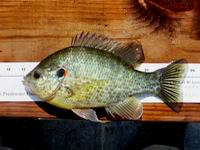
|
|
|
Moderated by Bill Cody, Bruce Condello, catmandoo, Chris Steelman, Dave Davidson1, esshup, ewest, FireIsHot, Omaha, Sunil, teehjaeh57 |
|







