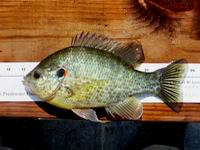
I have a few question about possible supplemental forage stocking, if needed....
Here are the facts about my pond:
* 2 acre pond in Indiana * 13 feet deep * Constructed in 2023 * Lots of various artificial fish structure, with open water areas * 4 aerators with 3/4 HP Pump * 2 Texas feeders feeding 3x a day
Stocking
* 100 lbs of fathead minnows on 8/10/23 * 100 lbs of golden shiners on 8/10/23
* 4000 Bluegill 2"-4" on 3/10/24 * 1000 Redear 2'-4" on 3/10/24
* 120 Large Mouth Bass 4"-5" on 10/12/24 * 80 Hybrid Striped Bass 4"-5" on 10/12/24 (lost approximately 45 fish)
I figure I have around 60 hybrid striped bass, this is just based on what I found dead in the water or banks of the pond.
Observations
Have fed pellet food ever since BG and RE were added. BG an RE are big fat and happy, lots of generations at various sizes. Currently have a lot of small BG and RE in pond. They had 7 months with no predators, but LMB were only 4"-5" when added and the BG and RE were about 6"-8" at the time. All the FHM are gone, to be expected. But they had 14 months with no predators and I had large schools and schools of them!!! Still see a lot of large golden shiners, do not see many medium to small ones, again no predators for 14 months so they are plentiful I assume. LMB are around 13-14" and above 110% relative weight, so I am very happy with the weight gain in 12 months. I finally saw and caught a HSB this week, I assume it was one of the 8"-10" ones I recently added
Questions
Anyone have the same issues with adding HSB? Should I assume more have died then just what I found dead? Again I finally saw and caught my first one ever since first adding them back in Oct of 2024. I don't feel I need to supplementally add more Golden Shiners? I guess the big question is should I be added supplemental FHM?
Goal is to grow big fat LMB and HSB, I plan to start harvesting in the summer of 2027? Or should I sooner?
Thank you for your input, please let me know if you have any questions. I am always looking for advice...
Yes add FHM. Even if they served their purpose and fed you original stocking you still have new generations to feed. If i were you i would add FHM yearly.
Great growth. Essentially fulfilled the model. Had earlier worked up climate for Boone County, IN and so just run the numbers starting from 4.5"on 10-12-24. Model estimates (assuming 13% mortality of LMB) that you now have 26 females averaging 1.4 lbs (13.43" at 110 RW) and 26 males averaging 1.1 lbs (12.5" at 110 RW). It estimates the consumption of 202 lbs of BG forage for the girls and 158 lbs of BG forage for the boys. In total, if they number 52 LMB/acre ... they consumed in the neighborhood of 360 lbs of BG equivalent forage.
They will surely reach the growth limiting forage soon. How soon largely depends on how much of bank of forage you still have remaining. You have two choices. You can supplement forage, or you can reduce the number of your LMB. For example, if you could remove all the estimated 26 males/acre ... you could free a minimum of 158 lbs/acre of forage for your females to grow on. So even if you kept all the females ... on the same amount of forage (360 lbs/year) your females could grow at the growth rate they are currently showing they are capable of. You could grow your girls to an average weight of 2.82 lbs by October 10th next year. By then you'd have 65 to 74 lbs/acre of LMB depending on natural mortality. You would have to start taking out females towards the end of next growing season OR you would have to supplement what would be lacking to continue growth.
For supplement forage, I would recommend GSH. They are usually about the same price per pound as FHM and usually the price per pound does not depend on their size. GSH grow comparably on a proportionate basis when compared to LMB. If you stock just below the optimum size ... as they grow ... they will remain very close to the optimum size as the LMB grow along side them. They are wonderful forage. For your girls, I would supplement GSH at average lengths of 2.5". Personally, I would remove enough BG to balance the weight of the GSH added. Restrict removal of BG to those > 5" and < 8".
It isn't what we don't know that gives us trouble, it's what we know that ain't so - Will Rogers
Great growth. Essentially fulfilled the model. Had earlier worked up climate for Boone County, IN and so just run the numbers starting from 4.5"on 10-12-24. Model estimates (assuming 13% mortality of LMB) that you now have 26 females averaging 1.4 lbs (13.43" at 110 RW) and 26 males averaging 1.1 lbs (12.5" at 110 RW). It estimates the consumption of 202 lbs of BG forage for the girls and 158 lbs of BG forage for the boys. In total, if they number 52 LMB/acre ... they consumed in the neighborhood of 360 lbs of BG equivalent forage.
They will surely reach the growth limiting forage soon. How soon largely depends on how much of bank of forage you still have remaining. You have two choices. You can supplement forage, or you can reduce the number of your LMB. For example, if you could remove all the estimated 26 males/acre ... you could free a minimum of 158 lbs/acre of forage for your females to grow on. So even if you kept all the females ... on the same amount of forage (360 lbs/year) your females could grow at the growth rate they are currently showing they are capable of. You could grow your girls to an average weight of 2.82 lbs by October 10th next year. By then you'd have 65 to 74 lbs/acre of LMB depending on natural mortality. You would have to start taking out females towards the end of next growing season OR you would have to supplement what would be lacking to continue growth.
For supplement forage, I would recommend GSH. They are usually about the same price per pound as FHM and usually the price per pound does not depend on their size. GSH grow comparably on a proportionate basis when compared to LMB. If you stock just below the optimum size ... as they grow ... they will remain very close to the optimum size as the LMB grow along side them. They are wonderful forage. For your girls, I would supplement GSH at average lengths of 2.5". Personally, I would remove enough BG to balance the weight of the GSH added. Restrict removal of BG to those > 5" and < 8".
Great information, thank you!
How many lbs of GSH should I add this fall?
So, you are saying I should remove BG between 5-8" equal to the lbs of GSH I add?
I'll defer to Eric on the quantity of forage to supplement. I agree with him that you need good representation of forage 2-3" in length.
With regard to removing some of the "too big to eat" BG to balance forage supplementation. Yes, I think that is wise. You've fed all season and you have very likely boosted the standing weights above the natural carry. Adding an additional weight of consumable prey for the water to carry over winter should probably be accompanied by removal of a similar weight of non-consumable prey fish. That way .... the forage adults in your pond will not have to endure more food shortage (over winter) than they would have if you hadn't added the forage. IMHO, you can remove more than that and get benefits of better production of YOY next year than if you harvested none. Many do not agree with me about that ... they would rather stock/sell more BG that can reproduce so that there will be more spawning.
Anyways, good management always looks forward and seeks to make the present condition appropriate for the gains sought for the next 12 months. Late Summer, Early Fall is a great time to do that. You really have 3 tools at your disposal. Removal of underperforming or unwanted LMB, limited harvest of BG to open carry for next year's YOY recruitment and improve overwintering condition of forage broodfish, and lastly supplementation of forage. The forage supplement should seek to supply the population numbers and biomass for which the pond is deficient of ... either for overwintering or potentially for the subsequent 12 months.
bstone, you are behind the curve on population management ... if ... you haven't removed any LMB and want to maintain an LMB standing weight below 80 lbs/acre. Got to get on that or the amount forage you will need to supplement to keep them growing will be cost prohibitive or possibly elevate standing weights to dangerous levels. Your LMB can essentially double in weight at their current size over the next 12 months and it's a good idea to make some room for them to grow with forage your pond is already making. You could take as much as 1/2 of the population of LMB. Were the pond mine, I would remove around 50 LMB from those 2 acres. For sure, I'd remove any caught that are less than 1.2 lbs in weight and as many as I could while the water is warm enough to have a good bite.
It isn't what we don't know that gives us trouble, it's what we know that ain't so - Will Rogers
I don’t know what the right answer to the question is Bstone but when it comes to growing big fat LMB and HSB I think the standard rule of thumb is less predator fish with a higher forage base.
We have a little smaller pond than you, stocked a lower Qty of LMB and zero HSB in 2024. We have seen some variation in the fish we’ve caught so far with a few being exceptional (compared to others in the pond) and some underperforming even though the RWs are still 103-108% for the lower performing fish.
What we chose to do was both supplement forage and cull what seemed to be the lowest performers. My novice opinion is that fish lagging behind the best fish in the pond will continue to lag behind the best fish in the pond throughout their lifetime. They do fillet well and taste great from my personal experience.
I’ll defer to the others on what and how much to stock. If I had a choice between GSH and FHM I’d lean toward GSH. The FHM will likely not get a chance to spawn at this point but anything remaining on the GSH current or supplemental stocking likely would next spring. More bang for the $$$ if they live long enough to both feed the LMB and spawn providing more forage to the pond as a result. FHM and GSH in my neck of the woods are nearly the same price per lb.
1.5acre LMB, YP, BG, RES, GSH, Seasonal Tilapia I subscribe to Pond Boss Magazine
Not sure if this helps in your forage counts, but in the 1.5 acre pond we stocked 50 LMB, and 100 YP total. YP would be both predator and prey. Again, no HSB were stocked. Our stocking was completed late May 2024.
Spring 2024 forage bump of 30lbs TP (mutts) Fall forage bump 2024 provided the LMB 100 lbs of GSH and 600ish BG Spring 2025 forage bump - none Fall forage bump 2025 provided the LMB 50 lbs GSH, 600ish BG and a pending RBT delivery of 56lbs.
Planned Spring 2026 forage bump - TP (Mozambique) 30lbs
You have a higher head count for predators, and a larger body of water. We do share the goal of raising the “big boned ladies” in regards to the LMB.
1.5acre LMB, YP, BG, RES, GSH, Seasonal Tilapia I subscribe to Pond Boss Magazine
Just remember this. Lusk sez that fish need groceries(prey) that is about 1/4 to;1/3 its size. A 5 pound bass would starve eating minnows. It’s a matter of energy expended vs calories obtained.
I’ve heard, probably from Lusk, that the best bass raiser is a bluegill farmer.
Feed the prey.
It's not about the fish. It's about the pond. Take care of the pond and the fish will be fine. PB subscriber since before it was in color.
Without a sense of urgency, Nothing ever gets done.
Boy, if I say "sic em", you'd better look for something to bite. Sam Shelley Rancher and Farmer Muleshoe Texas 1892-1985 RIP Grandpa
Supplementing the right size of forage is so essential for success.
What is success?
How I would define success?
1. The supplementation of forage is mostly consumed by the time they have grown to a size that LMB are unable to consume them.
2. The members of the supplementation grow while by being consumed so that weight consumed exceeds the weight supplemented by no less than 2 times. (This lowers the cost of the forage to 50% of the cost per lb of the forage).
3. The supplementation provides forage appropriately sized so that the LMB can consume at satiation. Such forage would be large enough to supply a good portion of its daily satiation ration and yet small enough to be easily subdued. The LMB should encounter these prey often enough that they will get enough pursuits to fulfill the satiation ration. Smaller prey has the advantage of being more numerous than larger prey. So LMB have to do less chasing when the prey is smaller ... provided ... the prey is not TOO small. Like so many things with biological systems, there is never only one truth ... but rather two. For most all things, there can be too few, too little, or not enough of whatever ... and equally true, there can be too many, too large, or too much of whatever.
I fully support the sizes that Eric is questioning BStone about. They are less than 25% length prey that he is trying to gain a census of. These are, IMO, very important to the growth of BStone's LMB ... both today and going forward from here.
I would like you think about this question ...
If your goal is to provide supplemental forage to your LMB to grow them at maximum rates of growth and provide the most forage at the least cost ... would it be acceptable to have any 1/3 (33%) length BG mixed in with supplement?
If your answer was yes, then I will ask you this...
Would it be acceptable to have any 34% length BG mixed in with the supplement? See the difference? ... a 1% proportionate increase in length is all it takes too be too big to swallow EVEN WHEN DEAD. So if 34% length BG stand a 0 percent chance of being consumed when dead ... what are the chances that an LMB would subdue a healthy 33% length BG trying to evade it? Even if it isn't 0%, would it be reasonable to assume that there is no challenge? If the probability of consumption for a 34% length BG is 0% ... then wouldn't the probability of consumption of 33% length BG be "in the neighborhood" of 0% too? Whatever one may believe the probability to be ... it is important. Its important because for the same weight of forage supplement, there are far fewer 1/3 length BG than 1/6 length BG. Less than 10.25% as many. So think about this. If 1/6 length BG are 10 times more numerous than 1/3 length BG ... wouldn't LMB encounter 1/6 length BG 10 times more frequently than 1/3 length BG if you supplemented the same weight of them? If LMB encounter 1/3 length BG only 10% as often and if the probability of consumption is less ... wouldn't the LMB have to do "a lot more chasing" of 1/3 length BG than for 1/6 length BG? The obvious answer is yes, yes they would.
If one supplements 1/3 length BG as forage, just a 1% increase in relative length takes the forage from something that could be swallowed to something that cannot be swallowed. So I ask this ... Can a person afford for 1/3 length supplemented BG to grow in relation to the LMB? The answer is ... of course ... no. It is important to understand the optimum length of forage. When a supplement is of lengths greater than this length, and when they grow proportionately faster than LMB, they become less optimum as forage as they grow. The opposite is true when forage is supplemented below the optimum length. As they grow proportionately faster than LMB, the smaller forage become more optimum. If equal weights are supplemented, there will be more encounters and those encounters will have greater success and so there will be less chasing going on ... provided ... one did not supplement the forage "too dang small". Worst case, however, if the forage is supplemented too small ... they will be thinned down and grow to sizes that are more optimum. This isn't the case if one errs on the side of too large.
Last edited by jpsdad; 10/14/2507:43 AM.
It isn't what we don't know that gives us trouble, it's what we know that ain't so - Will Rogers
My bass and catfish are a year old and very fun to catch, i plan to start eating the CC next year even though they are over a pound now. So yes fish your pond and have fun!
Again, stock FHM and shiners. Why, because common sense.
The questions are designed to establish the current status of the fish population/dynamics. Only with this type of info can one make good choices on $ spent on supplemental forage. Much the same as having visual , creel and seine survey data. Sure you can add FH and small shiners. But will you be better off if you spend the same $ on both adult BG and shiners? It depends on your current status.
The questions are designed to establish the current status of the fish population/dynamics. Only with this type of info can one make good choices on $ spent on supplemental forage. Much the same as having visual , creel and seine survey data. Sure you can add FH and small shiners. But will you be better off if you spend the same $ on both adult BG and shiners? It depends on your current status.
Are there drawbacks to adding crawfish? I have no plan to add crawfish right now, but have been wondering if that would not be an easy, risk-free addition.
The questions are designed to establish the current status of the fish population/dynamics. Only with this type of info can one make good choices on $ spent on supplemental forage. Much the same as having visual , creel and seine survey data. Sure you can add FH and small shiners. But will you be better off if you spend the same $ on both adult BG and shiners? It depends on your current status.
Are there drawbacks to adding crawfish? I have no plan to add crawfish right now, but have been wondering if that would not be an easy, risk-free addition.
If you want to get underwater vegetation established, it's very difficult to do that if crawfish are in the pond.
You guys need to subscribe to PB mag for articles like this;
The Cutting Edge - Science Review
Energy Values – Crayfish plus
In this Issue we look at energy values in some common fish prey items including crayfish aka crawfish. While there are multiple variables in fish nutrition, energy value is important but not the only controlling factor. Food availability is the most crucial factor and that undergoes many shifts and swings.
To set the stage in More Than Predator and Prey : A Review of Interactions Between Fish and Crayfish by N.J. Dorn, G.G. Mittelbach in Vie Et Milieu, 1999, 49 (4) : 229-237 the authors’ note crayfish provide an important food resource for many fish. Because of their abundance and relatively large body size crayfish have good energy value, but the interactions between fish and crayfish can have significant effects on the rest of the pond community (plant abundance and fish egg consumption). Below are some interesting facts about various crayfish aggregated by the authors from other studies. Here note the types of fish and crayfish. There are hundreds of crayfish species with differing characteristics and energy values.
See pic 1 below
In another study reviewing food values titled , Nutrient Content of Clupeid Forage Fishes by Richard J. Strange and Janice C. Pelton in Transactions of the American Fisheries Society 116:60-66, 1987 the authors provide energy values. The shads examined during the study appear to be intermediate in nutritional value in comparison with other forage fishes. Mean fat percentage of shad (24.2%) exceeded that of sunfish (15.2%) and fathead minnows (19.1%) but was less than that of mosquitofish (25.8%) and golden shiners (34.8%). Bluegill had lower caloric contents (1.06 kcal-g-) than gizzard and threadfin shad (1.17 kcal-g ). Data collected also showed sunfish to be lower in caloric content than the shads. The primary reason for the lower energy content of sunfish is probably a higher ash content (due to ash and scales), rather than a lower fat content. By comparison, another study showed energy values for crayfish , goby, and emerald shiners. The study titled Effects of Turbidity and Cover on Prey Selectivity of Adult Smallmouth Bass by Mark W. Carter, Daniel E. Shoup ,John M. Dettmers, and David H. Wahl in Transactions of the American Fisheries Society 139:353–361, 2010 is illustrative. Here the use of optimal sized prey accounted for energetic differences among round goby (3.65 kJ/g ), emerald shiners (5.14 kJ/g ), and crayfish (3.12 kJ/g ). The study noted the lower energy values provided from consuming crayfish contrasts with the universal finding of abundant crayfish in diets of smallmouth bass. These results indicate that smallmouth bass may not prefer crayfish more than other prey types, but crayfish can be the most common and available prey species in the habitats frequented by smallmouth bass. Time of year and type of bottom make a difference in the opportunity value of crayfish. If crayfish are abundant and easy to catch then they are often the best energetic choice of predators. Selective Predation, Optimal Foraging, and the Predator-Prey Interaction Between Fish and Crayfish by Roy A. Stein in Ecology, Volume 58, Issue 6 Pages 1237-1253 November 1977 provides that for fish species that feed extensively on crayfish, the percentage of crayfish in the diet increases during ontogeny (development to adulthood) . Ontogenetic diet shifts are due to changes in the relative vulnerability and abundance of crayfish as fish size increases . Crayfish nutritional values are further discussed in Comparison of morphology and edible tissues of two important commercial crayfishes, the noble crayfish, Astacus astacus Linné, and the red swamp crayfish, Procambarus clarkii (Girard) (Decapoda, Astacidae and Cambaridae) by Jay V. Huner , Ossi V. Lindqvist , Helena Könönen in Aquaculture Volume 68, Issue 1, January 1988, Pages 45-57. Here the authors found muscle composition was comparable in both crayfish species, having the following levels of moisture, protein, lipid, and energy: 79–85%, 80–88%, 13–50 mg/g, and 19 000–22 000 joules/g, respectively.
Another good comparison is found in Caloric Densities of Selected Fish Prey Organisms in the Lower Mississippi River , Michael A. Eggleton and Harold L. Schramm, Jr in Journal of Freshwater Ecology , Vol 17 , 2002 – Issue 3. They noted that although no literature values were located explicitly for Procambarus crayfishes, the study value for Procambarus sp. (3457 +- 50 cal-g) approximated a generalized average for crayfishes of 3536 cal-g reported by other studies,. The study contains the comparison chart below (crayfish listed last).
See pic 2 below.
Energy values are important for comparison purposes but only tell part of the story. Abundance and availability with good energy value and ease of catching are the rest of the story. Crayfish provide that energetic boost in the right situation.
Boon, I notice the values for BG in the table as well.
At this point, I know of 4 sources for the energy density of BG. Kitchell 1974 is reported 4186 Joules/g wet. Kitchell wound up lumping many centrarchid fish together with the same energy density.
To be sure, there is a lot of variation in the literature and this is probably depends on growth rate, time of year, etc. Long story short, it hasn't been easy to pin down a single number and so to some degree I go with it tongue in cheek. Kitchell Reported 4186 J/g, when I converted Strange and Pelton 1.06 kcal/g to joules/g wet I get 4435 Joules/g wet. In the that second table it is reported 4661 Calories/g dry. This is 19501 Joules/g dry. They found the dry weight percentage to be 27.6 and so this equates to 5382 joules/g wet. Miranda found 1.16 kcal/g wet (4853 Joules/g wet). So...
Kitchell..........4186 Strange Et al ....4435 Table 1 ..........5382 Miranda ..........4853
It does seem to be variable.
For what it's worth, I estimated GAM at 6163 J/g wet and 23300 J/g dry from the proximate analysis. My first attempt was 5440 J/g wet but this was later changed given better information on the energy density of fish protein and lipids.
I wish I had better info on GSH, will be looking closer at Eric's reference above. I had no idea that GSH have dry weight proportions of lipid of 34.8%. That's on par with carp which has an energy density of 7524 J/g wet per Cummins and Wuycheck 1971. Kelso 1972, however, reports GSH wet density at 4983 J/g wet so that's what I work with presently
It isn't what we don't know that gives us trouble, it's what we know that ain't so - Will Rogers
Who would agree with the following proposition for forage consumed by LMB:
Where carrying capacity of Forage and Predator species are achieved, consumption can be expressed as:
C = P - (B + Y)
Where:
P is the potential biomass of the forage species that the water can carry (food limited) in the absence of the predator species. B is the biomass of forage brooders Y is the biomass of consumable forage
So if at the end of growing season (Fall, let's say October 1st) we know the potential, the weight of brooders, and the weight of consumable forage ... we can estimate the weight of forage that was consumed over the past 12 months. Does anyone object to this accounting? Who among you agree?
It isn't what we don't know that gives us trouble, it's what we know that ain't so - Will Rogers


![[Linked Image from lh6.ggpht.com]](http://lh6.ggpht.com/_6_-SgakQ9co/S3Nx1jGAJWI/AAAAAAAABKU/DJIy4ZnF1t0/s800/I_subscribe.jpg)
.gif)