We all know that selective harvest of largemouth bass is one of the most important aspects for ponds. I would also contend that it is one of the best aspects as well because of the fried fish fillets.
That being said, is the fall harvest potentially the most important of all? Is there merit to this conversation or not really? I Google searched several articles that make a compelling point about fall harvest conditioning the pond for the winter months and then ultimately spring spawn.
His points were: 1. If the summer's fish weight gain is harvested at the end of the growing season, this thins the herd of consumers to allow all remaining fish sufficient available foods during winter to eat more and maybe grow or stay at good maintenance weight (if they are below the standing weight that natural fertility can maintain). They will not go hungry and they will likely gain a little over winter. Note the Fall harvest needs to remove enough fish to get the pond's carrying capacity or standing weight below what the natural foods will support.
2. Fall harvest also then allows more winter foods to be available for adult fish to eat more, be healthier and be in better body condition and ready for the spring time spawning season.
3. When fish standing weight is below what natural foods the pond can support fish grow well or best. Adding pellet food increases the pond’s natural foods and this suppliment feeding allows more fish pounds that the pond can produce. Adding pellet food increases the pond’s carrying capacity. However there should be annual harvest of the fish crop to keep the pond water a good healthy quality. Boosting the carrying capacity increases the danger of a fish kill. Be warned.
Last edited by Bill Cody; 09/17/2508:17 PM.
aka Pond Doctor & Dr. Perca Read Pond Boss Magazine - America's Journal of Pond Management
I’m in the process of this right now on selective harvesting on a 1+ year old pond. Looking for fish that don’t meet pond goals specifically for RW or very short fish. My take would be that it can only make room/food for the others to benefit from.
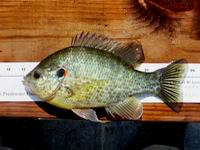
This little fella for example was caught tonight. 12-1/2” @ just barely 1lb. Not sure what was up with him/her but definitely don’t want a pond full of that style fish.
Released 2 others.
13-1/2 @ 1.4lbs 13-3/4 @ 1.6lbs
Little fella is currently chilling in a little saltwater in the frig.
1.5acre LMB, YP, BG, RES, GSH, Seasonal Tilapia I subscribe to Pond Boss Magazine
Fall is a great time to adjust LMB populations. I think this is also a good time to collect RW data.
However, any time you have a good handle that competition is slowing growth OR soon will be slowing growth below the targeted growth goals, that is also a good time to thin a population. A good example is Lake8's pond. He stocked F1s at 1.5" of length in his 3/4 acre pond last year's 4th of July. He culled some in mid spring (IIRC) because he knew he had stocked more than required for optimum growth. He took some out BEFORE growth was limited by competition. Now, not even quite 1.5 years of age, he has fish breaching 3 lbs.
But then he is a victim of success. Can he get another 2.5 lbs of growth out of them next year? Probably not without thinning them (and now is the time to thin them) AND/OR feeding them supplemental forage.
Fall, IMHO is an exceptionally good time to prepare for the following year. The present condition of fish is the cumulative history of the prior 12 months. It's not a predictor of the next 12 months. Things change ... it's like what they say about investments, the past doesn't predict the future. Especially once you have examples of LMB > 18", you need Fall representation of forage in large quantities in the 1"-3" size size ranges. These will be the forage for large fish in the coming year. They need to grow to be optimum food next year. Also, they need to survive the smaller LMB in sufficient quantities to feed larger LMB. So, the point Bill made above about keeping standing weights below what the pond can carry are absolutely essential to support LMB standing weight and growth. Here I am speaking of the standing weights of adult forage fish that are too large for consumption.
Neglecting standing weights of forage fish adults will eventually lower the production of consumable forage below what is needed to sustain the targeted standing weight of LMB and their growth. This is because, a growing standing weight of adults squeezes out the carry available to YOY. The sword is double edged and it's a good idea to use both of them.
Last edited by Bill Cody; 09/18/2509:27 AM. Reason: underline enhancements
It isn't what we don't know that gives us trouble, it's what we know that ain't so - Will Rogers
I really like that statement about anytime you see growth being hindered is the right time to thin the herd; not necessarily a certain season or month.
Subscribe to PB mag ! If you do then you read this article below. I don't post whole articles often but this one is a reminder that things aren't as they seem on first analysis. Cull underperforming fish all year long - don't wait for the problem to manifest. Fix the wheel before it starts squeaking. IMO its better to harvest underperforming LMB before fall (cull in summer). See the article below about harvesting LMB before fall so that the fish to be culled don't use up part of the fall feeding frenzy. That way your better LMB get all of the food rather than letting fish that should be culled use up resources.
The Cutting Edge - Science Review
Fall Frenzy , Winter Soon
Fall followed by Winter is an interesting time at the lake from a biological perspective. Many people think of Fall as a quiet time of year. In reality for many pond creatures Fall is a period of frenzy followed by Winter survival struggles . A good way to view the workings of a pond or for that matter a fish is like that of an engine. An engine that is dependent on sunlight for power and nutrients for growth. Add to that , fish are cold blooded making water temperature a critical factor in all metabolic aspects. Because fish are cold blooded they have optimum growth in warm spring and early summer waters , then growth slows and can stop or even reverse in extremely hot summer temperatures. Then as the water starts to cool in Fall metabolism ramps back up as optimum temperatures occur again. Then metabolism slows when temperatures cool more into Winter and feeding and growth slows substantially and stops. If not enough energy reserves of the right type are stored going into Winter fish may have a difficult time. Lack of adequate food resources is the most common reason for lack of energy reserves in many fisheries. Increasing food intake with very little energy use during the optimum Fall feeding frenzy period is good. More energy acquired and less used equals more energy reserves. Obviously in Fall and Winter the sun’s energy reduces to low levels so the pond and fish engine slows. However, in the optimum temperature Fall lead up to Winter there is a frenzied attempt by fish to secure energy reserves.
Fish energy sources are mostly carbohydrates, fats (lipids), and proteins (muscle). The amount of energy actually obtained and stored is lower than the amount present in the food as some energy is used in catching food and in the fish’s digestion, metabolism, and thermogenesis. Understanding the role of energy as it works through biological seasons of the year is fundamental to management. This was noted in Energy Partitioning in Largemouth Bass under Conditions of Seasonally Fluctuating Prey Availability by S. Marshall Adams R, . B. McLean and J. A. Parrotta, Transactions of the American Fisheries Society 111:549-558, 1982. Here, in order to maintain condition Largemouth Bass maximize caloric growth in the Fall, store visceral fat, and minimize active metabolic demands in preparation for Winter. This study site was in Tennessee which like many freshwater systems of the United States, particularly in temperate areas, have threadfin and gizzard shad as a primary prey source of several predators. These prey species have large fluctuations in abundance due to heavy Winter mortality thus the growth and mortality of a largemouth bass population were indirectly influenced by temperature effects on prey availability. Shads reach optimum size and abundance in early Fall when temperatures are perfect for Largemouth metabolism and the Largemouth need energy reserves, so the feeding frenzy begins. This study notes that growth of females was highest in June following the May peak in consumption (post spawn feeding) and then gradually declined through a summer depression in growth and consumption. Males had high growth levels in the summer and Fall. More importantly both male and female bass added fat during the Fall. Both sexes built up their fat reserves in the Fall when consumption (Fall feeding) was high as evidenced by a Fall increase in the visceral-somatic index (VSI). Decreases in VSI in both sexes during the Winter and early spring probably were due to utilization of stored fat to meet metabolic demands when feeding and prey abundance was low, which is also reported for other fish species.
Obviously, different species of fish differ in their ability to use fat deposits. This in turn affects the temperature range in which different species can grow and survive. For example, Nile tilapia do not store excess lipids in the muscles but rather rely on visceral deposits which it is incapable of using at low temperatures, resulting in high mortalities when water cools. However, many pond species which are capable of using lipids (fat) from muscular and visceral deposits are able to survive much colder temperatures under the same conditions. It is believed that the lipid composition in the fish muscle plays a vital role in the ability of fish to adapt from one temperature to another. Variations in the liver weight of largemouth bass reflect storage of glycogen, fat, and water, which vary with consumption rate. Consumption was high during the late spring and summer, yet the liver-somatic index (LSI) of both sexes declined. This decline may have been related to utilization of energy for reproduction and temperature-induced metabolic demands. Other studies have found this same pattern in the LSI for field-collected bluegill over a year and attributed the low summer LSI to spawning and temperature.
Fall is the period when many species accumulate these fat deposits while adjusting to a lower metabolism. Of course, it depends on a pond’s location and the type of fish involved. Bluegill in one report consumed at higher rates in the Fall like bass and very little food during the Winter in more northern climates. Whereas Yellow perch (a cool water fish) ate much more food than did bluegills during the Winter and did not have to indulge in the Fall feeding frenzy to the same degree.
So, as you watch the Fall changes around you also look for Falling fish as they eat away packing on fat in preparation for Winter.
Energy Partitioning in Largemouth Bass under Conditions of Seasonally Fluctuating Prey Availability
As the title of the reference states the abundance of prey is important.
Notwithstanding any other factors that may drive the use of energy by Largemouth Bass, excess of consumption above what is required to fuel growth (of bones, muscles, scales, fins, organs, etc.) will be stored as lipids for later use. This can happen during any season, but it requires consumption above what is required to fuel growth. In warmer water, LMB require more consumption to fuel growth (because in warmer water their potential for gain is greater) and so it takes more consumption in warmer water to have consumed enough to store lipids.
As temperatures cool, they require less for growth (because in cooler water their potential for gain is lower) and so it is easier to consume the excess they can store as lipids.
This works to the advantage of fish. Winter is a dearth in the production of new prey and so consumable prey diminishes to minimums over winter. Investigating just the maintenance (no winter growth) needs of LMB over the 6 coolest months in Rothberg Ohio, this equated to 30% of the yearly maintenance. They still eat when they can and rely on stored lipids (even muscle if need be) to maintain metabolism during winter.
It isn't what we don't know that gives us trouble, it's what we know that ain't so - Will Rogers
Each species has an optimum growth temp range that roughly corresponds to max feeding. In the south when it's really hot LMB and BG slow down eating, growth and activity as they move above optimum temps nearer their max lethal temp. Fish metabolism is dependent on temp not time of year.
To be sure, Eric, higher temperatures can only support faster growth up to a point. And then there is the temperature where it's so hot that fish die. The highest consumption and gain occur at temperatures just a few degrees below lethal temps.
The best I have seen in the literature was at 30 C (86 F). But to get the better gain, consumption is significantly higher, as are the metabolic costs. LMB can handle 86 F water, but it needs to have enough O2 to support the respiration of metabolism. Their metabolism is running hotter and they need to eat more just to maintain weight. Based on what I have gleaned from the literature, at 86 F, an LMB will lose 1.3% of its body weight daily if it doesn't eat. An LMB must eat 3% of its body weight in BG at that temperature to maintain its weight and it must eat more than that if it is to grow. Many ponds are unable to support this level of consumption being forage limited (or there being too many LMB). I guess what is causing the consumption shortfall depends on the person and their perspective (like whether a glass is half-empty or half-full). In any case, it's the consumption that matters at 86 F (along with good O2, low ammonia, etc.) At 86F, healthy water is necessary and plenty of forage.
The actual peak of metabolism, efficiency, consumption, and growth could occur somewhere between 77F and 86F. I've seen different numbers from different sources. One states optimum is 82F-84F. But 86F seems to be a temperature that LMB can grow remarkably at, much better than 77 degrees provided the water parameters are good. What are your thoughts on this? What is the critical temperature where gain potential is severely impacted? Or is this possibly a range of temperature depending on how poor the water quality is?
My models are lacking conversion parametrization between 77F and 86F. At temps between these nodes parameters determining conversion are interpolated by a fitted function. So, if the peak of consumption and growth occur at temps below 86F, the models underestimate consumption and growth between those two temps. I don't think they miss the mark by a lot, however. I never apply the model above 86F and in ponds with sufficient depth, there are generally depths where the temp is below this temp even in peak of Summer temps. Below, is a plot of FCR and Specific Growth (SGR) versus Temperature under constraints of Satiation Ration and LMB body mass of 1 lb. It may look like FCR varies a lot between 77F and 86F ... but that is an illusion due to the displayed scale. The interpolated variation is less than 0.3 of 1 percent. Conversion at satiation consumption rates is pretty stable between 77F and 86F. Even so the potential for gain is 33% higher at 86F than at 77F ... provided ... the LMB consumes the satiation ration which 37% greater at 86F than at 77F.
(Sorry attachment manager isn't working ... will add chart later)
What to do over 86F? I don't know. As temps increase, it breaks down because the fish are breaking down. There is not a lot out there on greater temps. One, a study at Pine Bluff, tested growth at 35C (95 F). They actually got growth there. But the model incorrectly modeled metabolic costs and consumption. At this stressful temperature, the metabolism is significantly less. They must shut down all but the most essential metabolic processes to maintain life.
Last edited by jpsdad; 09/24/2510:38 AM. Reason: Added additional context and chart
It isn't what we don't know that gives us trouble, it's what we know that ain't so - Will Rogers
In my experience and those opinions of some fishery pros with yellow perch and with a few other fish species such as LMB, I am not sure that the feeding consumption for all ages of fish keeps increasing when temperatures are close to the reported lethal temperatures. Lusk contends that big LMB slow feeding levels when in water that is near the reported lethal range. LMB do grow fast and big in waters with high summer temperatures. However a lot of these warm waters develop thermal stratification during summer. This temperature layering of the water column does allow fish to seek a lower temperature area or depth zone where a temperature comfort level is "better" and less stressful than the warmest water layer at the surfce. IMO when when hunger occurs the big fish makes feeding forays into the warmer water that is less comfortable to satisfy the hunger urge. t has been proposed that strong or complete continual mixing of the water column of smaller water bodies during the hottest part of the summer can be temperature stressful in ponds with the biggest LMB.
When reading the published articles on this feeding temperature topic most all of the research I have found was done using small or young individuals due to convenience for laboratory testing. When using the published literature to formulate universal guidelines, I think one has to pay close attention to the methods used in that specific research work so as to not to conclude all the results presented to be universal gospel for all ages or sizes of that specie or all fish species. Variations of species sizes and ages I think are natural features of all species.
My experiences are younger fish are able to feed and grow very well in warmer temperatures compared to the older or oldest individuals. Those younger fish are more temperature tolerant and remain more active during the high ends of temperature tolerance. This physiological feature allows optimum grow of young fish. This is probably why the term "dog days of summer" and lower catch rates were coined by anglers due to a slow down of catch results by anglers during the hottest part of summer. As many species age toward end of life span, I think these big old individuals do not feed, consume and behave as they once did as younger fish. This could be mainly due to reduced metabolism and or different hormone levels. The food and growth needs of the individual fish can I think change when big old fish are near the end of its life span.
When from long time dealing with all sizes of yellow perch (YP), the younger ones will from visual observation aggressively consume food at most all higher water temperatures compared to the large and largest individuals. YP up to a size or maybe age will actively feed and grow when in water temps are near their reported upper tolerance iimits. Whereas the large and largest individuals cease or significantly slow their active feeding rate when in water near the upper end of the reported active optimum temperatures. I think this feature could also apply to individuals of bass and other freshwater fish species.
Let's consider fish feeding activity at the other end of the temerature spectrum - cold or colder water. It is commonly known that fish (as cold blooded, warm and cool water species) significantly slow down their feeding activity during winter conditions as water temperature drops below 50F, then 40F or 39F. Optimum Metabolism is less thus feeding is less. My premise is why would this similar colder water feeding activity slow down or gradually decrease when big or old fish especially older larger fish with higher biomass are in water temperatures that are increasing toward or approaching above their optimum preferred upper warm water temperatures toward the lethal limits?. I contend too warmth can be uncomfortable or a stressor for that aged near end of life individual. One does not eat normally or the best when it is under some form of stress. When you are feeding pellets to fish and they quit eating there is almost always a stressor that is causing the lack of eating.
Last edited by Bill Cody; 09/24/2501:41 PM.
aka Pond Doctor & Dr. Perca Read Pond Boss Magazine - America's Journal of Pond Management
Lethal temperatures really are only a few degrees warmer than optimal. I can see where water quality affects lethal temperature (lowering it within the range of temperature I mention above). Also, I don't think the water quality in growout ponds is sufficient for LMB at 95F. I would expect high mortality. Experiments in RAS where quality is maintained do not replicate what is going on production ponds. I only mentioned that because of how those LMB reduced metabolic demand in response to that temp. 86F can be lethal under certain conditions but doesn't appear to be lethal when water quality is good.
I respect that you are drawing on experience that supports your thoughts on this matter. Fish bite is slower in warm water, growth slows or becomes negative in warm water. The part I would challenge is that they are consuming less necessarily because they are stressed by temperature (only in cases where the temperature lies within limits that good growth is documented.)
If big fish miss the warmest weeks for growth, they just missed them and can't make their potential weight increment. It's like Lusk says, every day fish doesn't eat enough to grow is a day it didn't grow. The context I remember dealt with formulated feed but it also applies to forage. If they are stressed due to environmental conditions, then it is unavoidable ... I do get that. But to be certain, I think one should first confirm that forage is plentiful enough to support growth at those temperatures.
It isn't what we don't know that gives us trouble, it's what we know that ain't so - Will Rogers
All good points to consider for helping to grow the best fishery for a pond. Note that I edited my post above to include that LMB in thermally stratified water have the ability to seek cooler water during periods of food digestion and then move to warm less optimum temperatuer conditions for their feeding forays. Note the 2nd study noted above used juvenile LMB to obtain the results. More in-depth studies need to be conducted using big old fish that I think have a somewhat different biochemical physiology compared to young fast growing fish. Lots of research still needs to be done. Truth be known, fish physiology probably changes by some degree from when a fish is a youngster, a teenager, middle age and old age,
Last edited by Bill Cody; 09/24/2502:02 PM.
aka Pond Doctor & Dr. Perca Read Pond Boss Magazine - America's Journal of Pond Management
Truth be known, fish physiology probably changes by some degree from when a fish is a youngster, a teenager, middle age and old age,
To be sure, Bill, my metabolism ain't what it used to be!
Quote
More in-depth studies need to be conducted using big old fish
I agree with this so very much!
A good place to start is testing large fish for weight decline for periods of starvation at differing temps. The decline in weight is a function of metabolism and if large fish lose weight at slower rates than smaller fish do at the same temp ... then their metabolism is running slower. That's a very good initial test that at least tells us whether large fish have similar metabolic demand. This same test could detect stress by determining the temperature where metabolism falls off significantly. This would be evidenced by slower weight decline than lower temperatures. A particular interest for me would be understanding if there exist critical DO concentration that varies over a range of temperatures associated with a lower metabolism. If found, then it could serve as a scientific definition of thermo-hypoxic stress.
Additional tests with forage can be conducted to determine consumption at various temps. If the maintenance ration is consistent with the maintenance ration of small adult fish then this would demonstrate that the science I have relied on also applies to large fish. FWIW, the maintenance ration for a 7" LMB is estimated to be around 5.59 lbs BG/annum per pound of body weight for a Tulsa location. A 7" fish is still growing geometrically and so this may be too high for maintenance of adult LMB. LMB seem to merge with a linear path of annual growth once they reach 9 to 10" length. After reaching this milestone LMB tend gain annually at the same increment (eg 1 lb or more a year depending on climate and its internal clock for growth) if they are consuming to satiation. So, in particular, I would be interested in understanding whether there are differences of maintenance ration for 1 lb LMB and larger sizes (as large as could be tested).
I am more interested in characteristic growth, maintenance, and conversion up to no more than 6 years of life. I am totally uninterested in the comings and goings of geriatric LMB. So perhaps I will be able to contribute to our understanding of young to middle aged adults in the future.
It isn't what we don't know that gives us trouble, it's what we know that ain't so - Will Rogers
Imagine this has been covered, but I don't know the answer; is there a simple/easy way to age a bass?
You can age fish by examining their otoliths (ear bones).
Based on reading past discussions it is not easy, but I don't think it is impossible for amateurs.
I think you can search the archives and find some of the discussions. (I also think members have actually performed that work, maybe Bill Cody and Snipe have mentioned it.)
You may even be able to find a good tutorial on Utoob.
P.S. If you do get serious about aging fish in your lake, I have a nice reflected-light microscope that you can borrow if you and I cross paths in our future travels.
Lethal temperatures really are only a few degrees warmer than optimal. I can see where water quality affects lethal temperature (lowering it within the range of temperature I mention above). Also, I don't think the water quality in growout ponds is sufficient for LMB at 95F. I would expect high mortality. Experiments in RAS where quality is maintained do not replicate what is going on production ponds. I only mentioned that because of how those LMB reduced metabolic demand in response to that temp. 86F can be lethal under certain conditions but doesn't appear to be lethal when water quality is good.
I respect that you are drawing on experience that supports your thoughts on this matter. Fish bite is slower in warm water, growth slows or becomes negative in warm water. The part I would challenge is that they are consuming less necessarily because they are stressed by temperature (only in cases where the temperature lies within limits that good growth is documented.)
If big fish miss the warmest weeks for growth, they just missed them and can't make their potential weight increment. It's like Lusk says, every day fish doesn't eat enough to grow is a day it didn't grow. The context I remember dealt with formulated feed but it also applies to forage. If they are stressed due to environmental conditions, then it is unavoidable ... I do get that. But to be certain, I think one should first confirm that forage is plentiful enough to support growth at those temperatures.
This makes sense to me. Around here the ponds with the largest LMB in them are spring fed and have water constantly flowing out of them.
In my experience and those opinions of some fishery pros with yellow perch and with a few other fish species such as LMB, I am not sure that the feeding consumption for all ages of fish keeps increasing when temperatures are close to the reported lethal temperatures. Lusk contends that big LMB slow feeding levels when in water that is near the reported lethal range. .... When reading the published articles ....I think one has to pay close attention to the methods used in that specific research work so as to not to conclude all the results presented to be universal gospel for all ages or sizes of that specie or all fish species.Variations of species sizes and ages I think are natural features of all species.
My experiences are younger fish are able to feed and grow very well in warmer temperatures compared to the older or oldest individuals. Those younger fish are more temperature tolerant and remain more active during the high ends of temperature tolerance. This physiological feature allows optimum grow of young fish. ...
Let's consider fish feeding activity at the other end of the temerature spectrum - cold or colder water. It is commonly known that fish (as cold blooded, warm and cool water species) significantly slow down their feeding activity during winter conditions as water temperature drops below 50F, then 40F or 39F. Optimum Metabolism is less thus feeding is less. My premise is why would this similar colder water feeding activity slow down or gradually decrease when big or old fish especially older larger fish with higher biomass are in water temperatures that are increasing toward or approaching above their optimum preferred upper warm water temperatures toward the lethal limits?. I contend too warmth can be uncomfortable or a stressor for that aged near end of life individual. One does not eat normally or the best when it is under some form of stress. When you are feeding pellets to fish and they quit eating there is almost always a stressor that is causing the lack of eating.
Excellent Bill !!!
All fish eat less when under stress , including less in cold water or very hot water. Being cold blooded they have an optimum temperature range which directly effects metabolism. This is common sense and validated science. It applies to both old and young fish but may affect one more than others. All animals I am aware of have a faster initial growth rate when young and it slows as they age. There are plenty of studies that show growth and feeding slow outside of the normal temp range.
The study in the article I posted was all about LMB feeding and growth in Tenn waters slowing in very hot temps and then when temps fell back into optimum growth range feeding exploded while metabolism steadied (thus adding needed reserves) before feeding and metabolism dramatically slowed as the waters got cold.
Honestly, I saw no mention of Fall Frenzy or the optimum temperature for growth being in the Fall in Tennessee in that paper.
It would be very helpful to actually state what is optimum for temperature and at what temps it falls off. That's all I was trying to get a conversation going around. I thought you might actually be able to share some factual knowledge about that.
Lake8's fish in Tylertown, MS defied your theory and were growing at 6 grams a day in July and August. Rest assured, they ain't going to be doing that in October ... even if there is plenty of forage. I ain't saying they were having a feeding frenzy in July and August, but they were eating as much as their metabolism and forage abundance allowed in the heat of Summer. So I guess it just depends? Or maybe some real science could explain why?
It isn't what we don't know that gives us trouble, it's what we know that ain't so - Will Rogers
"Studies have indicated that LMB can grow in 10–32 ◦ C (50-89.6F) water temperatures, but the thermal referendum is between 26 and 29 C 78.8&84.2F)(Coutant, 1977; Díaz et al., 2007). However, Tidwell et al. (2003) demonstrated that LMB raised at 32 (89.6F) grew aswell as those raised at 26 ◦ C (78.8F) grew just as C, indicating that the thermal referendum may be higher than previously reported. The southern US is home to many state- and privately-owned hatcheries that produce LMB fingerlings. In this region, water temperatures typically are well above the reported thermal referendum of LMB during warmer months. Commercial producers indicate that when water temperatures exceed 29.5 ◦ C(83.3F) , a significant reduction in feed consumption by LMB occurs and that fish lose biomass. Typically, producers feed LMB four times a day until water temperatures exceed 29.5 ◦ ◦ C, after which they feed only once or twice a day as fish do not consume as much. Water temperatures in shallow commercial ponds in Arkansas can exceed 35 C (95F) or higher during the summer , higher than any temperature study conducted to date with LMB. ....
When culturing fish, it is best to know the upper and lower thermal tolerance of the species. It has been established that water temperature directly influences food consumption in fish. As water temperatures increase, food consumption increases until a specific temperature and then will dramatically drop as the temperature approaches the upper thermal tolerance limit of the species (Jobling, 1994). Many studies have examined the effect of constant acclimation temperatures on upper and lower lethal temperatures (Loeb and Wasteneys, 1912; Hathaway, 1927; Doudoroff, 1942; Sumner and Doudoroff, 1938; Fry et al., 1942; Fields et al., 1987). A small number of studies have examined upper thermal tolerances using cycling water temperatures (Brett, 1956; Heath, 1963; Feldmeth et al., 1974; Otto, 1974; Barton, 1985). Even fewer studies have examined the upper thermal tolerance of LMB using cycling temperatures as found in natural habitats. Currie et al. (2004) used a living stream stocked with LMB, cycled the water temperature over 32 days from 20 to 30 ◦ C(68-86F) , and determined the upper thermal tolerance ranged from 38.5 to 39.6 ◦ ◦ C(100-102F) . This upper thermal tolerance range could explain why Tidwell et al. (2003) were able to raise LMB at 32 C (89.6F) successfully. In this study, we chose to raise LMB at 35 Key 1. 80 g fish 2. 105 g fish 4. Discussion When culturing fish, it is best to know the upper and lower thermal tolerance of the species. It has been established that water temperature directly influences food consumption in fish. As water temperatures ◦ C as this is a typical temperature found during the summer in aquaculture ponds in Arkansas and coincides with reports of reduced feeding by commercial producers. Since these are commercial aquaculture ponds, they are typically not very deep and can heat up considerably during the warmer months. The LMB in this study grew slowly and consumed relatively low percentages of their body weight daily. Although the larger-sized fish did grow slightly over the study period, their growth rates were too low to make LMB culture profitable at high temperatures."
Last edited by Bill Cody; 10/01/2504:30 PM. Reason: added F temps
Thank you Eric, especially for the Tidwell reference. I am hoping this reference will help me to piece together the range of temperatures I don't have enough data points for.
Your post supports what I previously thought. The peak of metabolism occurs before 86 F.
The peak of consumption and growth however is not at the preferred temperature but rather very modestly above that temperature. It falls off sharply with additional increments of temperature. The most efficient use of feed is at the temperature that is preferred (something that is line with optimum foraging theory). Under a satiation diet, LMB apparently optimize the use of resources by preferring the most efficient temperature. This is apparently preferred by LMB over growing faster at modestly higher temperature.
I reviewed the Tennessee paper and there were red flags. First, they did not measure growth from the samples but rather these were calculated. To actually measure growth, you have to get two weights. They reported growth in specific units of calories gained per unit weight. Being a daily rate of gain per unit body weight (a specific rate of gain), we could presumably compound the rate over the days of the month and get the growth for a month. But if we do that, we have a two-year-olds gaining from ~ 1 lb on March 1st to 2.64 lbs on November 30th. This modestly exceeds the growth potential of NLMB in that climate and is not consistent with the reported weight of 2.5 year olds.
The measurement of consumption was inferred from stomach contents and the state of decomposition of the consumed prey. I think the consumption estimates were reasonably close to actual (judging from simulating the consumption with my model) but the results from that exercise were very much different from the study in terms of reported growth. In July and August, the model calculated that consumption was insufficient to fully meet metabolic demands and that the weight of fish declined slightly in July and August. The reported consumption (per the model) supported maximum rates of growth in October and modestly lower than maximum in September and November. This is consistent with your analysis. Slow to no growth in the heat of Summer and good growth in the Fall. Our analysis, contrasts with theirs pertaining to growth in the summer months (the red flags I was mentioning). They reported higher growth in July and August than in September, October, and November for female LMB. Given the consumption they reported, the model implies that LMB growth was forage limited. Consumption was most prevalently limited in July and August per the model. That consumption was limited in July and August is something we agree on.
But what we may not be able to agree on is why LMB were not consuming what was required to make their potential for growth. Estimating the water temperature for Watts Bar Reservoir, I am very confident that the reason was sourced to prey availability. I think they would have consumed more if prey had been more abundant. You may, however, think that the LMB were stressed by temperature in July and August leading to lower consumption. If anything, this demonstrates how what we "observe" or "experience" of any particular set of observations can vary depending on perspectives. Truth be told, LMB can have slow growth in July and August as a result of an insufficient supply of prey OR due to the stress of excessive temperatures. Both occur. What we should seek to do is to understand the reason for slow growth for each particular circumstance where slow growth occurs. There are also cases, even in the deep south (for example Lake8's pond) where LMB that are managing July and August temps while setting the standard of maximum growth. It is for these exceptions that we need to be able to discern the cause of slow growth for any arbitrary pond in the heat of summer.
It isn't what we don't know that gives us trouble, it's what we know that ain't so - Will Rogers
There are all varieties of info in many studies on LMB and temps. From looking at them, I can tell you it is very complicated - too complicated for me to draw straight line conclusions. Some of the variables are type of LMB (both male/female and Fla vs Northern), size/age of LMB , location of the fish (north/south/central), water quality/contents, type of water body (pond/lake/resiv/stream), type and amount of food, stress levels and more.
The variation is significant. I don't draw this conclusion "The peak of metabolism occurs before 86 F." I think it depends. In other studies, the peak of consumption is not equal to max metabolism, nor highest growth etc. as to many other conditions are ongoing and effect outcomes. The most that can be said is -- it depends - and that a compilation of studies indicate "the thermal referendum is between 26 and 29 C , 78.8 & 84.2F). Somewhere in that range (individual range per water body), depending, you will see max consumption, growth and metabolism and they likely aren't necessarily at the same temp. I will add that in those temp ranges, whether going up in spring/early summer and on the way down in fall LMB bass will eat like crazy.
This may have been previously mentioned above, but what size/s were the LMB in the studies that were tested for optimum temperature growth? If I read this correctly #2 above was 105 grams this is a 3.7 oz LMB at about 5"-7". . IMO more food consumption and growth will occur for LMB at higher temps when the bass are younger and less than 1 lb and most probably less than 3 lbs? At above 5 - 6 lbs and maybe even 3 - 4lbs for LMB, I think the data will be different and IMO mathematically or biometrically significantly different. It probably All Depends and likely Depends a Lot on the many variables as ewest mentions in his post above. This could be why jpsdad notes that his modeling data does not sometimes agree with growth of bigger LMB in natural waters.
Quote
What we should seek to do is to understand the reason for slow growth for each particular circumstance where slow growth occurs.
Last edited by Bill Cody; 10/02/2504:12 PM.
aka Pond Doctor & Dr. Perca Read Pond Boss Magazine - America's Journal of Pond Management
IMO more food consumption and growth will occur for LMB at higher temps when the bass are younger and less than 1 lb and most probably less than 3 lbs?
More proportionate food consumption and more proportionate gain will occur at satiation rations for smaller LMB than for larger LMB --- At any temperature. It's a strawman argument. Small LMB don't make larger weight increments than large LMB when large LMB are feeding to satiation.
Case in point.
Bill, numerous times you have advised us that LMB in your climate should average/make 1 lbs weight increments each year if there is sufficient forage. Do you no longer believe that? If so, what would it be? 1 lb for 0 year olds, .8 lbs for 1 years olds, .6 lb for 2 year olds, etc? If you still believe that an LMB can make consistent annual weight increments, then the objection above just doesn't apply. To disagree with the model is to disagree with your own advice of what person should expect when his LMB are satiated.
Quote
At above 5 - 6 lbs and maybe even 3 - 4lbs for LMB, I think the data will be different and IMO mathematically or biometrically significantly different.
But why? There is no science upon which you relying. Actually, it's not clear what the objection is. The growth in my model in its present form is constrained as a maximum growth at satiation. It is not constrained by consumption. Consumption is coincident with growth to the balance energy gained in growth. If ACTUAL consumption cannot meet the demand for growth ... then the model will not predict the average of ACTUAL weights gained. IOWs, the growth is actually forage limited and therefore below model estimate of maximum growth.
Quote
This could be why jpsdad notes that his modeling data does not sometimes agree with growth of bigger LMB in natural waters.
The model only estimates maximum average growth on a daily climate adjusted basis. There is one for NLMB and another for F1s. It cannot estimate what will be actually consumed. It doesn't try. It doesn't take into account LMB density and population structure, prey density and production. It can't actually predict what any individual fish is going to grow. That will depend on many environmental factors. BUT, if your fish are feeding at satiation, the model is very effective at predicting a weight about which your sampled females will vary about. It can do this in time. It's value lies in what it can tell you about performance relative to the benchmark. One can use it to look for underlying causes of disagreement. It works just like Lusk says, on days where growth doesn't happen, that growth is lost ... it didn't happen. So in forage limited waters, it would always overestimate growth ... Soooo, I would never use it for that.
To be sure, I am not even sure I have not overly limited the potential for growth. I've used Pond Boss forum member's metrics as a source of data. It could be that the best climate adjusted growth thus far observed for each strain is not the best LMB of each strain can do. I just don't know, but I have so far had good agreement over multiple sample times (independent of season) for multiple ponds and multiple temperature regimes during the first year and one/half post stocking. At 1.5 years most stockings are forage limited and cannot sustain the maximum average growth of the model without significant reduction of the LMB population and/or supplementation of forage.
It is possible that the model is wrong about LMB being able to make consistent annual weight increments. If that is the case, then Bill, we are both wrong because as far as I know we once agreed about that. I find the assumption of consistent annual increments an agreeable assumption because environments that support observed maximum weight increments are consistent with that.
Finally, it is totally irrelevant what the optimum temperature for growth is. It just doesn't matter. Temperature is an environmental variable that governs metabolism. In as much as this is true, temperature constrains growth. One cannot expect more growth than the climate would allow at satiation. Satiation consumption as a proportion of body weight is greater for a smaller LMB and lesser for a large LMB. They are biometrically different in terms of proportionate consumption and proportionate growth. This is baked into the model. It's baked into the idea that LMB are capable making consistent yearly weight increments regardless of age.
It isn't what we don't know that gives us trouble, it's what we know that ain't so - Will Rogers


.gif)