I didn’t really want to read threw a bunch of posts to maybe find an answer Since my eradication in May ‘23 and predator stocking 9/15/23 (almost 2 years) ago We hit 2 milestones in the last week by catching a 2# SMB and 3# LMB. I know there are bigger out there swimming around but will use these numbers because they have actually been caught and weighed. Is this good growth, normal growth or below average for the Midwest? Like most everyone else, we have had drought, flooding and lately sever algae blooms with zero water visibility. Not really ideal growing conditions. Both species in the same 5 acre pond which I’m sure is not suggested or normal either. Also what should the growth rate variance be between the 2 species ?
On another note, I’m very confused by the offspring or 2nd year class that I have been targeting lately. Some of the LMB I’ve been catching have been as small as 2” and as large as 7”. The 2” were obviously born at some point in ‘25 but the 7” fish seem to small for a ‘24 spawn but to big for a ‘25.
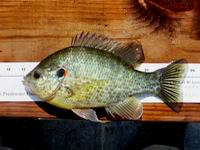
That little LMB does look healthy, so maybe it's a good sign of the presence of forage for fish his size, or he's taking feed.
I think a 2 lb SMB in 2 years is very, very good.
The 3 lb LMB in the picture (if that's the three pounder) looks to have great body shape, and I think that growth is really good, but maybe not off the charts, so to speak.
Excerpt from Robert Crais' "The Monkey's Raincoat:" "She took another microscopic bite of her sandwich, then pushed it away. Maybe she absorbed nutrients from her surroundings."
That little LMB does look healthy, so maybe it's a good sign of the presence of forage for fish his size, or he's taking feed.
I think a 2 lb SMB in 2 years is very, very good.
The 3 lb LMB in the picture (if that's the three pounder) looks to have great body shape, and I think that growth is really good, but maybe not off the charts, so to speak.
Thanks for the response. My main reason for posting was 1. - those 7" bass are throwing me for a loop 2. - The overall growth on my Bass has slowed significantly since this time last year. The SMB have had the growth I was expecting in year 2 The LMB, not so much, as on average they have gone from 14" - 1.75# in year 1 to 15.8" - 2.39# in year 2, I expected the avg. to be quite a bit more.
There really are no set standards for growth. The variance is huge depending on lots of factors. Most times fish are gauged against weight and length (RW and RC) not age. IMO RC relative condition is the most important. The condition of all 3 of those fish are very good. The generally encountered situation is that the first fish stocked (assuming a good stocking plan) grow the best. Every generation after the first encounter more competition for resources thus slowing growth rates. See poor quality pic below.
There are slow growers, average growers and fast growers in every spawn of bass and this occurs in most other fish species. This is due to the genetic variation within the gene pool of the parentage. Very often growth rate of the fastest growers is determined by the amount and right sizes of available food. The individual variation of fish aggressiveness of especially predatory fish IMO exists and has also been reported and concluded to occur in the literature. Fastest growers usually have a more aggressive “personality” compared to those slow and average growers. It is those fish that are first caught by anglers. When one buys most all species of fish especially sport fish those fish as a group raised in a pond have been graded for a more uniform size; small, medium and large. Depending on what was purchased from whom and when does have an impact on the growth potential of each size group of fish. In the Fall those fish are sold as 2”-3” 4-6” and 6”+; all the same age.
It is common to see the growth slow down of LMB after they reach 3-4 lbs. Causes are often too many LMB were stocked based on the type and amount of forage and its production ability that exists in the pond. LMB, as they grow and then reproduce, the growing population will quickly overeat the new forage base and growth slows down for pond years 2 and 3+ years as noted by ewest above. This is often due to competition of stocker siblings and new offspring; all together,,, overeating the forage base. Forage species present cannot keep up the densities needed to feed all the increasing poundages of fish. Having a constant overabundance food or having fewer predators fuels fast fish growth. As noted so far, your fish growth appears good for a Kansas climate. If forage base is the problem, growth the next year or two could further slow down or be slower than it was in pond year 2.
It is hard for someone here to give you more specific answers when the entire pond stocking was not detailed in your post for analysis.
LMB can grow to 7”-12” and maybe even 14” at just 1 yr old with ideal conditions of habitat, overabundant foods, good genetic quality and 24/7 high water quality. See this for examples of excellent LMB growth from our Common Pond Q&A archives:
Good LMB growth after 15” long is 1 lb per year and exceptional growth is 2 lb/yr. As noted depending on numerous conditions.
Once LMB grow to 15” AND they are getting plenty of food,,, they can grow around 1 lb or more per yr. Noted below are some standard weights of LMB. The length weights will give you an idea of how well your LMB are growing since you know the current ages of the original stockers. In good conditions your bass should be growing 1 lb per year and have the listed weights . Currently your LMB growth is very good as 2 yr old LMB for being 3 lb, ave growth weight of 1.5 lb per year. Then after your bass get to 3 to 4lb per fish growth rates do tend to slow down mostly due to lack of adequate forages. Consider your pond management a success if you can grow a few 7 lb LMB after 8 yrs in your pond as one pound of growth per year in a KS pond. Going forward your management challenge will be to keep them growing at 1 lb or more per year that most importantly requires abundant proper sized forages. As LMB grow they "prefer" as in optimal foraging theory to eat larger and larger foods. Increased food benefit from each captured meal. I have now caught two 14" LMB each with bird legs in its throat. Standard weights of LMB - note the weight increases around 1 lb per year for each 1”+ length increment. Yr 1 12.4”=1lb, 15”=2lb, 17.5” =3lb, 19” =4lb, 20” =5lb, 21.5” =6lb, 22.7” =7lbs.
However - based on the info you provided IMO the 7” bass was from the 2024 year class. For a new Kansas 2 yr old pond your current fish look to have good body condition (RW) so they are appear to be getting enough food at this point in year 2 for very good growth so far Your challenge IMO will be to keep them growing at the current rate.
You ask – “Also what should the growth rate variance be between the LMB and SMB?” From what I know about smallies their average good growth lags behind that of LMB. Often this is due to SMB often not growing optimally the first year where they can range from 3”upto12” long. Very often at 1 yr they are usually sold as 3”-4” long fish indicating to me as slowed crowded conditions. SMB growth at 1 yr can be a fast growing smallie and in optimum conditions it can can grow 1 lb per year similar to a good growing LMB. A 3 lb, a SMB (17.5” SW) with good growth is 3 to 5 years old and you had a few 2 yr old LMB that weighed 3 lb. Often a 4 lb smallie at 19” could be 5 to 9 yrs old based an average reported growth rates and on food quality and availability. Well fed SMB with optimum foods could be 4 lb in 4 years in IDEAL conditions. A well fed fast growing LMB could be 4 lbs and 19” at 3 years old. So often it takes the SMB longer to reach 4 lbs compared to a well or average fed LMB.
Did I address all your questions?
Last edited by Bill Cody; 08/31/2507:58 PM.
aka Pond Doctor & Dr. Perca Read Pond Boss Magazine - America's Journal of Pond Management
That little LMB does look healthy, so maybe it's a good sign of the presence of forage for fish his size, or he's taking feed.
I think a 2 lb SMB in 2 years is very, very good.
The 3 lb LMB in the picture (if that's the three pounder) looks to have great body shape, and I think that growth is really good, but maybe not off the charts, so to speak.
Thanks for the response. My main reason for posting was 1. - those 7" bass are throwing me for a loop 2. - The overall growth on my Bass has slowed significantly since this time last year. The SMB have had the growth I was expecting in year 2 The LMB, not so much, as on average they have gone from 14" - 1.75# in year 1 to 15.8" - 2.39# in year 2, I expected the avg. to be quite a bit more.
LMB need fish that are 1/4-1/3 their body length. Look at the forage fish for the bigger bass. You might be running out of 3.5"-5.5" fish to get them to grow bigger than 14". If the forage fish are smaller, the bass are expending more calories catching smaller fish. Also, if there isn't cover for them to hang out and wait for the correct size fish to swim past and nab it, they are burning calories that way too.
Cody note: yes - esshup has info correct. When the LMB growth slows down lack of proper sized forage fish is the problem or you have too many predators or both things as problems slowing the LMB growth rate. Lusk says once LMB hig 16" long they need a differernt type and size of forage fish to keep them growing well.
Last edited by Bill Cody; 08/29/2510:07 AM. Reason: typo - made a note
Im in southwest mi.(little shorter growing season). I can speak a little too SMB. Ive been growing them since 2007 and started raising fry in 2014. In the last 3 seasons i have been documenting some of my findings. After spawn i move fry to a pond that has only fathead minnows. This usually happens in the last week in may. Before i can get them trainned on feed, which takes about a week. I notice some larger size fry. This i think is because they eat the smaller fry in the bunch while the smaller are focusing on smaller plankton etc. That 1st few weeks sets the growth stage. Keep in mind these fry are from the same spawn timing. Growing seasons can be very different. Early spawn bigger fish by the end of first season. Example, spawn this yr was 2 weeks later than last yr. 3 mths growth this yr shows fry from 2" to 6" with the majority in the 4" range. Last season were averaging 5" at 3 mths. And 2.5" to 8". Jason d. Your 7" fish could have just been aggresive or feeding on siblings. The runts get pushed up into shallower water were the food may be smaller. The fry that i saved from last yr are now 15 months old. Smaller size around 8" up to 12" average being around 10" fat and healthy! Also note: LMB will dominate the SMB. They will push the smb into deeper water and take over the shallow water for spawning and feeding. Most of my smb nest are in 2ft of water because there are no lmb. They thrive here in water from about 74° to 82° feeding aggresively.
Ron, I believe you are correct on all these smaller sizes are from this year, if those 7” fish were from ‘24, some of them would have been caught before July 23rd 2025, No school of baby LMB is going to elude me for almost a full year then all the sudden get caught by the dozens. There has been no sign of SMB reproduction in my pond but obviously the LMB have. I also have 2 areas in my pond that are rocked from waters edge out about 25’, from 0 to 4’ of water.
Hopefully you also had a SMB spawn this year, and the SMB just need to get a bit bigger and you will start catching them too.
Is your water generally pretty clear in the spring? If so, there is a chance your smallies might want to spawn a bit deeper than 4 feet.
OTOH, with all of the big Kansas rains this year did you have a bunch of silt wash in during your expected SMB spawn? I think with a couple of weeks of muddy water it is possible to lose your entire spawning class for the year.
Looking forward to more good fishing reports from your pond!
The rains and muddy water didn’t come in until June 7th so the spawn would have already taken place. With that, I feel like I lost a lot of the growing season, my LMB growth was pretty stagnant up until early August. I was getting very concerned that something was wrong. They have started getting larger here as of late. I fish often and record every predator fish caught. There is a big gap from 1.75# to 2.25#, I have very few LMB recorded between those 2 weights Now every LMB I catch is either over 2.25# or this years hatch (under 8”) I’ve also had some sort of Algae bloom going since the first of July and it just won’t go away
Numerous fishery studies have shown that SMB will not produce a succssful spawn that recruits new SMB into a "pond" with reproducing LMB. In larger water bodies SMB can often but not always recruit new SMB. In a pond having SMB with LMB, for new smallies for the long term, they have to supplimentally periodically stocked usually as larger sized SMB stockers. Jason if you ever get SMB to recruit new young smallies, we definately want to hear about it because you are definately doing something VERY right and different.
Last edited by Bill Cody; 09/11/2502:10 PM.
aka Pond Doctor & Dr. Perca Read Pond Boss Magazine - America's Journal of Pond Management
Bill, I have not seen or caught any SMB YOY. I really did not think they would reproduce but if they do then great. Was hoping maybe with the light stocking of both SMB and LMB I would get 1 year reproduction. I even added a 150ft. stretch of gravel from the shore out 30ft. on a slope hoping they may use it. If I don't that is ok. I only stocked 50 as a bonus fish, I totally expected them to be gone in 6-7 years anyway.
That little LMB does look healthy, so maybe it's a good sign of the presence of forage for fish his size, or he's taking feed.
I think a 2 lb SMB in 2 years is very, very good.
The 3 lb LMB in the picture (if that's the three pounder) looks to have great body shape, and I think that growth is really good, but maybe not off the charts, so to speak.
Thanks for the response. My main reason for posting was 1. - those 7" bass are throwing me for a loop 2. - The overall growth on my Bass has slowed significantly since this time last year. The SMB have had the growth I was expecting in year 2 The LMB, not so much, as on average they have gone from 14" - 1.75# in year 1 to 15.8" - 2.39# in year 2, I expected the avg. to be quite a bit more.
Make a couple of these and put them in 24" to 36" deep water where you can observe them. Those are #2's or railroad ballast sized stones on that pallet. SMB spawn on them, I have't seen a LMB use it. If you do see a LMB on it, catch it - it will most likely be a male and taking it out of the pond will be a good thing.


.gif)

![[Linked Image from lh6.ggpht.com]](https://lh6.ggpht.com/_6_-SgakQ9co/S3Nx1jGAJWI/AAAAAAAABKU/DJIy4ZnF1t0/s800/I_subscribe.jpg)
![[Linked Image from i.imgur.com]](https://i.imgur.com/aPU5zzj.jpeg)





