|
Forums36
Topics42,112
Posts571,656
Members19,114
| |
Most Online13,012
Jun 7th, 2026
|
|
|
1 members (Dave Davidson1),
2,086
guests, and
44
robots. |
|
Key:
Admin,
Global Mod,
Mod
|
|
|
|
Joined: Jan 2024
Posts: 122 Likes: 8
|
|
Joined: Jan 2024
Posts: 122 Likes: 8 |
So my pond just filled up about half way with the latest rounds of rains we just got. This got me thinking about when I should stock my forage fish. How long should I wait once the pond is full before adding fat head minnows and BG? Also can I start tossing them in now before the pond is full? Our rain falls off mid June so if this pond isn't full by then then it likely won't fill until the fall. Seems like my forage fish can be doing a lot of spawning this summer that I don't want to miss out on. Thanks,
David
|
|
|
|
|
Joined: Nov 2007
Posts: 4,914 Likes: 1002
Lunker
|
|
Lunker
Joined: Nov 2007
Posts: 4,914 Likes: 1002 |
I think we had a recent thread on this exact same topic, but I can't remember what keywords would be best to search.
I would start your FHMs right now. They certainly won't mind lots of areas with shallow water.
I think(?) some of our experts also wanted BG early - provided your partially-filled pond had decent water clarity. Putting them in muddy water puts them at some risk, and they won't gain much weight or spawn much anyway.
Can you list your fish species that will be in your finished pond? That will help the actual experts give you some more solid advice on the timing.
If LMB are your top predator, are you planning on putting them in this fall, or next spring? Or is it dependent on getting enough rain this spring before you get the usual evaporative losses during the hottest parts of a Texas summer?
|
|
|
|
|
Joined: Jan 2024
Posts: 122 Likes: 8
|
|
Joined: Jan 2024
Posts: 122 Likes: 8 |
I figured somebody already asked and I tried using the search feature, but you end up getting a lot of irrelevant results.
Right now the current idea is to have LMB, CNBG, Regular BG, Shell crackers, FHM, bullfrog tadpoles and crawfish. I was also debating on golden shiners but not super sure about those. I'm going to probably hold off on bass and the red ears until the pond is full as I have heard that a large influx of rain water can lead to fish kills. Over all, the baitfish are pretty cheap so if I lose some or all it's not the end of the world, plus my neighbor is going to let me fish out the existing bluegill from his pond for free. All I was looking to purchase at the moment were a few CNBG and fathead minnows (plus the tadpoles but I'm not too worried about them). I know from experience that a few bluegill can turn into a heck of a lot of bluegill when there aren't any predators around. When the pond is full or when I'm ready to stock my bass, I'll likely purchase additional baitfish at the same time. Just figured I would like to get the baitfish going sooner rather than later.
|
|
|
|
|
Joined: Feb 2011
Posts: 5,574 Likes: 402
Moderator
|
|
Moderator
Joined: Feb 2011
Posts: 5,574 Likes: 402 |
When I drain and then refill my hatchery pond, I start over with the water, not the fish. Texas water can be funky so I add lime and gypsum first, then go from there. Lime balances the PH and helps alkalinity. Gypsum adds the hardness fry need, and may also add clearness to the water. Getting the water numbers right will help all successful spawns.
AL
|
|
2 members like this:
FishinRod, jpsdad |
|
|
|
|
Joined: Feb 2025
Posts: 132 Likes: 42
|
|
Joined: Feb 2025
Posts: 132 Likes: 42 |
We gave our bluegill, and shell crackers a 6 month head start (April 2024). Started our feeding program immediately to help supplement them. One piece of advice here is to be patient with the feeder. The fish are small in the beginning and it takes them some acclimation time to get adjusted to the feed. Once they do it's certainly a sight to see. Don't be surprised if this takes multiple weeks.
(October 2024) we added F1 tiger bass from the Montgomery, Alabama hatchery and additional fat head minnows for an added boost.
Very happy with our decision to wait 6 months; our fish surveyed(Spring 2025) are very healthy. My best approximation is our bluegill to bass ratio is around 20 to 1 right now perhaps a little higher than that. There are visibly zero fat head minnows left. As spawning takes place, it's going to be important for us to supplement & cull to keep that abundant bluegill to bass ratio high.
Ephesians 2:10
|
|
1 member likes this:
FishinRod |
|
|
|
|
Joined: Apr 2002
Posts: 15,993 Likes: 1496
Moderator
Ambassador
Field Correspondent Lunker
|
|
Moderator
Ambassador
Field Correspondent Lunker
Joined: Apr 2002
Posts: 15,993 Likes: 1496 |
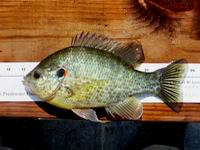
Hint: If you are angling for the stocker breeder size BG do some GOOD homework to be able to recognize male and female BG. You could erronously bias the 50:50 M-F ratio by catching and stocking more numbers of one gender. ewest here has presented several posts showing pictures from my PBoss articles of growing Behemoth BG for the differences between M&F BG. Hopefully some member here will provide a link to that information. Here is one example of ewests PB forum post provided by Google, This entire thread is excellent info for sex determination of BG. Note the noted regional, water clarity and seasonal issues for the differences of determining gender of BG. https://forums.pondboss.com/ubbthreads.php?ubb=showflat&Number=422568For best success for amateurs or novices recognizing M & F BG it is best done 2-3 weeks prespawn or during the main spawning season when male and female dimorphic features are most prominent.
Last edited by Bill Cody; 05/30/25 09:50 AM.
aka Pond Doctor & Dr. Perca Read Pond Boss Magazine -
America's Journal of Pond Management
|
|
2 members like this:
Learninboutfish, FishinRod |
|
|
|
|
Joined: Jan 2024
Posts: 122 Likes: 8
|
|
Joined: Jan 2024
Posts: 122 Likes: 8 |
I just ordered a water test kit and we just got another rain storm last night. All of that rain is falling on saturated ground, so there's a good chance the pond will be with in 80% full by the end of this rain event. I'm probably going to wait for the water to clear up before taking my test sample, so 3-4 days after the last rain. Assuming the water test comes back normal then I'm guessing there really isn't any reason to pause on stocking the fish?
Totally separate question that kind of spun up here, is it important to have equal numbers of male and female bluegill? I totally understand that equal numbers is preferred because if we toss in 20 of them and only 5 are females then I essentially only have 5 fish that can spawn, however is there some sort of negative outcome if the balance is off? The owner of the pond that we are pulling these out of has his land for sale, so he really doesn't care at all what we pull out so I was just going to pull out whatever we can catch and then toss them in our pond.
|
|
|
|
|
Joined: Feb 2025
Posts: 132 Likes: 42
|
|
Joined: Feb 2025
Posts: 132 Likes: 42 |
We waited a few weeks after the initial fill up. I wanted the sediment to settle down. Once I noticed other aquatic life I felt good about adding the baby fish.
The acclimation process of adding a small amount of pond water to the fish container over the course of 30 minutes has always worked well for me; no casualties.
Ephesians 2:10
|
|
|
|
|
Joined: Dec 2008
Posts: 4,856 Likes: 23
Moderator Ambassador Field Correspondent  Lunker
|
|
Moderator Ambassador Field Correspondent Lunker
Joined: Dec 2008
Posts: 4,856 Likes: 23 |
Can stock FHMs in a puddle so no worries on starting them off too early.
RES (shellcrackers) can be stocked early too. No worries on them overpopulating.
Frogs will find their own way, as will turtles. No need to stock them in my opinion.
Crawdads, I'd wait on these until predators are established. In my acre puddle, I stocked a bunch early, and they've wrecked all my attempts at vegetation. Even with a decent amount of rocky structure.
Can't advise on CNBG vs. regular BG. Too cold up here!
BG in general, wait a little bit for the FHMs to really get going, then get them in there. Not that the BGs will pound the FHMs, but just allowing that extra forage to flourish. If that makes sense.
LMB, it's awesome if you're patient. Wait until the pond is just teaming with forage. They'll probably be difficult to catch for a while with their bellies constantly full, but the "end" results will be nice.
|
|
|
|
|
Joined: Apr 2002
Posts: 15,993 Likes: 1496
Moderator
Ambassador
Field Correspondent Lunker
|
|
Moderator
Ambassador
Field Correspondent Lunker
Joined: Apr 2002
Posts: 15,993 Likes: 1496 |
is it important to have equal numbers of male and female bluegill? This is a matter of opinion and the ratio can be debated To my knowledge a male will allow multiple females to lay eggs in the nest. In one of your posts I recall you said for this forage pond you planned to stock 50 BG. I initially incorrectly assumed you were getting them from a fishfarm. Not true now. If your BG stock goal is around 50 adults as best you can determine, I would shew the ratio to more females compared to males. Read through the information in the link provided previously above. If it were my forage pond, I would chose the biggest best looking males from the total that you catch as maybe 10 to 15 males and the rest of the 50 being females (1male to every 2 females). . The 8" female BG when healthy can have around 30,000 eggs and a 6.5"-7" female can have 13,000-16,000 eggs.BG here on the PB forum are said to have a rolling spawn where females can produce a few to several spawns per season depending on geographic location. . A 5"+ female BG in TX was found to produce 80.000 eggs during the entire summer spawning season. Thus 10-16 good quality 6"-8" females could produce 100,000+ fry. How many that survive is dependant of numerous factors in the pond such as insect or hydra species presence and their ability of fish fry predation, pond fertility, plankton production and proper sized zooplankton availability as foods and who knows what other numerous factors that limit the survival of BG fry to 1+" long. I very much doubt that the forage pond co-habitants of FHM will eat very few if any BG early hatchling fry. IMO Insect predation will consume many more early fry aka pro lavae) compared to the fry consumption by adult FHM. Try and get some close good side pictures of the BG you catch from the donar pond and keep up up dated on the progress of your forage pond. We are keenly interested in your experiences with this project. .
Last edited by Bill Cody; 05/30/25 07:50 PM.
aka Pond Doctor & Dr. Perca Read Pond Boss Magazine -
America's Journal of Pond Management
|
|
1 member likes this:
jpsdad |
|
|
|
|
Joined: Apr 2002
Posts: 15,993 Likes: 1496
Moderator
Ambassador
Field Correspondent Lunker
|
|
Moderator
Ambassador
Field Correspondent Lunker
Joined: Apr 2002
Posts: 15,993 Likes: 1496 |
Last edited by Bill Cody; 06/15/25 06:55 PM.
aka Pond Doctor & Dr. Perca Read Pond Boss Magazine -
America's Journal of Pond Management
|
|
|
|
|
Joined: Jan 2006
Posts: 16,555 Likes: 411
Moderator Lunker
|
|
Moderator Lunker
Joined: Jan 2006
Posts: 16,555 Likes: 411 |
Fire is Hot says it best. Check the water first; PH and Alkilinity.. My next step is getting a couple dozen minnows and putting them in a bucket of the water. If they make it 24 hours, I figure good to go.
It's not about the fish. It's about the pond. Take care of the pond and the fish will be fine. PB subscriber since before it was in color.
Without a sense of urgency, Nothing ever gets done.
Boy, if I say "sic em", you'd better look for something to bite. Sam Shelley Rancher and Farmer Muleshoe Texas 1892-1985 RIP Grandpa
|
|
|
|
|
Joined: Mar 2005
Posts: 22,032 Likes: 483
Moderator Hall of Fame 2014 Lunker
|
|
Moderator Hall of Fame 2014 Lunker
Joined: Mar 2005
Posts: 22,032 Likes: 483 |
FH asap
BG CNBG and RES 2 mths later
LMB a year from now assuming good forage numbers.
|
|
|
Moderated by Bill Cody, Bruce Condello, catmandoo, Chris Steelman, Dave Davidson1, esshup, ewest, FireIsHot, Omaha, Sunil, teehjaeh57 |
|


.gif)