Hmm.....looking forward to providing to loose test data on woverwinter growth rates. I don't know if the .22mm per day is high, dead on, or low. I would assume they still grow in the winter but at a decreased rate for sure.
1.5acre LMB, YP, BG, RES, GSH, Seasonal Tilapia I subscribe to Pond Boss Magazine
Very little , if any (many lose weight) over-winter growth in LMB or BG (warm water fish) in northern states. Energy in - energy used (metabolic statis) = growth or loss.
Boon, the model computes only weight which is highly predictable from modeled consumption. What isn't as predictable is the length at weight which is highly variable. It all depends (it would seem) on the individual fish which tend to vary relative to peers. Unfortunately, I am not able to answer the question because of this variability of Length at Weight among individuals. In addition to chubby and short vs thin and long at weight, recent individual consumption can make a big difference in RW. An LMB can only grow so fast in length but recent consumption that exceeds what is needed to support that length increment can substantially boost RW even if only temporarily.
I am kind of confused at this thought, maybe you can shed a little more light on what you are trying to convey.
From my personal experience, also in Kansas with a much higher sampling rate, probably closer to 50% Weight is highly unpredictable. My LMB currently vary from 1.3# to 2.1#, Large spread among 13 month old fish. The length (even though a large range) is pretty predictable vs the weight of fish. A 12" fish in my pond is right around 1.3# where as a 15" fish is closer to 2.1# If I catch a fish and weigh it, I could guess within a 1/4" of how long it is The guestiment has been off a few times, but its pretty close. Maybe I'm reading this wrong but it sounds backwards
Very little , if any (many lose weight) over-winter growth in LMB or BG (warm water fish) in northern states. Energy in - energy used (metabolic statis) = growth or loss.
I'm sure this has been a topic somewhere in the past but lets bring it back.
LMB fingerlings stocked in late September VS, stocked in April/May. First years growth A fall stocked fish should have very little growth coming into the spring and get its growth the following summer, whereas a Spring stocked fish should grow like crazy the first 6 months and slow down over the Winter. After 12 months, does one growth plan have an advantage over the other or is it a wash ?
Just to muddy things up, a LMB stocked in September would still have at least a month of feeding and growth left in the north, and more time in the south.
If the LMB was on feed, you'd get even more growth over those 4-10 or 12 weeks.
Excerpt from Robert Crais' "The Monkey's Raincoat:" "She took another microscopic bite of her sandwich, then pushed it away. Maybe she absorbed nutrients from her surroundings."
After 12 months, does one growth plan have an advantage over the other or is it a wash ?
Firstly as you are seeing from growth rates in your new bass population, siblings from a hatching or stocking have different growth rates if all have/had the same access to the same amount of food. Some are genetic runts and some are the fastest growers (shooters or jumpers); all others are in between. State record fish were at the top of the Shooter category. Genetic aggressiveness and genetic growth are big influencers, both are individually variable and due to individual specificity of the DNA. It is known as natural genetic variability. There is still a lot to learn about this science.
As far as your question about length weight growth ability, IMO this concept might not have been explained well enough for all to fully understand. I will try and get the originator of that concept to come back and more fully explain or simplify the concept. I will email the forum member to help us with explaining or simplifying he concept. IMO it probably has to do again with genetics of the individual fish. Some have the tendency or propensity to be more tubby whereas some body growth trends toward long and lanky even if they both receive the same amount of food. I think individual physiology of the fish determines how the foods deposited and growth is distributed. IMO all are not exactly DNA equal; similar to humans, dogs, birds and fish. Example - why did some die from covid and some did not even realize they had it, minor or no symptoms? I think most of it is in the DNA.
Last edited by Bill Cody; 10/24/2402:26 PM.
aka Pond Doctor & Dr. Perca Read Pond Boss Magazine - America's Journal of Pond Management
Please allow me to explain. I did not mean that the weight of an individual fish is predictable. It is not possible to predict how much it will eat. But lets say I can know EXACTLY what each fish is going to eat each day because I give each fish a weighed ration in isolation of competitors. Each fish will gain similarly with small variation if the weights of food they consumed are the same. Now the lengths will be a different story. Some will be shorter while others longer even though they weigh nearly the same. I can predict the gain from a known ration but I cannot predict how long any particular fish is going to be. But for fish allowed to eat fixed and equal rations, the shorter fish will have the highest RW and vice versa. I just cannot predict the length of a fish from a known ration. I can estimate length only by assuming RW.
Take another look at Boon's growth chart that I posted. In actuality, the model (the middle curve) only explains around 89% of the variation of weight. Another way of saying that? The model does not predict the weight of any particular fish. I would go further to say that it is not intended to. All the model is trying to do is model the average weight through time. Some fish will exceed the weight modeled ... while others will not. In Boon's case, most fish fall within 20% of the model. So if the model predicts a weight of 1 lb at a particular time, then one can expect samples ranging from 0.80 lbs to 1.20 lbs if the model accurately predicts the average weight of the population. Boon's data is less variable than others I have seen. In part, I think that may be due to all fish consuming as much as needed to be satiated. IMHO, satiation (a proportion of body weight) is governed by how much the internal genetics is influencing growth. If that influence is to grow faster than peers, then that fish will require more consumption to be satiated.
I like the way Bill described it and I like to imagine all the female LMB as beautiful girls. Some are pleasingly plump barmaid types while others are thin supermodel types. But at the same weight and same age, I consider them equal fish. After all, for a state record aren't they both equal fish? IOWs the barmaid will not be docked for being shorter and the supermodel will not be docked for having lower RW.
So there is also the question of whether the model can accurately predict the average weight of a population. To do so, the model has to understand how much the fish are eating. This can be highly variable because it depends on forage availability. So of particular interest to me is this question. "What are the maximum rates of consumption when fish have an unlimited availability of forage (can eat all they want to satiation)." If this can be known, then we can also know by comparison with the model whether fish are growing at their full potential. In this case, in their initial year of life. IMHO, Boon's fish are very close to that maximum. I can't say for sure, but it provides a baseline.
To test the model in a different location I tried to use Lake8's lone sample in Tylertown, MS. (I put his link below). The model predicts with his climate a weight of .254 lbs on 9/14/24 (stocked 07/3/24). At consumption 5% over model the weight on the same date is .289 lbs. But Lake8 only provides a length. He estimates 8" but when I do pixel lengths on the photo the fish is 8.8" We have no group of samples to establish an average sample weight so I don't know whether the sample is reflective of the population, an overachiever, or an underachiever. If an overachiever, the model is pretty close but if an underachiever ... it misses the mark by a long way. The only way to make a comparison of model length is to assume an RW. At .289 lbs and 100 RW the fish would estimate at 8.65" which isn't far from the tree (his actual length measurement according to the photograph pixels) but I doubt that his fish is only 100 RW. They are not the same genetics as Boon's. Lake8's LMB are Tiger F1s and this could explain why the model built on Boon's Northern LMB is under estimating growth in Lake8's pond. There are other possible explanations as well. Warmer than normal in Mississippi while cooler than normal near KC, among possible others
I have a confession to make. I was really thinking I was going to see something in the 11-12" when I sampled last. It was to damn nice outside this afternoon and I "had to" go to the farm to test the feeder. It doesn't seem like it's putting out the right amount of food, and I just added the Optimal Winter (sinking) to it. Had the allen wrenches to adjust the plate on me but couldn't find the screwdriver that I "always" have in the truck for the life of me.
I did happen to have the fishing rod though and decided to still make use of the time to see if I could find that elusive 11-12" fish I had hoped to see.
Caught a few BG, one TP, and two additional LMB before calling it.
First up, a shorty - 9.25" .44lb @ 119% RW
Second up one of the standard LMB in the pond - 10.43" .64lb @ 115%RW
Both looked healthy and it seems as though fish growth stalled in the 10" range.
Love the info you guys are laying out and the questions that are being asked.
1.5acre LMB, YP, BG, RES, GSH, Seasonal Tilapia I subscribe to Pond Boss Magazine
jps wrote: " Each fish will gain similarly with small variation if the weights of food they consumed are the same."
That's a massive assumption.
Excerpt from Robert Crais' "The Monkey's Raincoat:" "She took another microscopic bite of her sandwich, then pushed it away. Maybe she absorbed nutrients from her surroundings."
Boondog, the 'shoulder' or back-hump on that LMB is huge. That fish is going to get big.
Excerpt from Robert Crais' "The Monkey's Raincoat:" "She took another microscopic bite of her sandwich, then pushed it away. Maybe she absorbed nutrients from her surroundings."
I was starting to get curious if they were going to go trick or treating as BG, or perhaps this is the LMB version of BeetleJuice. It's the second fish in the pond that I've seen with a similar shape.
Guessing it's easier and faster to convert food/forage to flesh than it is to bones and cartilage thus what appears to be a bigger body on a smaller head. I do prefer this shape than big head and no body though...
Spring 2025 will be exciting on data for what the fish have done over the winter.
1.5acre LMB, YP, BG, RES, GSH, Seasonal Tilapia I subscribe to Pond Boss Magazine
Kind of the opposite of Chris Farley in "Tommy Boy" when he's the.....Fat Guy in Little Coat.....
Excerpt from Robert Crais' "The Monkey's Raincoat:" "She took another microscopic bite of her sandwich, then pushed it away. Maybe she absorbed nutrients from her surroundings."
jps wrote: " Each fish will gain similarly with small variation if the weights of food they consumed are the same."
That's a massive assumption.
No. It's true. There is plenty out there on conversion of foods. I consider a R^2 greater than .90 small variation.
Consider a 12.65" LMB. Its RW can range from 70 to 180. Another way of saying the same thing? The weight at that length can range from 0.70 lbs to 1.8 lbs. So you can't predict length from a weight without high variation. The R^2 of length-weight relationships is much lower than the energetics relationships of consumption and gain.
It isn't what we don't know that gives us trouble, it's what we know that ain't so - Will Rogers
Boon, what are your thoughts on the 9.27.24 supplement in terms of the lengths of GSH supplemented. I know you said they were to average 3". From this I took that they ranged from say 2.5" to 3.5". To the best of your recollection, was this the case? Did you happen to measure a group of them?
It isn't what we don't know that gives us trouble, it's what we know that ain't so - Will Rogers
"It is not possible to predict how much it will eat."
-I agree with this statement.
"But lets say I can know EXACTLY what each fish is going to eat each day because I give each fish a weighed ration in isolation of competitors."
-I'm not sure how you get to this statement from the previous sentence unless you are playing in the purely theoretical realm; both ends of the sentence don't occur in the real world. The end of the sentence about 'weighed ration in isolation...' can be attempted, but there is no way to know that any given fish will consume the entire ration which to me makes it a very shaky assumption.
" Its RW can range from 70 to 180. Another way of saying the same thing? The weight at that length can range from 0.70 lbs to 1.8 lbs."
-To me, this seems to contradict your idea that you can predict weight as opposed to length. The stated variation from 0.70 lbs to 1.8 lbs. is a huge variation.
Anyways, as I've mentioned before, to me it seems like a lot of stacked assumptions which leads me to think there's not much usable information from the exercise.
Of course, others may find it useful
Excerpt from Robert Crais' "The Monkey's Raincoat:" "She took another microscopic bite of her sandwich, then pushed it away. Maybe she absorbed nutrients from her surroundings."
"It is not possible to predict how much it will eat."
-I agree with this statement.
"But lets say I can know EXACTLY what each fish is going to eat each day because I give each fish a weighed ration in isolation of competitors."
-I'm not sure how you get to this statement from the previous sentence unless you are playing in the purely theoretical realm;
No not so. If an experiment is performed on fish in isolation where only that fish can eat its ration the conversion properties can be determined. Experiments just like this have been performed many times over. To be sure, I know it won't help you in any way. But yes, if consumption is controlled then conversion can be determined. AND the variation for a group of fish is small and the functions resulting from the analysis practical and effective.
It isn't what we don't know that gives us trouble, it's what we know that ain't so - Will Rogers
I didn't measure but they were much more uniform in size than the 100lbs that came later. I would say they ranged from 2.5-3.5" (Medium Shiners). - Edited based on pics...
The second stocking had a mix of sizes up to 5"+ The big ones were definitely shorter in number but they were present none the less.
I did have a couple of pics that I took from each stocking. Here's the edited in pics.
1st stocking:
2nd Stocking:
Last edited by Boondoggle; 10/25/2409:55 AM.
1.5acre LMB, YP, BG, RES, GSH, Seasonal Tilapia I subscribe to Pond Boss Magazine
Boondog, the 'shoulder' or back-hump on that LMB is huge. That fish is going to get big.
First thing my wife said when she saw the photo, what’s wrong with that fish’s head LOL So I went back through my photos and every LMB that was 15% or more shorter then my average has this same trait. Interestingly those are also my fish with the highest current RW’s but still weigh alot less than normal It’s like they forgot to grow out and grow up instead
I have ask this question before with no response
1 year in which fish is better? 12” - 1.30# (144% RW) or 14.5” - 2.03# ( 124% RW)
I know they are both great fish but which one has the most future growth potential?
"It is not possible to predict how much it will eat."
-I agree with this statement.
"But lets say I can know EXACTLY what each fish is going to eat each day because I give each fish a weighed ration in isolation of competitors."
-I'm not sure how you get to this statement from the previous sentence unless you are playing in the purely theoretical realm;
No not so. If an experiment is performed on fish in isolation where only that fish can eat its ration the conversion properties can be determined. Experiments just like this have been performed many times over. To be sure, I know it won't help you in any way. But yes, if consumption is controlled then conversion can be determined. AND the variation for a group of fish is small and the functions resulting from the analysis practical and effective.
The problem with this is : these fish are not in isolation, they are free to roam a pond, you have no idea how each fish metabolizes its food or how much energy each fish expels on a given day. I have fish that sit under my dock all day, they are on the larger side, I also have fish that roam around and explore, they really like swimming with the GC, why ? I don’t know but these fish are much more average size.
Can someone help on the ID of the 'shiner' in Boondoggle's 2nd picture in the post above? The shiner doesn't seem to have the appearance of a GSH (lateral line seems quite straight). That one looks very much like other shiner types and very similar to my spotfins although I know many other shiners look similar. The shiner looks healthy but just curious if he actually has a mix of shiner types.
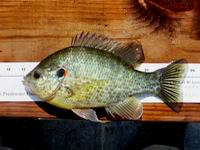
Very possible on the mix. The first stocking was picked up at a bait wholesaler in KC (50lbs). The second forage bump came from a hatchery which likely got them from Arkansas. Here's one that I caught earlier in the year on that silly white spinner which I believe is GSH (before all the forage madness).
1.5acre LMB, YP, BG, RES, GSH, Seasonal Tilapia I subscribe to Pond Boss Magazine
I didn't measure but they were much more uniform in size than the 100lbs that came later. I would say they ranged from 2.5-3.5" (Medium Shiners). - Edited based on pics...
The second stocking had a mix of sizes up to 5"+ The big ones were definitely shorter in number but they were present none the less.
I did have a couple of pics that I took from each stocking. Here's the edited in pics.
1st stocking:
Try measuring the length of your middle finger. The GSH in the photo looked about that long. Mine is 3.5" long
It isn't what we don't know that gives us trouble, it's what we know that ain't so - Will Rogers
Canyon - I called and talked to Minnesota Bait and Tackle on the shiners. They said either emerald or common shiner. It was like pulling teeth to get the info from them and not sure how accurate it is as the guy on the phone didn't have a lot of interest in helping to find the info....
1.5acre LMB, YP, BG, RES, GSH, Seasonal Tilapia I subscribe to Pond Boss Magazine
Can someone help on the ID of the 'shiner' in Boondoggle's 2nd picture in the post above? The shiner doesn't seem to have the appearance of a GSH (lateral line seems quite straight).
For the camera view of the shiner one cannot see the Lateral line. The view angle is wrong for any kind of ID except probably shiner. You are seeing the lateral band not the lateral line both are different. The lateral band can follow the lateral line but does not have to be on top of it.


.gif)

![[Linked Image]](https://forums.pondboss.com/ubbthreads.php?ubb=download&Number=20658&filename=LMB 102424.jpg)
![[Linked Image]](https://forums.pondboss.com/ubbthreads.php?ubb=download&Number=20660&filename=1st Stocking - GSH.jpg)
![[Linked Image]](https://forums.pondboss.com/ubbthreads.php?ubb=download&Number=20661&filename=1st Stocking - GSHb.jpg)
![[Linked Image]](https://forums.pondboss.com/ubbthreads.php?ubb=download&Number=20662&filename=2nd Stocking GSH.jpg)





