Greg :
Great observation and question .
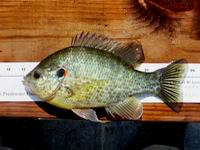
RE usually spawn earlier {a little cooler water}. Over here two times most years around the full or new moons , which ever comes first after water temp. is right , in March and April . The BG spawn four to five times and may overlap one month with the RE (April). In our ponds, the RE spawn deeper , a foot or two , if they are spawning at same time as BG . If they are not spawning at the same time , the RE are very shallow (6in to 2ft) while the BG when they spawn are at 2-4 ft if the water is clear.
If a RE male comes too close to a BG male's nest the BG will turn very dark and the RE will back off. On the other hand , if a BG male comes too close to a RE male's nest the RE will flair its red tipped ear flap and the BG will back off . This is the threat effect . Sometimes , if water is muddy , they will mix and you may get BG/RE crosses. See Bruce's post last week on IDing male and female BG where we discussed this. The threat effect above is why I think they segregate on a spawn site when they spawn at the same time provided they can see each other { not muddy }.
Having said all that , I will now try to answer the question . We have had a cold spring in the SE and I think the BG and RE spawn , as it started , is late , is out of sequence and in complete overlap. The first RE moved up early and took their preferred spot in very shallow water-- then the BG started moving in and took their preferred spot in the center of the site in a little deeper water-- then the late moving RE took the spot they usually take if there is an overlapping spawn in deeper water on the edge , which just happens to be the only spot left on the spawn site. You may not have been able to see the deepest RE beds at the deep outside of the site. I bet they were there. You may have had a different progression than we did. If there were no deeper RE nests then all of your RE may have moved up first and taken their preferred shallow and outside beds.
I noticed the same thing you did over the last 2 weeks in progression. This opinion is based on what I know from reading and observation from prior years and the fact that I observed it in progression this year. It looks like the RE have herded the BG up and surronded them. I have never seen what you described until this year. Thanks --ewest


.gif)