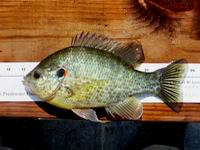
Interesting
Childers found in
Hybridization of Four Species of Sunfishes (Centrarchidae)
WILLIAM F. CHILDERS
Here are the sex ratios (percent male) that Childers got with various hybrid crosses. The male parent is listed first. There is some variation in the numbers from other studies
Redear X Bluegill 97 (3)
Bluegill X Redear 97
Redear X Green 69
Green X Redear 48
Bluegill X Green 97
Green X Bluegill 68 (2)
Redear X Warmouth 55
Bluegill X Warmouth 69 (2)
Green X Warmouth 16
Warmouth X Green 84
Bolnick and Near provided
" The only crosses with total inviability in
both directions are M. salmoides 3 (Ambloplites rupestrus,
Pomoxis annularis, or Pomoxis nigromaculatus) at 28.94 million
years, while 10 other crosses of that age have some
viability in one or both reciprocal directions (see online Appendix).
Centrarchids also retain nonzero viability and heterosis
for much longer than most other taxa."
All there is a difference in producing a fry and having it survive for a period of time up to viability in a pond. See below.
Childers
No hybrid type was significantly different from its maternal parent species in the percentage of zygotes that hatched; however, more than 90 percent of the WR and WB F1 hybrids were morphologically abnormal ( Fig. 1 and 2). Both WR and WB F1 hybrids exhibited high mortality between the hatching and swim-up fry stages. At the time the experiments were terminated, only 2 percent of the WR hybrids and 1 percent of the WB hybrids appeared to be morphologically normal. All of these morphologically normal appearing WR and WB F1 hybrid fry were very sluggish. When petri dishes containing these hybrid fry were tapped with a pencil, the fry responded with weak swimming movements or not at all, and it is very doubtful that any of these fry would have become free swimming. Fifty-five percent of the WG hybrid and 75 percent of the pure green sunfish zygotes developed into normal-appearing swim-up fry ( difference significant to 0.05 level). The WG hybrid swim-up fry appeared to be behaviorally normal. The remaining nine kinds of hybrids were not significantly different from their maternal parent species in the percentages that developed into normal swim-up fry.
Table 9.�The degree of viability of 16 different kinds of fishes produced by pairing gametes from red-ear sunfish, bluegills, green sunfish, and warmouths. Data from experiments Sl-S11 are combined.
Parent Species ----# of Eggs----% Hatched----% NormalFry
R x R ---------------512-----------39------------- 27
B x R--------------- 512---------- 41------------- 33
G x R--------------- 552---------- 46------------- 37
W x R--------------- 548---------- 321------------ 2**
B x B--------------- 681----------- 87------------ 75
R x B--------------- 742----------- 86------------ 83
G x B--------------- 639----------- 87------------ 69
W x B--------------- 699----------- 61--------------1
G x G--------------- 639----------- 78------------ 75
R x G--------------- 597----------- 80------------ 79
B x G--------------- 589----------- 73------------ 70
W x G--------------- 678----------- 76------------ 55
W x W--------------- 295----------- 58------------ 49
R x W--------------- 317----------- 62------------ 58
B x W--------------- 311----------- 58------------ 44
G x W--------------- 276----------- 62------------ 47
�R. = red-ear sunfish, B = bluegill, G = green sunfish, W = warmouth. tPercentage based on number of eggs at the time sperm and eggs were mixed together and the number that hatched. $Percentage based on number of eggs at the time sperm and eggs were mixed together and the number of morphologically normal-appearing fry. �More than 90 percent of these larvae were morphologically deformed. **These fry appeared morphologically normal, but all were behaviorally abnormal.
Last edited by ewest; 08/21/17 10:01 AM.


.gif)