A few notes from recent threads.
IMO the reason crappie don't work in ponds is not forage related but is rather because of their spawning traits. With the potential of over one hundred thousand crappie yoy per pair of spawning adults I am not sure one can keep enough forage of the right size supplied.
For example one factor may be that many of the yoy crappie die due to starvation because other species eat all the right size plankton/inverts etc leaving none/little for the yoy crappie while in a pre piscivore stage.
Crappie spawn first which is a problem due to the competition advantage their yoy have over other species yoy.
Crappie - Spawning occurs from about 59 degrees Fahrenheit to 68 degrees Fahrenheit ( 15-20 C )
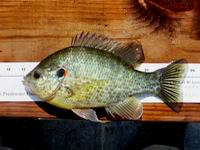
BG - Bluegill start spawn�ing in late spring at around70 F (21 C) and spawn periodically until early fall, providing a plenti�ful supply of small forage. In small, east Texas reservoirs, female bluegill spawned an average of five times over the season.
RES - Reported spawning temperatures for redear sunfish vary widely, with several pub�lications indicating that redear start spawning at slightly cooler tempera�tures than bluegill (68 to 70 F; 20 to 21 C), while other literature indicates the opposite.
LMB - after the water temperature
has stabilized above 60 F.
Bass normally spawn at temperatures
of 65 to 75F
Tilapia - spawning normally occurs at temperatures greater than 22� C (72� F). Tilapias are mouth-brooders; the female picks up fertilized eggs and incubates them in her mouth. The number of eggs that can be reared (typically 300 to 1,200 per clutch) is limited by the size of the female�s mouth. Thus, although they spawn frequently, relatively few offspring are produced at one time.
TFS - Threadfin shad spawn starting at 67 to 70 F (19 to 21 �C) and broadcast adhesive eggs over vegetation and woody debris. Prolific spawners, shad mature in less than 1 year and produce large quantities of eggs. The length of the spawning season is vari�able and spawning can occur over a broad temperature range.
GS - Golden shiners spawn in the spring when water temperatures rise above 68 F (20 C). They quit spawning when temperatures exceed 81 F (27 C). Once spawning
begins, fish will continue to spawn even when temperatures drop below 68 F. Golden shiners spawn frequently, attaching their adhesive eggs to aquatic vegetation or spawning mats.
FH - Water temperatures higher than 64 F (18 C) trigger spawning. Females spawn at frequent intervals, up to several times a week. Once the water warms to 84 F (29 C) or higher, spawning
stops.
Just checked crappie spawn in brush , roots or plants in depths of 20 cm to 6 meters.
Crappie have a history of spawning in waters with large depth fluctuations . Unless water depth is changing rapidly then fluctuation should not matter in most ponds.


.gif)