Cold intolerance is the known reason. Many studies confirm this. There are plus and minuses and corresponding reasons for each LMB stocking approach. There is no one "I am right" plan. See info below map for others view.
There is little to no proof that outbreeding depression applies to Fla/North crosses whether they are F-1 , 2 or FXs (all referenced as integrades)
in there natural integrade zone .
Status of Subspecies as of 2011 subject to change:
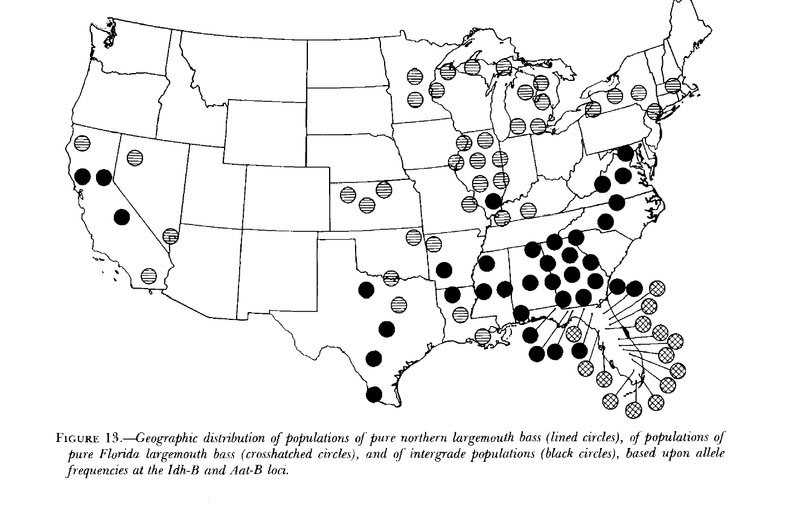
Florida Largemouth Bass and the Northern Largemouth Bass were once considered to be subspecies. Many state fisheries agencies still consider them to be subspecies and treat them as such, often stocking �Florida strain largemouth� on top of the native Largemouth Bass stocks. Although the American Fisheries Society (AFS) also officially still recognizes them as subspecies, biologists specializing in the field are calling for them to be separated into two distinct species: Florida Bass and Largemouth Bass. This is based off genetic studies that suggest that the genetic variation between Florida Bass and Largemouth Bass . A natural intergrade zone occurs where the two species� ranges meet and overlap in the deep southeast. Artificial intergrade zones exist where state agencies have stocked Florida Bass over Largemouth Bass for decades.
 http://sepond.com/fish-stocking/largemouth-bass
 --- Southeastern Pond Management approach
Here is American Sport Fish�s approach.
Florida bass in the southern latitudes grow faster after age two, and live longer than Northern bass. They also have the potential of reaching larger sizes. These are record-breakers. However, they are less tolerant of cold temperatures, and they can be harder to catch. As they grow older, they learn to ignore artificial bait. Pond owners often complain about not being able to catch larger Florida bass, except on live bait. Nevertheless, their size and long lifespan make them excellent additions to many ponds.
Through more than 15 years of genetic selection, American Sport Fish has developed a very aggressive strain of northern bass called the Gorilla bass. Aggressive feeding behavior is an inheritable trait, and each generation of bass has been selected for its aggressive behavior. These fish are strong feeders and respond well to artificial baits even when they become older. They are more tolerant of colder water than the Florida bass..Adult Gorilla bass are often added to lakes that are home to a majority of Florida bass, to increase the angler's catch rate and to introduce their aggressive feeding genetics to Florida bass populations.
Created by our team of scientists, the Tiger Bass� has been specially bred for aggressiveness and fast growth. In well-managed lakes, Tiger Bass� have consistently gained more than two pounds per year. Biologists refer to this fish as a true F-1, because it is a cross between two pure subspecies of bass: a special strain of aggressive Northern Bass (which we call Gorilla Bass) and a pure strain of Florida Bass that comes from proven trophies (females from 13 to 16 pounds). American Sport Fish is the only hatchery licensed to produce and sell the Tiger Bass�
The world record bass, which weighed 22 pounds and 4 ounces, came from southern Georgia and is thought to be a northern/ Florida intergrade. Our Tiger Bass� have already gained weights of 15 pounds in eight years. We expect them to break state records in the next several years.


.gif)