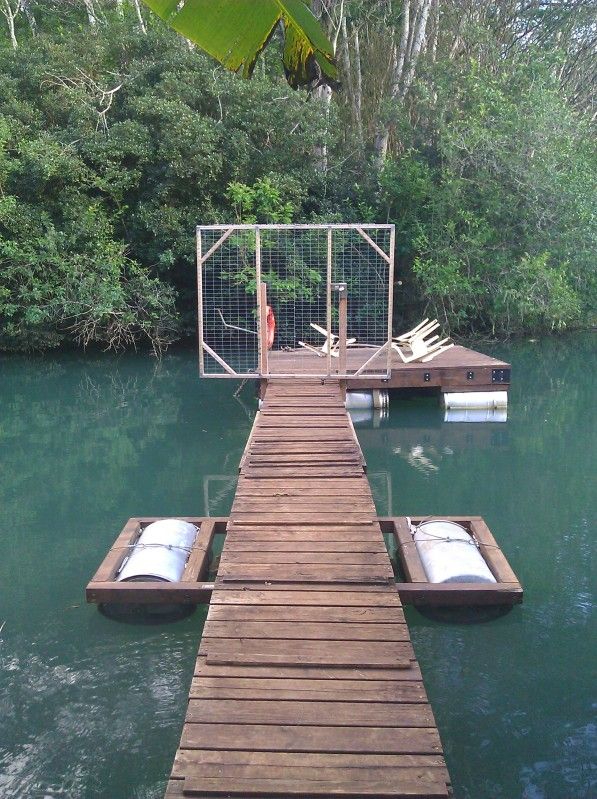
Looking for some help on what so far has turned into a failed initial attempt to build a floating bridge.
Need to build a floating gangway/dock system to span about 40 feet connecting a dike to a field area.
My thought was to build multiple sections at 8ft lengths. The multiple sections at short 8ft sections was thought to be easier to maintain if a barrel went bad it could be maintained/repaired easier.
After a few hours on design and build we have found that having only one section at this time it is very unstable when launched.
Currently this dock is 8ft x 38in. Are we on the right track with some possible solution to stabilize the bridge/gangway with multiple sections connected to one another?
Some details that need to be considered. Our goal is that this will be in the water all year round including when the water freezes. We are in northern Ohio. Bridge must span a 40ft plus span of water. Sections must be management for launch and maintenance/repair as needed.
Hoping we can come up with a solution. Have $150 invested with a $1000 budget for the full project.
I cannot think of a good way to stabilize the sections except with piles or pipes driven into the pond bottom and then fastened to the sections so they can only move vertically. That may not fit with your budget though.
If you're committed to keeping such a narrow width, I believe supports driven into the bottom or outriggers of some sort that will increase the barrel footprint, will be your best bet.
"Forget pounds and ounces, I'm figuring displacement!"
If we accept that: MBG(+)FGSF(=)HBG(F1) And we surmise that: BG(>)HBG(F1) while GSF(<)HBG(F1) Would it hold true that: HBG(F1)(+)AM500(x)q.d.(=)1.5lbGRWT? PB answer: It depends.
Depending on the water depth, pipes may or may not work. It is unstable because all the weight is up high (a person) and there is nothing to keep it from turning turtle when the weight is place on it - the center of gravity changes from low to the water to high.
I think the outrigger idea will work better than the pipe idea. You need play in the sleeves that go around the pipes to allow the dock to move up and down, and without diagonal bracing on the pipes under the pier, there is nothing to keep them from swaying side to side, like Cecil's long pier across his front pond.
If you do not need to keep the pier on the water and it's just to be used as a bridge, I would make it a fixed pier with pipes. For a 40' long pier, I don't think you can build it with that budget unless you really, really get creative with finding donated or free material.
This is a budget buster, but I would use two 40 or 50' building trusses or I beams and make a bridge. Or build two 20' sections attached to each bank with a floating dock in the middle to support both ends that are over the water. Make the mid section 8x10 or something wide enough to be stable.
Turn barrels 90 degrees and put four under each walkway. Add some water for ballast like stated. two separate barrels on each end will give better stability (better being key word there).
Did you add water to the barrels for ballast on your test section? If not, IMO that should help a lot with stability.
What's the plan for handrails? I'm thinking you will definitely need them.
Thanks. We had thought of the ballast solution but this we do not believe will be a solution for our problem as the dock will need to be left in the water year round in freezing conditions. We have been told that with barrels the docks will rise to the top of ice during freeze. Therefore, barrels will not be crushed by freeze. If we add water to barrels we fear the dock will not rise and barrels crushed. And, water inside will freeze and expand and blow out barrel. And, we need these to be manageable. The added weight of water in barrels may make them difficult to work with without machinery.
Looking at this as a possibility as well that I saw on this forum. Just wondering how stable it is. I notice there are no posts driven and no railings.
Without a pic or link my earlier reference to utility poles makes no sense. You could span the 40' using 2 utility poles and simply have a bridge instead of a floating gang way. See this link as one of many examples.
Without support somewhere besides on the ends, wouldn't the utility poles begin to sag?
"Forget pounds and ounces, I'm figuring displacement!"
If we accept that: MBG(+)FGSF(=)HBG(F1) And we surmise that: BG(>)HBG(F1) while GSF(<)HBG(F1) Would it hold true that: HBG(F1)(+)AM500(x)q.d.(=)1.5lbGRWT? PB answer: It depends.
I don't think they'd sag. For a footbridge the support should be more than adequate. I'd put in a midway support to take any bounce out of it when I walk across it, but that's just me. There are lots of these being built for bike trails and ATV trails. If you need more support for vehicular traffic I've seen old flatbed trailers used to span creeks and ravines on mountain properties. A pretty cheap bridge that you just have to sit it in place.
Utility poles are much more affordable than perhaps some may think. They come in various lengths, diameters, and woods/coatings. The key is to find a utility pole / pilings supplier close to you for ease of transport.



![[Linked Image]](https://forums.pondboss.com/ubbthreads.php?ubb=download&Number=11852&filename=I_subscribe_zps2qlyoyn2.gif)


![[Linked Image from lh6.ggpht.com]](https://lh6.ggpht.com/_6_-SgakQ9co/S3Nx1jGAJWI/AAAAAAAABKU/DJIy4ZnF1t0/s800/I_subscribe.jpg)