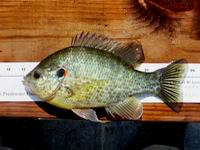
TGW1 you are correct. Here is some info on how it works. You want to get as much energy into the fish with food as you can with as little effort expended as possible.
From a prior thread
http://forums.pondboss.com/ubbthreads.php?ubb=showflat&Number=127798&page=1 The concept of 'bioenergetic' is not hard to understand. The sun is the basic source of energy for the pond plus anything you add (extra forage fish or pellets). Here is a good site with basic info.
http://www.aqualex.org/elearning/fish_feeding/english/bioenergetics/intro_biogen.html"The flow of energy through a biological system and the system's inherent energy requirements are covered by the term 'bioenergetic'. In biology energy is required to maintain life, grow and reproduce. From a fish farming point of view, growth is the main area of interest. The main energy source for consumers (as opposed to producers such as plankton and plants) is their diet or food. This provides the energy to drive chemical processes giving rise to new tissues, to help in osmoregulation, to aid digestion (the means by which consumers unlock energy stored in food) and so forth. [Note: energy cannot be made or destroyed but can only be converted from one form to another].
Energy taken in by fish through digestion of food is used ultimately in one of three ways - that is for growth, metabolic processes and that lost to the fish through waste. During digestion the main components of the diet (protein, fat, carbohydrate) are broken down into carbon dioxide and water with heat as a by-product, the latter being rapidly dissipated to the surrounding water. The energy liberated is temporarily stored in special 'energy compounds', the main one being adenosine triphosphate (ATP), which become cellular level energy sources for functions such as protein manufacture (i.e muscle growth), swimming and so on."
The same concepts apply to the pond as a whole ( plants like plankton or pondweed and animals like zooplankton , bugs and all others).
A key fisheries science concept that is key to understanding the working of the entire system. Energy in = energy used + growth. Read then comment.
Welcome to the world of fish physics. Many of us understand basic fish behavior and can reach logical conclusions about where the best place to throw a fishing line is. But when we don�t think much further than that we are missing out on some very interesting details of fish behavior. We can never fully understand why we find some fish in one location and some fish in other locations until we consider the concept of fish bioenergetics. Ultimately, fish behavior is a product of bioenergetics, ... this concept to demonstrate how interrelated physics is with fish behavior. First, ... take a look at basic fish bioenergetics, understanding the underlying quantitative principles. Then, ... look at some examples of how physical forces, thermodynamics, and light characteristics are specifically related to fish bioenergetics.
BASIC FISH BIOENERGETICS
Fish bioenergetics includes components of physical forces, thermodynamics, and light characteristics, and follows energy laws and theories describing any other closed system. What it all boils down to is the net rate of energy intake. If this rate is positive a fish will grow and if it is negative then a fish will begin to undergo the stresses of losing biomass.
Fish bioenergetics is really a matter of efficiency. Potential profit for a fish at any given position ... (is) ... the amount of energy coming into its system as prey minus the cost of staying at that position.
Bioenergetics
the biological study of energy transformation.
Bioenergetics is the subject of a field of biochemistry that concerns energy flow through living systems. This is an active area of biological research that includes the study of thousands of different cellular processes such as cellular respiration and the many other metabolic processes that can lead to production and utilization of energy in forms such as ATP molecules. All biological processes including the chemical reactions of bioenergetics obey the law of thermodynamics.
Thermodynamics
First Law is the conservation of energy: energy can neither be created nor destroyed.
Second Law states that the degree of disorder or entropy (S) of a closed system or of the universe as a whole can only increase.[1
Overview
Growth, development and metabolism are some of the central phenomena in the study of biological organisms. The role of energy is fundamental to such biological processes. The ability to harness energy from a variety of metabolic pathways is a property of all living organisms. Life is dependent on energy transformations; living organisms survive because of exchange of energy within and without.
In a living organism chemical bonds are broken and made as part of the exchange and transformation of energy. The chemical bonds in carbohydrates, including sugars, are important for the storage of energy. Other chemical bonds that are important for metabolism include the terminal phosphate bonds of ATP and the energy-rich bonds of fats and oils. These molecules, along with oxygen, are important energy sources for many biological processes. Utilization of chemical energy from such molecules powers biological processes in every biological organism. Bioenergetics is the part of biochemistry concerned with the energy involved in making and breaking of chemical bonds in the molecules found in biological organisms.
Food molecules are sources of chemical energy for many organisms. Not all metabolizable energy is available for the production of ATP.[2]


.gif)