I'm baaaaaaaaaack!
Went from tropical temps to subarctic! WTH! If the eastern Pacific would just cool down about 8 degrees we could get rid of of this 's' curve in the Jet Stream that is bringing this polar air straight down to the midwest!
Bought the bass as 4 to 5 inch feed trained fingerlings from Laggis Fish Farms in Gobles, Michigan in the spring.
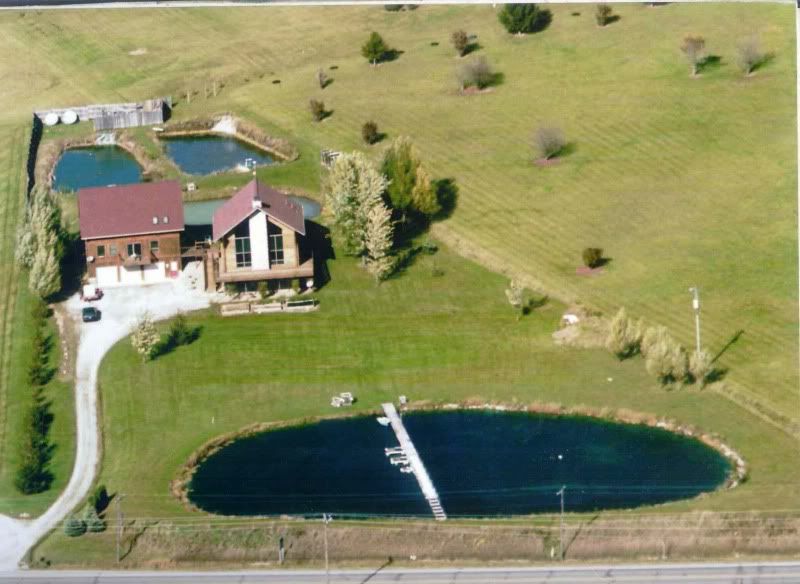
Fed them floating fish pellets in a cage at low density of 100 per 4X4X4 cage until the fall when they had reached 8 to 10 inches and were relased into the rest of the population of the .62 acre pond. They were kept in the cage until fall to get some size on them to keep them from being eaten by the larger bass in the pond. At 8 to 10 inches they were large enough not to become expensive predator fish food.
These are aproximate average ages and bass sizes. Keep in mind there are always a few smaller size bass and a few larger size bass. Males are smaller than female largemouth bass.
Spring Year 01 (March-April) Age ~ 9 to10 months. Size 4 to 5 inches placed in cage
Fall Year 01 (October) Age 16 months. Size 8 to 10 inches. Released from cage
Fall Year 02. (October) Age 2 years 4 months Size 14 to 15 inches 1.5 to 2.5 lbs.
Fall Year 03. (October) Age 3 years 4 months Size 16 to 18 inches 2.5 to 3.0 lbs.
Fall Year 04. (October) Age 4 years 4 months Size 17 to 19 inches 3 to 5 lbs. plus
The bass grew quite rapidly until they reached about 2.5 to 3 lbs. and then slowed down in growth. The rapidly growing fish exibited small heads and fins. As the fish slowed down in growth they showed more normal proportions. The younger fish were quite stocky with lots of internal fatty tissue. One 19 inch fish weighed just over 6 lbs.
I'm convinced many of the oldest fish went off the pellets. There was bluegill, yellow perch and largemouth reproduction to feed on. also saw a significant decrease in the number of the largest fish to to natural attrition as they weren't removed from the pond - at least not at first.
I'm convinced that pellet fed bass, although faster growing initially,have a shorter lifespan than their natural fed counterparts.
There may be some variation in growth rates and maximum size as I know a bass farmer in Missouri that produces lots of feed trained bass over 6 lbs. in his broodstock pond. I was also told the same by a central Indiana producer.


My bass were somewhat interbred judging by the triangular lower jaws in some of the bass.