If and when I build another floating dock, I'd bite the expense bullet and only use flotation that was designed for that specific application, NOT plastic barrels. The labor involved to make them work, and the labor involved to replace them when they leak doesn't justify the difference in price for me.
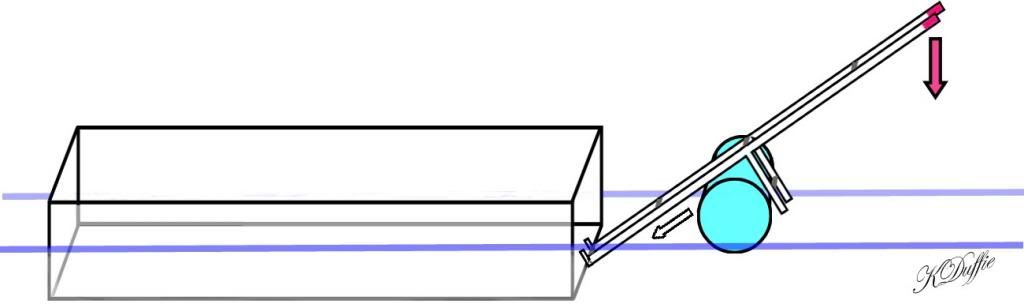
My dad (way back when) built a nifty little "drum-jack" (lever) that we used to install and replace plastic drums beneath our floating docks. Continually pushing the right end of the lever-jack downward eventually causes the drum to roll along the opposite end of the "pipe-rails" and pop-up into place (after the dock-frame is in the water).
*Be forewarned: the "pop-up" happens VERY rapidly and with lots of force. Keep all fingers, toes and limbs clear of the slot into which the drum will rise.*Of course, our drum-slots were oriented parallel to the dock's length-wise perimeter - whereas the slots on Scott's dock are perpendicular to its long-side perimeter. Even so, this type of lever (or two) could be used to partially elevate the floating dock and allow "easier" removal and replacement of floatation drums or blocks.
BTW, the downward force needed to submerge the �pivot-drum� (and cause it to roll along the lever-rail) is equal to the mass of the water displaced by the pivot-drum. For a 30-gal drum, that downward force is roughly 250 lbs. Therefore,
securely welding the jack�s perpendicular pipe-legs approximately 1/3rd of the rail's length away from the �dock-frame grabber-cleats�, thereby leaving 2/3rds of the rail-handles for leverage, serves to multiply the force transmitted to the frame-grabber end (which is important if you only weigh 150 lbs).