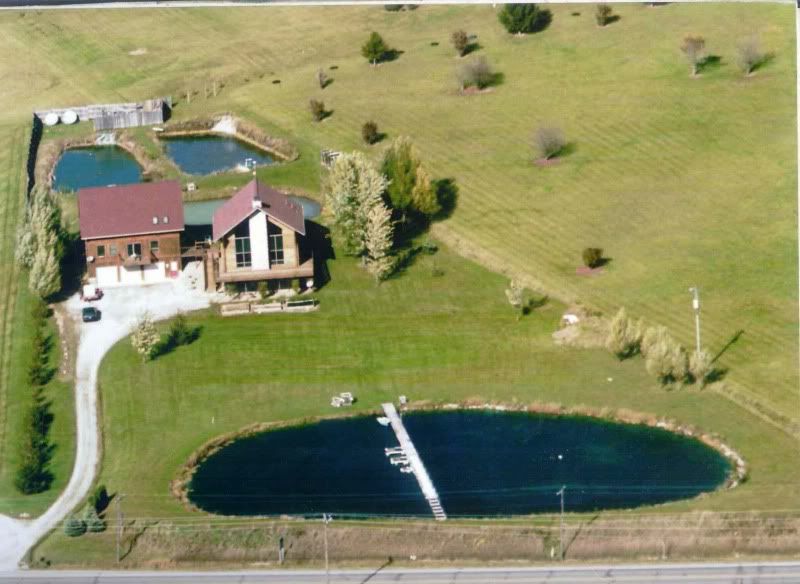
I have absolutely no clue how much DO is in my pond right now simply because I don't have three hundred dollars to spend on a meter. I Only know when it's getting low because the fish start sucking at the top and act lethargic.
Bottom diffusers lift water allowing it to be exposed to air. During that proces that water is exposed to less pressure which allows it to off gas the bad stuff. While are the surface it is also allowed to pickup some O2.
Meanwhile, the water that was at the surface when this started will be circulated towards the bottom introducing some more O2 to the lower levels which is beneficial.
Surface aerators add far more O2 (due to the added agitation and air exposure) to the surface water and starts a circulation process that will also move saturated water to lower levels.So in short:
bottom diffusers = water movement to surface Surface aerators = O2 injections to the top water and circulation.
FWIW Fish farmers use far more surface aerators.
Hopes this helps.
BTW: For Georgetopia, I noticed and immediate increase in the O2 saturations at the surface first and all levels with in two hours using a surface aerator. In fact my numbers were so impressive, I checked my calibration three times and sampled the water in the pond three times over the course of a day before posting my results.
I highlighted part of the quote because it's partly true. In ponds that are deep enough to develope a thermocline, surface agitators will just move water around (with the increased O2 levels) above the thermocline. Bottom diffuser aerations systems homogenize the whole water column, from surface to bottom, distributing the O2 laden water thru the whole water column. It also distributes the higher upper surface water temps thru the whole water column too, which is NOT what you want for trout. Not because it's bringing warm air down deep, it's mixing the warm upper water with the cooler bottom water. The temp won't be as warm if the system wasn't running at all, but at least in my experinece, it warmed up the water too much for the trout to live in. That's why I'm experimenting with hypolimnetic aeration this year in my pond.
It will prevent any stagnant water but not sure if you will really have any with only four feet of water and flow through.
There's a 1/8th hp surface aerator available that might be the ticket.
Who sells it? The smallest surface aerator I've seen is 1/4 horse power
My bad I think it was 1/4th horsepower. Cheapest I've seen it was for about $800.00. But it's low amps. Here's a video of the model in action. I see it's on Amazon and might be on Ebay. Model 1400 jfl pond fountain.
Instead of my well water just feeding the pond from the shore I did this last May to at least move some water (pre-aeration) and for aesthetics, but now realizing my bottom diffusers aren't necessarily adding O2, yet the fountain is? I made this for less than $20, making a "T" using 1 1/4" PVC and drilling holes in it. Capped the bottom, pounded it into the pond bottom and used a PVC "T" to attach the 1 1/4" poly tubing from the well-water at the shore. I pulled it out over the winter and was going to make a water-feature (waterfall) at the shore. But now reading that running well-water over rocks before it enters the pond may not be such a good idea, and the fountain would be much more beneficial?
So two things: 1. Could Small Pond, using smaller PVC and a small pump do virtually the same thing for cheap? 2. With my pond at 2 acres and approximately 5-6 acre feet (very little wave/wind action), is this fountain more beneficial than I think? Especially compared to the water feature I was contemplating?
Bottom diffusers lift water allowing it to be exposed to air. During that proces that water is exposed to less pressure which allows it to off gas the bad stuff. While are the surface it is also allowed to pickup some O2.
Meanwhile, the water that was at the surface when this started will be circulated towards the bottom introducing some more O2 to the lower levels which is beneficial.
Surface aerators add far more O2 (due to the added agitation and air exposure) to the surface water and starts a circulation process that will also move saturated water to lower levels.
So in short:
bottom diffusers = water movement to surface Surface aerators = O2 injections to the top water and circulation.
FWIW Fish farmers use far more surface aerators.
Hopes this helps.
BTW: For Georgetopia, I noticed and immediate increase in the O2 saturations at the surface first and all levels with in two hours using a surface aerator. In fact my numbers were so impressive, I checked my calibration three times and sampled the water in the pond three times over the course of a day before posting my results.
You are spot on Highflyer! I get so tired of people calling diffusers "aerators."
If pigs could fly bacon would be harder to come by and there would be a lot of damaged trees.
I ended up making a small stream with 2 water falls in it tell me what you think. Should it be sufficient enough to aerate the water? Thanks. I used 2 garbage bags to line the bottom of the stream and it seems to be holding water very well. It's not done yet I still need to put down some more rocks.





![[Linked Image from lh6.ggpht.com]](https://lh6.ggpht.com/_6_-SgakQ9co/S3Nx1jGAJWI/AAAAAAAABKU/DJIy4ZnF1t0/s800/I_subscribe.jpg)