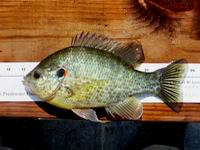
Start with this from a 1972 study. Things have changed a lot since then but you can see the basics here. Back later with more.
LINKAGE RELATIONSHIPS OF SIX ENZYME LOCI IN INTERSPECIFIC
SUNFISH HYBRIDS (GENUS LEPOMIS)*
T. E. WHEAT2 AND G. S. WHITT3
Department of Zoology, University of Illinois, Urbana, Illinois 61801
and
W. F. CHILDERS
Section of Aquatic Biology, Illinois Natural History Survey, Urbana, Illinois 61801
Manuscript received December 19, 1972
Backcross hybrids produced from the bluegill, the red-ear sunfish, and their
F, interspecific hybrid have been analyzed for the inheritance of six enzyme
phenotypes.
From the analysis of the F, hybrids, we can conclude that all six loci are present
and functional with both alleles at each locus being expressed to the same extent.
Linkage analysis in backcross hybrids: Table 1 presents the frequencies of
TABLE 1
Allele frequrncy: RB F, 8 X R 0
!tlnll-A >lD�l-R Est ro &PDII BPGDH
Homozygotes 76 62 67 68 62 65
Heterozygotes 64 78 73 72 78 75
ISOZYMES IN SUNFISH HYBRIDS
TABLE 2
Allele frequency: RB F, 8 x B 0
347
MDH-A MDH-B Est TO rrGPDH GPGDH
Homozygotes 53 58 69 58 68 70
Heterozygotes 67 62 51 62 52 50
homozygotes and heterozygotes for all six markers among the progeny of
8 F, X 9 red-ear sunfish. Similar data for the mating 8 F, x P bluegill are
given in Table 2. There is no significant deviation from the expected ratio of
1 homozygote to 1 heterozygote for each locus at the 99% significance level.
However, it is possible that there is an increased frequency of the bluegill allele
for aGPDH in both crosses reflected in excess homozygotes in the backcross to
the bluegill, and excess heterozygotes in the mating with the red-ear sunfish.
The excess of individuals receiving the bluegill allele from the Fl parent
(146/114) is significant at less conservative confidence limits (x2 = 3.94;
.01 < p < .05). These observations are consistent with the inheritance of the
parentally derived genes as codominant alleles at nuclear loci. In addition, there
are no apparent differences in viability between the two reciprocal backcrosses,
confirming the suitability of this genetic system for linkage analysis.
Tables 3 and 4 show the distributions of parental phenotypes and presumed
recombinant classes for the fifteen pairs of markers in the matings of the F,
hybrid with the red-ear sunfish and the bluegill, respectively. The x2 value is
calculated for the deviation of the observed data from the 1:1:1:1 distribution
TABLE 3
Linkage relationships: RB F, 8 X R 0
99p
homA het A hom A het A Percent confi ence
A B homB het B het B homB x2 recombination limit
MDH-A MDH-B 33 35 43 29 .MO 51.4 10.9
MDH-A Est 32 29 44 35 2.20 56.4 10.8
MDH-A TO 39 35 37 29 .5ai 47.1 10.9
MDH-A 6PGDH 37 37 39 27 .616 47.1 10.9
MDH-A aGPDH 35 37 41 27 ,210 48.6 10.9
MDH-B Est 32 43 30 35 .629 46.4 10.9
MDH-B TO 31 41 31 37 .091 48.6 10.9
MDH-B 6PGDH 29 42 33 36 .005 49.3 10.9
MDH-B aGPDH 25 41 37 37 ,708 52.9 10.9
Est TO 29 34 38 39 1.44 55.0 10.8
Est 6PGDH 24 32 43 41 5.81 60.0 10.7
Est aGPDH 22 33 45 4.0 6.83 60.7 10.6
TO 6PGDH 32 39 36 33 .021 49.3 10.9
TO aGPDH 29 39 39 33 ,144 51.4 10.9
6PGDH* aGPDH 53 66 12 9 68.2 15.0 7.79
* These two loci show significant linkage.
348 T. E. WHEAT AND G. S. WHITT
TABLE 4
Linkuge relationships: RB F, 8 X B Q
A
99%
homA hetA homA hetA Percent confidence
B homB het B hetB homB x2 recombination limit
MDH-A
MDH-A
MDH-A
MDH-A
MDH-A
MDH-B
MDH-B
MDH-B
MDH-B
Est
Est
Est
6PGDH
TO
6PGDH*
MDH-B
Est
6PGDH
TO
aGPDH
Est
6PGDH
TO
(uGPDH
GPGDH
TO
aGPDH
TO
aGPDH
aGPDH
29 38 24 29 1.55
33 31 20 36 382
34 31 19 36 1.08
25 34 28 33 .051
29 28 24 39 .I47
36 29 22 33 ,959
33 25 25 37 .a95
24 28 34 34 2.17
28 22 30 40 3.22
45 26 24 25 3.16
30 23 39 28 1.53
45 28 24 23 4.84
27 19 43 31 6.41
31 25 27 37 ,474
56 38 I4 12 37.2
4.4.2 11.7
46.7 11.7
45.8 11.7
50.8 11.8
52.5 11.8
45.8 11.7
51.7 11.8
56.7 11.7
58.3 11.6
40.8 11.6
55.8 11.7
39.2 11.5
61.7 11.5
53.3 11.7
21.7 9.7
* These two loci show significant linkage.
expected for unlinked loci. The frequency of recombination (MATHER19 51)
and the confidence limit at the 99 % level are also presented.
In both tables (3 and 4), there are no significant deviations (99% limit) from
random assortment for the first fourteen pairs of markers; the frequencies of
recombination are on the order of 50%. These data are not significantly different
from the random assortment of codominant alleles at unlinked nuclear loci.
However, loose linkage cannot be excluded.
In contrast, for both backcrosses, GPGDH and (uGPDH show highly significant
deviations from random assortment, and the calculation of the frequency of
recombination confirms linkage between these two markers. The recombination
values calculated for both backcrosses are not significantly different, so the true
frequency of recombination is probably between 15% and 22%.
Other possible deviations are found for Est-aGPDH in the backcross to the
red-ear sunfish (x2 = 6.83; 0.01 < p < 0.05), and for GPGDH-TO in the backcross
to the bluegill (x2 = 6.41; 0.01 < p < 0.05). In view of the large number
of tests, it is probably better to consider only differences at the more conservative
limit. In any case, these deviations could not reflect linkage since the observed
frequency of recombination exceeds 0.5.
DISCUSSION
These data clearly demonstrate the utility of interspecific sunfish hybrids for
genetic analysis. The viability of the interspecific hybrids and their progeny, as
well as the large number of isozyme markers, is particularly advantageous. All
six markers examined are inherited in a mendelian manner as codominant alleles
at nuclear loci. There is no allelic repression detected in these interspecific
ISOZYMES IN SUNFISH HYBRIDS 349
hybrids, although allelic inhibition has been observed for interspecific sunfish
hybrids formed from more distantly related species (WHITTC, HOa nd CHILDERS
1972). No differential mortality was detected in either backcross population.
Finally, no significant differences between the reciprocal crosses were detected.
The slight excess of bluegill alleles for (rGPDH in both crosses probably reflects
statistical variation due to the large number of tests being made. However, it may
reflect differential mortality or some other distortion of the patterns of inheritance.
Additional data would be necessary to clarify this point.
The absence of close linkage between the MDH-A and MDH-B loci has been
previously observed in the backcross between the RB F, hybrid and the red-ear
sunfish (WHEATW, HITTa nd CHILDER1S9 72). This conclusion is confirmed by
the present study. Since the two supernatant MDH loci (A and B) of teleosts are
such closely homologous duplicate genes (BAILEY et al. 1970), the absence of close
linkage may be of developmental or evolutionary significance. These data are
consistent either with tandem duplication followed by some form of chromosomal
rearrangement or with duplication during an ancient polyploidization event
(OHNO 1970).
The significance of the linkage of the loci encoding 6-phosphogluconate dehydrogenase
and the liver form of a-glycerophosphate dehydrogenase for metabolic
regulation is doubtful since the enzymes are in different metabolic pathways.
These loci are unlinked in Drosophila (Fox, ABACHERLaIn d URSPRUNG19 71).
Since recombination occurs with a frequency of 15 %-20% between these linked
loci, recombination between the parental chromosomes in the F, hybrid is clearly
demonstrated in this case. No data are available concerning the frequency of
recombination between these loci in the parental species, so it cannot be determined
whether the frequency of recombination is altered in the F, hybrid. Apart
from its intrinsic genetic interest, the observation of linkage is of special significance
to other studies of interspecific sunfish hybrids. The presence of linked
enzyme loci should be very helpful in investigating the mechanisms of synchrony
of gene function during development. In addition, the determination of the
specificity of the mechanisms responsible for allelic repression in interspecific
hybrids could be assessed with linked enzyme loci, The observations that recombination
can occur between these linked loci in the F, hybrid, and that there is no
substantial difference between the two backcross populations, clearly demonstrate
the utility of this interspecific sunfish hybrid system for further genetic
analyses.
Last edited by ewest; 06/10/13 03:34 PM.


.gif)