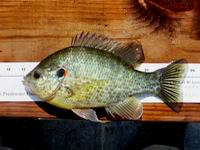
Greg there are a bunch of studies on your point about BG and TShad. Also a thread here with lots of data.
Here you go.
Here are a couple from this thread --
http://forums.pondboss.com/ubbthreads.php?ubb=showflat&Number=188082&page=1 Title: The effects of threadfin shad as a forage species for largemouth bass in combination with bluegill, redear, and other forage species
Date: 1976
Abstract: Threadfin shad, Dorosoma petenense (Gunther), were stocked in ponds with an established population of bass, bluegill, and redear and in three ponds containing bass, golden shiners, and fathead minnows. Comparisons of fish populations were made before and after the first successful spawn of shad. The production of bass with bluegill and redear plus shad was essentially the same as with golden shiners and fathead minnows--59.2 pounds per acre and 58.7 pounds per acre, respectively.
A significant increase in the growth and condition of bass was seen in the pond stocked with bluegill and redear after the first shad spawn while no change was seen in bass survival.Bluegill and redear recruitment increased significantly after the shad population became established. This apparently was caused by a decreased rate of predation by bass. As a result, the catch per unit of effort of bluegill and redear decreased significantly after the introduction of shad. Bass were in better condition after shad stocking while no change in the condition of bluegill and redear could be detected. In ponds stocked with forage minnows, fathead minnows disappeared the second summer after stocking. An F/C ratio (Forage/Carnivorous) of 2.7 and an A value for bass (percentage of bass over 10 inches in length) of 93.4 was computed for the pond, indicating a bass-crowded condition due to heavy predation on the forage species.From these data, the stocking of shad as additional forage in bass-bluegill-redear ponds cannot be recommended. The stocking of shad with bass and other forage species appears to offer some advantages to bass fishermen if the production of forage species can be increased.
Stocking Threadfin Shad: Consequences for Young-of-Year Fishes
DENNIS R. DEVRIES, ROY A. STEIN, and JEFFREY G. MINER
Ohio Cooperative Fish and Wildlife Research Unit,3 and Department of Zoology The Ohio State University, Columbus, Ohio 43210, USA
GARY G. MITTELBACH
Kellogg Biological Station, Michigan State University, Hickory Corners, Michigan 49060, USA
Abstract
Threadfin shad Dorosoma petenense are commonly introduced into reservoirs to supplement prey available to piscivorous fishes. To determine how early life stages of threadfin shad and their potential competitors and predators interact, we introduced this species into two Ohio lakes�Clark and Stonelick�and evaluated how its young of year influenced young-of-year bluegills Lepomis macrochirus and largemouth bass Micropterus salmoides. After adults were stocked in April, peak abundance of young-of-year threadfin shad occurred in August in both lakes.
Bluegills generally spawned earlier than threadfin shad, which apparently reduced competition between young of these species. In Clark Lake, young-of-year threadfin shad did not reduce zooplankton populations, but in Stonelick Lake, peak abundance of young-of-year threadfin shad was followed by a precipitous decline in zooplankton. Data on cladoceran birth rates indicated this decline was due to increased predation by threadfin shad. Survival of bluegills to a size at which they move into the littoral zone also declined in Stonelick Lake, perhaps because of the virtual elimination of zooplankton. Limited survival of bluegills in turn contributed to reduced growth of young-of-year largemouth bass dependent on them as prey. Given that zooplankton declined in one but not the other lake, interactions among young-of-year fishes due to annually introduced threadfin shad will likely vary among systems and years. Nonetheless, introduced threadfin shad could,
in some systems in some years, negatively affect growth and recruitment of the very species they were meant to enhance.Young-of-year threadfin shad, though their abundance peaked in late summer, co-occurred at low densities with limnetic young-of-year bluegills during May through September in Clark Lake. When both species co-occurred in the limnetic zone, they ate only limnetic zooplankton; however, diet overlap values were typically <0.50. Once blue gills moved inshore, the potential for competition with threadfin shad declined greatly.Diets of bluegills collected from the littoral zone did not change between 1987 and 1988 in Clark Lake; all prey types (littoral, limnetic, and cyclopoid copepods) were eaten. Though collected inshore, bluegills apparently moved far enough offshore to consume some limnetic prey, but they ate enough littoral prey to reduce overlap with threadfin shad, which continued to feed entirely on limnetic prey. Consequently, although competition between young-of-year bluegills and young-of-year threadfin shad may occur (particularly during August in Stonelick Lake), the outcome of such interactions in a lake ultimately depends on abundance and species composition of the zooplankton community and on the relative spawning times of the predator fishes. As demonstrated by our results, these factors vary among lakes and years, making generalization difficult.Thus, interactions between limnetic young-ofyear threadfin shad and bluegills may have a pronounced negative effect on young-of-year largemouth bass growth if they lead to reduced survival young-of-year bluegills in the limnetic zone and then to reduced recruitment of bluegills to the littoral zone. Additionally, slower growth may reduce overwinter survival of young-of-year largemouth bass if overwinter survival depends on body size and fat reserves (Adams et al. 1982a, 1982b; reviewed in Adams and DeAngelis 1987). As a consequence, the very management practice intended to enhance the fishery for adult piscivores may reduce survival of the target species. Although these negative effects are not direct (unlike the positive effects of increased prey availability), they could have substantial consequences over several years of such management manipulation
The study with LMB , BG and TShad in ponds stated " Bass were in better condition after shad stocking while no change in the condition of bluegill and redear could be detected.
Yes zooplankton #s were reduced in Stonelick lake but look at the authors conclusions about that :
"Consequently, although competition between young-of-year
bluegills and young-of-year threadfin shad may occur (particularly during August in Stonelick Lake), the outcome of such interactions in a lake ultimately depends on abundance and species composition of the zooplankton community and on the relative spawning times of the predator fishes. As demonstrated by our results, these factors vary among lakes and years, making generalization difficult."
Note that the lake with reduced zooplankton was not a eutrophic pond but a large lake.


.gif)