|
Forums36
Topics42,113
Posts571,677
Members19,115
| |
Most Online23,413
1 hour ago
|
|
|
0 members (),
4,945
guests, and
284
robots. |
|
Key:
Admin,
Global Mod,
Mod
|
|
|
|
Joined: May 2010
Posts: 182
Fingerling
|
|
Fingerling
Joined: May 2010
Posts: 182 |
My oldest girl (turned 3 last Saturday) loves feeding the fish every day. She is always asking to catch one so she can eat it. I know the fish are not big enough yet since they were stocked this past may but I let her give it a try anyway. I set her up with a little #8 cricket hook, a bobber and a worm. She had a blast reeling in a few little CNBG. It also gave me a chance to take a look at how they are growing. I think I should have used a bigger hook because when she would get the larger ones close they would throw the hook. The little angler:   Another:   More:   Last one:  Is it common to have this much of a color/pattern variation? I bought CNBG, is that what these look like? I may throw a line with a larger hook this evening to see if any of the larger ones will bite. A cool front came through yesterday so I'm not expecting much.
|
|
|
|
|
Joined: Mar 2005
Posts: 22,033 Likes: 483
Moderator Hall of Fame 2014  Lunker
|
|
Moderator Hall of Fame 2014 Lunker
Joined: Mar 2005
Posts: 22,033 Likes: 483 |
Lots of color variation in BG and CNBG is common. Those look like CNBG mostly. Where did you get the fish.
Great pics !!!
|
|
|
|
|
Joined: May 2010
Posts: 182
Fingerling
|
|
Fingerling
Joined: May 2010
Posts: 182 |
Thanks! My CNBG, RES, and FHM came from Sheperd's Sport Fish in Maurice, La. http://shepherdsportfish.com/What distinguishing features stick out to make they appear like CNBG? I put 1100 CNBG in May 12 of this year. 200 RES, 2500 FHM, and a dozen or so albino CC 2 weekends ago I am thinking hard about making the trip to Buffalo, Tx this coming sprin/summer to get my LMB and some GSH from Overton's
|
|
|
|
|
Joined: Mar 2005
Posts: 22,033 Likes: 483
Moderator Hall of Fame 2014 Lunker
|
|
Moderator Hall of Fame 2014 Lunker
Joined: Mar 2005
Posts: 22,033 Likes: 483 |
I looked at their web page and not sure about some of the info. I assume you did not get any hybrid fish. If so you could have a problem. http://forums.pondboss.com/ubbthreads.php?ubb=showflat&Number=66840&page=1From PB mag. - order it now. THE CUTTING EDGE � SCIENCE REVIEW By Eric West Coppernose Bluegill vs. Regular Bluegill � which one for you? A question we often get on the Pond Boss Forum is should I stock Regular Bluegill Lepomis macrochirus macrochirus or Coppernose Bluegill Lepomis macrochirus mystacalis also previously classified and referred to as Lepomis m. purpurescens . To answer that question we should look at the traits of both and use the one that will work best for the particular goals for the water in question. As we all know traits come from genetics. So what is the difference in the genetics of Coppernose vs. Regular Bluegill? Well it started a long time ago and it took a long time to get there. Here is the basic story. Millions of years ago peninsular Florida was, like it is today, connected to the mainland. Bluegill were present all over the eastern US. Sea level rose and peninsular Florida was cut off by the sea from the mainland creating two separate populations. Bluegill on both the mainland and on the peninsula continued to evolve separately each influenced by local conditions with a divergence time of roughly 2.3 million years. After a few million years of this separate path sea level fell and the two land masses were connected again. However the two bluegill sub-species were now a little different genetically. The rivers were connected and the two subspecies migrated and integrated in a zone along the deep southeast where the two sub-species mixed. If this sounds familiar it should � it�s the same story as the Florida Largemouth Bass and the Northern Largemouth Bass where the divergence time between Northern (M. salmoides) and Florida (M. floridanus) bass is approximately 2.8 million years. If you know one story you should have a fairly good idea of outcome of the other. Surely as a pond owner you have heard the bass story. Florida Bass get bigger under the proper circumstance and do not due well in cold climates. Yes Bluegill have a similar story. Coppernose Bluegill get bigger under the right circumstance but do not flourish in colder climates. In fact Coppernose are susceptible to poor results and substantial winter kill in northern US regions as are Florida Largemouth Bass. So how do you tell Coppernose and Regular Bluegill apart. Take a look at the pictures included. The Coppernose has a copper band across its head/nose in adult males, has fewer and wider vertical bars, has orangish/red fin margins and tail coloration , 12 anal fin rays and often light/white fin edges most visible when young. The Regular Bluegill has 11 anal fin rays and none of the other traits mentioned. So how do they compare? Here are some points from a study on the subject titled Performance Comparison between Coppernose and Native Texas Bluegill Populations by John A. Prentice and J. Warren Schlechte in the 2000 Proceedings of the Annual Conference of the Southeastern Association of Fish and Wildlife Agencies , Vol. 54 at pgs 196-206 looking at growth (size at age) , survival and catchability. Coppernose Bluegill were significantly larger than Native Bluegill in all scenarios tested with the largest observed difference being 19.2 mm total length (.756 inch) and 33.5 grams ( 1.18 ounces) over 2 years. At 3 years there was a 16 mm (.63 inch) difference on average and at 4 years 24 mm (.945 inch). With other fish species present there was no difference in angling vulnerability between the types. Spawning activity of the brooders began at the same time (last week of Feb in 1995 and first week of March in 1997) and produced the same size offspring for tagging at the same time each year ( mid-April) in what appeared to be similar numbers. Survival of young of the year Coppernose was substantially greater than for Native Bluegill. Before you draw to many conclusions note this was in Texas where the weather is close to that of the Coppernose�s native range. That is a critical key to success with Coppernose. While there is an often cited study titled Cold Tolerance in Two Subspecies of Bluegill by , A. J. Sonski , K. E. Kulzer , and J. A. Prentice, in the 1988 Proceedings of the Annual Conference of the Southeastern Association of Fish and Wildlife Agencies , Vol. 42 at pgs 120-127 , that states Coppernose and Native Bluegill have similar cold tolerances the key is the test was done on bluegill all from the same area (Texas). Its purpose was to determine if Coppernose could survive the Texas climate. There is substantial observed and anecdotal evidence that Coppernose do not do well in cold climates (roughly north of the north line of Arkansas/Tennessee extended) . In the far northern US Coppernose become subject to high winterkill rates. This would be consistent with their similar relationship to Florida Largemouth Bass which have repeatedly been tested to do poorly and die in cold climates. The study first cited above was also in ponds with no supplemental feeding. Reported scientific evidence is substantial that in ponds the most common cause of reduced growth is a shortage of food. It is not known how much, if any, of the early growth difference between the two sub-species was due to limited forage. The two sub species will integrate (inter-breed) with the offspring exhibiting mixed traits and no apparent negatives but there is very little published data on them. So the answer to the question should I stock Coppernose Bluegill or Regular (native) Bluegill or both is � it depends. Your location (climate) and your goals are key factors. If you are in the Deep South or the Southwest (including Southern California) and not at high elevation (Appalachian, Rocky or Sierra Mountains) Coppernose should be considered. In short is your temperature profile similar to those areas? To some extent management practices and the existing bluegill population, if any, are also possible factors. Whichever type you choose keep in mind that the most important factor to growing nice bluegill is to be sure they have enough food to eat and not to much competition.
Last edited by ewest; 10/01/12 01:40 PM.
.gif) 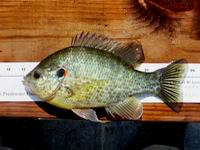
|
|
|
|
|
Joined: Nov 2011
Posts: 910
|
|
Joined: Nov 2011
Posts: 910 |
Ewest, this is a very well written and informative article but you should include pictures, maybe semi-nude fish.
|
|
|
|
|
Joined: May 2010
Posts: 182
Fingerling
|
|
Fingerling
Joined: May 2010
Posts: 182 |
ewest, Thanks for the article and I will be subscribing.
I made it very clear when ordering and picking up the fish that I did not want HBG in any form or fashion. I was nervous being how they raise them and have them on site and there could always be a mix up. Reading the article and looking at the pictures it does appear I received CNBG as I was supposed to.
In hind sight, I wish I would have made the trip to overton's since, from what I understand, they do not mess with HBG and have an outstanding CNBG bloodline.
|
|
|
|
|
Joined: Mar 2005
Posts: 22,033 Likes: 483
Moderator Hall of Fame 2014 Lunker
|
|
Moderator Hall of Fame 2014 Lunker
Joined: Mar 2005
Posts: 22,033 Likes: 483 |
Overton has excellent CNBG.
Yours that I looked at did not look like any HBG variety .
I don't know from their site what they mean by some of the names they use or understand some of the stocking suggestions. They do however note in some the use of 2000-3000 BG per acre rather than 1000.
|
|
|
|
|
Joined: May 2010
Posts: 182
Fingerling
|
|
Fingerling
Joined: May 2010
Posts: 182 |
Overton has excellent CNBG.
Yours that I looked at did not look like any HBG variety .
I don't know from their site what they mean by some of the names they use or understand some of the stocking suggestions. They do however note in some the use of 2000-3000 BG per acre rather than 1000.
As per the consensus of this site I went with a lower stocking rate compared to what most hatcheries in the area were pushing. I stocked at around 750 per acre and am giving them a year to get their numbers and size up before predators are introduced.
|
|
|
|
|
Joined: Jan 2009
Posts: 29,788 Likes: 1295
Moderator Ambassador Field Correspondent Lunker
|
|
Moderator Ambassador Field Correspondent Lunker
Joined: Jan 2009
Posts: 29,788 Likes: 1295 |
Without predators in the pond they should pull off a spawn this coming Spring.
|
|
|
|
|
Joined: Mar 2005
Posts: 22,033 Likes: 483
Moderator Hall of Fame 2014 Lunker
|
|
Moderator Hall of Fame 2014 Lunker
Joined: Mar 2005
Posts: 22,033 Likes: 483 |
Yes fewer BG and more time to grow and reproduce will work. Kenc the pics are in the link and all of them are nude. 
Last edited by ewest; 10/01/12 09:17 PM.
|
|
|
|
|
Joined: May 2010
Posts: 182
Fingerling
|
|
Fingerling
Joined: May 2010
Posts: 182 |
Without predators in the pond they should pull off a spawn this coming Spring. That was my only choice due to the fact I could not locate larger stockers within a reasonable driving distance. I know they pulled off at least one spawn, possibly two, this past summer.
|
|
|
|
|
Joined: Mar 2005
Posts: 22,033 Likes: 483
Moderator Hall of Fame 2014 Lunker
|
|
Moderator Hall of Fame 2014 Lunker
Joined: Mar 2005
Posts: 22,033 Likes: 483 |
You could check with Todd and see if he has a few adult CNBG to add to yours. That would give you some additional CNBG genes which would be a good idea. Be sure to ask for G Glazener offspring.
|
|
|
|
|
Joined: May 2010
Posts: 182
Fingerling
|
|
Fingerling
Joined: May 2010
Posts: 182 |
Will do, assuming they will be fine to stock with stocker LMB this spring. I am hoping to stock Camelot Bell LMB.
|
|
|
|
|
Joined: Nov 2011
Posts: 910
|
|
Joined: Nov 2011
Posts: 910 |
Ewest, semi-nude may be better as it leaves a little for the imagination.
|
|
|
Moderated by Bill Cody, Bruce Condello, catmandoo, Chris Steelman, Dave Davidson1, esshup, ewest, FireIsHot, Omaha, Sunil, teehjaeh57 |
|


![[Linked Image from lh6.ggpht.com]](https://lh6.ggpht.com/_6_-SgakQ9co/S3Nx1jGAJWI/AAAAAAAABKU/DJIy4ZnF1t0/s800/I_subscribe.jpg)





