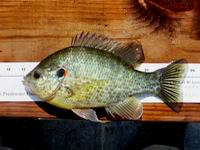
The following should add some more info wrt my post above. It�s all about energetics and conditions relative to optimal foraging theory. Those are based on instincts that come through genetics and enhanced by conditioning.
From
Transactions of the�4rnerican Fisheries Society 114:725-731, 1985
Effects of Cover and Prey Size on Preferences of Juvenile
Largemouth Bass for Blue Tilapias and Bluegills in Tanks
HAROLD L. SCHRAMM, JR. &
ALEXANDER V. ZALE
Abstract
The effects of vegetative cover and relative size of prey were tested on the forage preference of
juvenile largemouth bass Micropterus salmoides offered blue tilapias Tilapia aurea and bluegills
Lepomis macrochirus in laboratory electivity experiments. When offered forage at or near the
maximum consumable size in tanks without vegetative cover, largemouth bass preferred bluegills,
but consumed blue tilapias in the presence of vegetation. When offered forage smaller than the
maximum consumable size in tanks without vegetation, largemouth bass selected blue tilapias.
Differences between the forage species in body morphology and effective use of protective cover
apparently caused the changes in prey selection �.
When offered forage at or near the maximum
consumable size in tanks without vegetative cover,
largemouth bass consumed more bluegills than
blue tilapias in 11 of 12 trials (Table 1). When
offered forage of the same relative size in tanks
with vegetation, largemouth bass consumed more
blue tilapias than bluegills in all 8 trials (Table
1). In trials with forage smaller than the maximum
consumable size in tanks without vegetation,
largemouth bass consumed more blue tilapias
than bluegills in 8 of 10 trials (Table 1).
Selection was significantly different from random
in all three cases.
In the absence of vegetative cover, juvenile
largemouth bass consumed blue tilapias rather
than bluegills when both species were smaller
than the maximum consumable size, but reversed
their preference when prey were at or near
the maximum consumable limit. We suggesthis
reversal is consistent with optimal-foraging theory
(Schoener 1971; Pyke et al. 1977). Within
each of these trials, body depths of both forage
species were equivalent and interspecific differences
in total lengths were relatively small or
absent (Table 1). However, blue tilapias consistently
weighed more than bluegills of equivalent
body depth or length. This difference in depthor
length-specific weight was attributable to the
more robust morphology of blue tilapia; blue tilapias
are conspicuously thicker bodied and have
a greater girth than bluegills of equivalent length
or body depth. When offered easily ingestable
forage, well below the maximum consumable size,
largemouth bass selected the heavier, and therefore
more energetically valuable, prey item (blue
tilapia). Conversely, when offered forage at or
near the maximum consumable size, for which
handling costs are high (Werner 1974), largemouth
bass selected the more laterally compressed
prey (bluegill). Thinner-bodied prey may
be ingested more efficiently because of reduced
girth or defensive struggle capabilities, or may
have been selected simply because largemouth
bass perceived them to be smaller, despite their
body depth. Largemouth bass prefer forage
smaller than the maximum consumable size
(Tarrant 1960; Wright 1970; Shaftand and Pestrak
1984).Because the largemouth bass in experiment 3
(forage smaller than the maximum consumable
size) were larger than the largemouth bass in experiment
1 (forage at or near the maximum consumable
limit), differences in predator size may
have affected prey selection. However, both
groups of largemouth bass were of a size considered
to be predominantly piscivorous (Carlander
1977) and no relationship between predator size
and prey selection within each experiment was
evident (Table 1). We consider relative prey size
to be a more likely explanation of the observed
reversal in prey selection.
The presence of vegetative cover caused a profound
shift in the diet of largemouth bass offered
blue tilapia and bluegills of maximum consumable
size; bluegills were consumed in trials in
open tanks but largemouth bass selected blue
tilapia when vegetation was present. Glass (1971)
and Savino and Stein (1982) found reduced predation
success by largemouth bass on bluegills
at high densities of simulated aquatic vegetation.Young bluegills typically occupy vegetation
(Stuntz 1975; Werner et al. 1977) and, hence,
reduce the risk of predation (Werner et al. 1977;
Cooper and Crowder 1979; Stein 1979; Savino
and Stein 1982; Werner et al. 1983). Habitat use
by young blue tilapias is not known but small
individuals of other tilapias occupy vegetated
habitats in native African lakes (Lowe-Mc-
Connell 1959; Jackson 1961; Donnelly 1969;
Bruton and Boltt 1975), apparently in response
to predatory pressures (Lowe-McConnell 1959;
Jackson 1961). We have collected young blue
tilapias in dense beds of eelgrass Vallisneria
americana in Lake George, Florida, and Hulon
and Williams (1985) collected young blue tilapias
in littoral habitats in Lake Tohopekaliga,
Florida. However, our casual observations of blue
tilapias in aquaria indicate they are not as inclined
to enter cover when frightened as bluegills.
The increased consumption of blue tilapias by
largemouth bass in the vegetated tanks suggest
that blue tilapias did not use vegetative cover to
escape predation as effectively as bluegills.
Our findings indicate habitat characteristics
may affect relative use of blue tilapia by largemouth
bass. Furthermore, the consumption of
blue tilapia may affect the predator-prey dynamics
of other forage species. High densities and
stunting of bluegills are commonly attributed to
reduced vulnerability to predation by piscivores
when aquatic vegetation is abundant. Juvenile
largemouth bass selectively foraging on blue tilapias
when vegetation is present may further
reduce predation on bluegills. Shaftand et al.
(1983) found an increase in the abundance of
small bluegills in a vegetated lake containing
largemouth bass and an expanding population of
blue tilapias.
Last edited by ewest; 02/06/12 10:27 AM.


.gif)