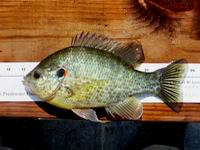
I am going to attempt to answer some of the questions on this thread or at least provide some food for thought in understanding the why of prey selectivity.
To be clear there are multiple factors involved and the best we can do is try to understand some of them in context. IMO the factors are biologic/genetic. By that I mean the choice of prey is based on biology and instinct not learned behavior or choice (likes/intelligence). I will do this in parts as one of the studies I have to relocate and copy and paste.
I believe the main factors are predator gape size , energetics and the lake's prey dynamics (statistical probability). Here is some info that should set the stage.
Experimental Analysis of Prey Selection by Largemouth Bass:
Role of Predator Mouth Width and Prey Body Depth
Transactions of the American Fisheries Society
120:500-508, 1991
K. DAVID HAMBRIGHT
Prey-selection behavior of piscivores also influences the vulnerability of prey. Optimal foraging theory postulates that predators maximize the ratio between the benefits gained and the costs incurred in obtaining prey. Obviously, the benefits gained increase as a function of prey size, but cost, in particular that due to handling time, also increases rapidly with prey size (Werner 1974). Hoyle and Keast (1987,1988) demonstrated that, for two piscivores (largemouth bass Micropterus salmoides and grass pickerel Esox americanus), the weight-adjusted handling time for prey of equivalent lengths varied with body shape: it was lowest for shallow-bodied bluntnose minnows Pimephales notatus and tadpoles Rana catesbeiana and higher for deeper-bodied yellow perch Percaflavescens and bluegills Lepomis macrochirus. In addition prey body depth has been shown to influence other cost-related aspects of ingestion by piscivores, such as pursuit time and capture success (Moody et al. 1983; Webb 1986). I here present further evidence that prey body depth in relation to piscivore mouth size is important in determining the sizes of prey selectively consumed by gape-limited piscivores.
Perhaps the most important variable in the selective feeding of piscivores is prey size. Gut analyses show that piscivores are size-selective and that prey size typically increases with piscivore size (Parsons 1971; Knight et al. 1984). Although the upper limit in prey size is constrained by the relationship between piscivore mouth size and prey body depth, piscivores tend to consume prey sizes that are much smaller than the maximum possible (Lawrence 1958; Gfflen et al. 1981). The high occurrence of small prey sizes in piscivore guts is usually assumed to reflect the high relative abundance of these sizes in the prey assemblage (Hoyle and Keast 1987). However, prey size distributions in piscivore guts can be skewed toward sizes smaller than those most abundant in the assemblage, especially when the assemblage is dominated by deep-bodied species such as sunfish, ale wives Alosa pseudoharengus, and gizzard shad (Gillen et al. 1981; Knight et al. 1984).
Using a simple graphical model and census data from a small lake, Hambright et al. (in press) illustrate that this pattern can be explained simply as an interaction between prey body depths available and mouth widths in the piscivore population. If encounters are random, the probability of a particular prey fish encountering a piscivore of mouth width large enough to ingest it decreases as prey body depth increases. As a result, most or all sizes (juveniles to adults) of shallow-bodied species will be highly vulnerable to piscivory. Ingestion of deep-bodied species will be concentrated on the smaller (younger) individuals in the populations, whereas larger adults occupy a size refuge with very low vulnerability to piscivory. In the present study, preference of intermediate and large predators for fathead minnows and pumpkinseeds with similar body depths was equivalent to preference for adult fathead minnows but juvenile pumpkinseeds. Small largemout
bass tended to prefer juveniles of both species This pattern of selection appeared independent of relative prey abundance. Prey were distributed evenly across size-classes (with a few exceptions) at the beginning of each feeding trial, although the distribution of prey sizes changed during the 2-d experiment, resulting in occasional depletion of one or two size-classes. Thus, the preferences observed provide a conservative measure of selection by the largemouth bass. Any tendency for the predators to track the more abundantsize-classes would have directed them toward
the remaining prey (i.e., the larger pumpkinseeds and smaller fathead minnows), thereby potentially reducing the observed preferences.
Last edited by ewest; 02/03/12 09:19 PM.


.gif)