|
Forums36
Topics42,115
Posts571,695
Members19,116
| |
Most Online45,564
Yesterday at 03:05 AM
|
|
|
0 members (),
9,175
guests, and
169
robots. |
|
Key:
Admin,
Global Mod,
Mod
|
|
|
|
Joined: Aug 2002
Posts: 20,043 Likes: 1
Hall of Fame  Lunker
|
|
Hall of Fame Lunker
Joined: Aug 2002
Posts: 20,043 Likes: 1 |
Tyler,
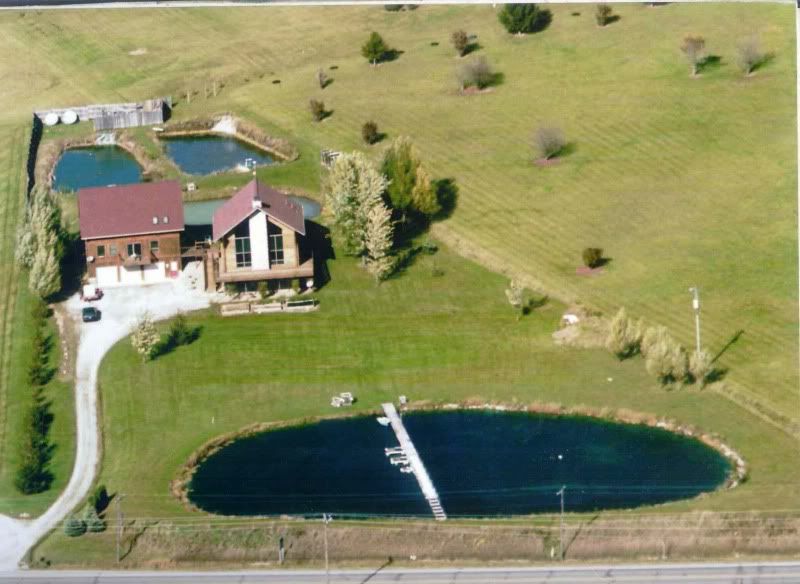
Don't know if that was enough as I'm no expert. But I know what seemed to work for me last winter, and my pond is about the same size as yours (.62 acres 150 by 200 feet). But I think I can improve on that, but more on that later in the post.
Last winter I used a compressor that puts out 1.5 cfm's with a flexible circular diffuser that sits on a PVC stand about one foot off the bottom in about 5 feet of water on one end of the pond. (I aerate in the center of the pond in summer). This size compressor actually may have mixed the pond too well, but kept a hole open as large as 20 feet during average winter conditions. I say too well, as even in the center of the pond in the deepest water, I had temps lower than 39 F., which may have indicated too much mixing. I also caught and released some bass that had red gums that is a sign of stress. However, oxygen levels were fine, so the stress was probably from water being a little too cold in the deep water. (Believe it or not, warmwater fish can be stressed from too cold of water and prefer that relatively warmer santuary of the upper 30's in the deepest water if there is enough dissolved oxygen there.)
This winter I will use a smaller compressor that puts out only .7 cfms and see if there are more stable deepwater temps. I used it on my smaller trout pond last winter and it creates a good surface boil.
Additionaly since I attempt to raise trophy fish for sale and I have a lot invested, I also go out on the ice (stay a safe distance away from the diffuser hole) with my snow blower and blow off the snow whenever we have more than an inch of snow. Less than that and the wind did a good job of blowing it to one side of the pond.
If I had to guess, as you surmise too, the heavy snow on the ice did the most damage to your fish along with apparently not enough methane and/or hydrogen sulfide being vented off, and then when you started aerating too late you actually brought up those lethal gases even more. But it may have been better than nothing as your smaller fish survived that can handle bad water conditions better than larger fish.
As far as removing snow, according to some literature I have, you don't need to get it all off like I do. You can remove it in strips.
To show you how toxic the methane and/or hydrogen sulfide can be, I have been told by one fish farmer to NEVER EVER move a diffuser in winter as it can stir up the methane and/or hydrogen sulfide, which can have the same effect as aerating too late as you may have done. I also read about one fishing technique some Indians employed in very fertile bodies of water. They would pull large rocks behind a canoe to stir up the bottom gases that would stun fish and cause them to float to the surface for harvest.
Although in your shoes, I would feel more confortable with a bottom diffuser like mine, I would think that if you do not allow the gases to build up by running the aerator just before ice up, and get alot of that snow off, you should be O.K. next winter. But like I said, I'm no expert I just know what works for me.
If you are in the Lake Effect Snow belt you have your work cut out for you if you decide to remove snow periodically off the ice. Just make sure the ice will support you before you take equipment on the ice, and hopefully the ice freezes thick enough before the snow piles up.
I did lose one 4 lb + bass to fungus this spring but that may have been from handling the fish before release from icefishing. I won't icefish the pond anymore as I have been told from a reliable source it stresses warmwater fish.(Would be O.K. if you were not releasing them)
Good Luck.
If pigs could fly bacon would be harder to come by and there would be a lot of damaged trees.
|
|
|
Moderated by Bill Cody, Bruce Condello, catmandoo, Chris Steelman, Dave Davidson1, esshup, ewest, FireIsHot, Omaha, Sunil, teehjaeh57 |
|