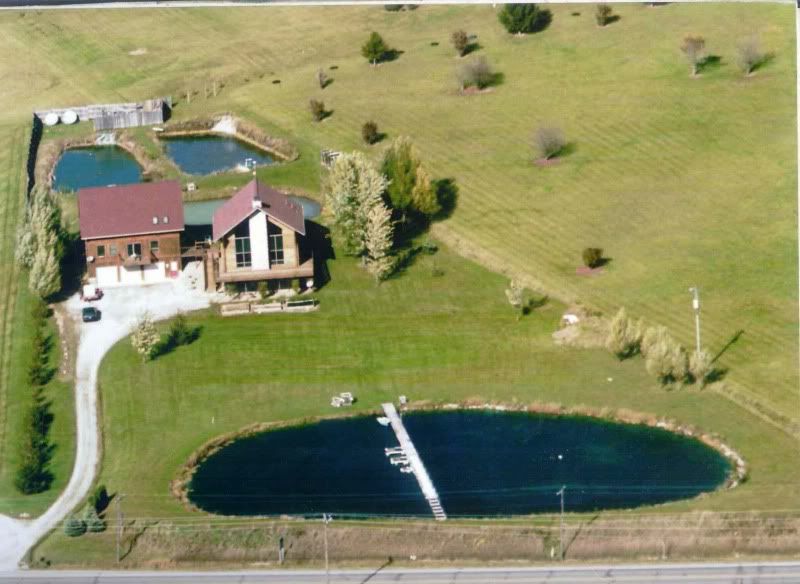
I finally got to fish today although the conditions were less than ideal. Caught one trout and it started raining as I was reeling it in so that was it for fishing. Pics of it here as well as how the first feeding went:
Thanks! I'll hopefully be able to get some better pics with a real camera. While researching stocking trout on here I saw some pictures of your pond and fish, they are both very nice! I especially like how you're able to grow out some native brookies in the pond and return them to your stream, it's a very nice setup you have going up there.
Unfortunately my pond being only 8 ft deep is like spitting into the wind, and although I have available plenty of water inflow spring, summer and fall to aerate and cool the pond I still had a winterkill problem for the trout. Now that I'm pumping water from the stream through an insulated pipe to keep water levels up we'll see if this is the year they survive, if not I'll put in a bigger pump next winter.
That really stinks, sound like your problem is the opposite of what I'll have with the heat down here. How far do you have to pump the water from the stream? Having ice on ponds is pretty much an unknown problem down here. This one had a couple inches on it for a few weeks but was never completely covered except for maybe two or three days. There have been a few years where the lakes up in the mountains freeze over for several weeks but I wouldn't trust the ice enough to ice fish on them.
Yeah Virginia is a nice climate, I lived near Charlottesville for 6 years back in the 70's and early 80's, right about now I wouldn't mind being back there.
The stream runs past about 120ft. from the pond and about 10ft. below it. The pump is putting out 12gpm and keeping the pond within 8 inches of full, I just hope there's enough oxygenated water to keep them alive.
If you can get them, tiger trout would be a fun addition to your pond, IMO they are the most aggressive trout and easiest to catch.
I live a little more than half an hour from Charlottesville, on the western side of the mountains. Does the stream flow below your pond for the length of your property? I've seen a pond beside a stream that was fed by running a pipe from upstream of the pond as an inlet with a discharge pipe going out downstream from the pond. It would probably require a steep gradiant stream to work but it would do away with needing a pump and the ground may provide some added insulation depending on how deep the pipe was buried.
I didn't see anyone listed on the VDGIF's list of private hatcheries as producing tiger trout but someone might, I may call and ask around next fall to see. The state used to stock them for a while but I think they stopped around 1996 or 1997 due to them not being easy to produce. I've read that WV still stocks them although they don't list them as a stocked fish, so I don't know.
The stream runs through my property for about 1/2 mile and has naturally reproducing native brook trout.
I do have gravity siphon pipes that run from above a waterfall and travel 300ft. down to my pond supplying 95gpm. The problem is it's too cold in the winter and they freeze up. This past fall I decided it was easier to pump water 120ft. up to the pond where the stream passes closest to the pond, I insulated the pipe and buried it shallow cause up here we have little dirt and lots of rock. Fish farms in PA. have tigers so that may be an option if you decide you want some.
I hope the pump works out for you, it would be nice if you could keep the trout long enough to reach their maximum potential size, big tiger trout are some nice looking fish! Since your trout have lots of natural forage as well, if you could introduce them as fingerlings they'd be as close as you could get to a wild trout by the time they were adults. I looked up some trout hatcheries that produce tiger trout online, some of them seem quite expensive! I did find one in PA that recently opened a hatchery in WV, it'd probably be closer to me but is still like three hours away.
Upstate here we have 2 colleges that raise tigers as part of their aquaculture program and their about the same price as rainbows. Maybe there is a college in VA. that raises them also.
Thank you for the link, I'll check around some more in VA and see what I can find. I really hope a few tropical storms make it this way this summer or fall so there will be a full pond going into the winter. The trout seem to be hanging out in the deepest part of the lake now although I did see a few goldens up near the shoreline as the sun was setting this evening so they're probably hitting it up in the evening/morning looking for food. Only put a couple handfuls in today, no takers again. A feeder isn't really in the budget right now and it'd be kind of hard to place with the lake being down like it is. I think I'm going to get a sling shot and put a bigger pouch on it, that should get the food out a lot further than I can throw it. While fishing with my cousin we saw a couple jump out on the shallow end of the lake. I'm pretty sure they were trout as the bass I've caught have mostly been from the deeper water as they're still not super active due to water temps. A couple of the ones we caught today had some stuff in their stomachs, not sure what it was but it looked kind of like beetles? Any aquatic insects that look like that? Still too cool for beatles to be out I'd think. Here's a pic of todays catch for anyone who hasn't visited the other thread. If you live in VA and are looking for some trout, I'd definitely recommend Castaline Farm where these came from. I grilled the larger rainbow up with the two I kept yesterday, sent two of the goldens home with my cousin and the four other ones are going to my mom tomorrow, they're a good skillet size. Out of 200 trout stocked, 10 have been creeled, about twice that many that could have the hook quickly removed without being removed from the water have been released.
Thanks, I'm happy with the fish. Fin wear seems to be expected on most hatchery trout and these have some but so far the ones I've caught have been decent looking. I've caught trout stocked by the state before that pretty much just had a worn out tail and stubs where all the other fins were supposed to be. As far as the taste and texture of the goldens differing from the rainbows, I actually have yet to eat one of the goldens. My cousin ate one for dinner last night and didn't mention anything about the taste. I don't recall the ones I've caught elsewhere being different but it's been a while since I've had one so I'll have to compare them next time I catch a few to eat. One thing that is kind of odd is that the two largest rainbows I've kept have had eggs developing in them and I think all of the goldens I've kept have been full of milt while none of the rainbows have. Even though the rainbow to golden ratio was 3:1, the catch ratio has been about 2:1 in favor of the goldens. I'm not sure if the fact that they're males that seem to be ready to spawn has anything to do with it or not or if it's just a coincidence. Haven't noticed any rainbows with milt yet.
I put both in the pond during the winter of 2009/2010 and found that the goldens were more agressive towards lures by at least 3:1 over the RBT. The first one that I cooked seemed a bit softer than the RBT, but after a week I couldn't taste a difference. I like the Goldens over the RBT because they are easier to see in the water, and they are more agressive towards lures.
I wonder why, same exact species just a color morph... Perhaps the original stock that produced the golden genetics is very different from the genetic stock of the normal colored rainbows you got and one is more prone to feed on fish than the other?
I've noticed the same thing with the lures in the short time I've fished for these. Bait was used for the first time yesterday and caught a higher ratio of rainbows than with lures although it was still about even. As far as why that is, I'm not sure. My understanding is that the golden trout were all derived from a single trout found in a WV state hatchery in the 1960s. You would think that there would've been enough bred by now to be similar to regular rainbows but I guess there could be another gene that goes with that one that produces the color morph that makes them more agressive. I would think that a lot of inbreeding would've had to initially occur with the goldens, if those first few fish happened to be more agressive than usual, I suppose it could still be present. In the aquarium hobby fish bred for a particular trait within a species usually exhibit some other traits that make them different from the original species beyond simply having different coloration.
Golden trout are simply Rainbow Trout with a genetic defect that changed the color....similar to an Albino catfish.
The hatcheries breed the goldens and get more, but they also get normal colored rainbows if the spawns also. Still, the goldens, sometimes called Palomino Trout are actually Rainbow trout and not a seperate species.
It is also noticed that Golden trout are more aggressive and stay higher in the water....one theory for both these "traits" is that the bright color makes them more easily seen by predator and prey alike...They stay higher to avoid predation from fish,but making them vulnerable to birds of prey...they are more agressive, because prey see them and avoid them more easily...thus, they are hungrier and more agressively chase food.
The WV goldens and palominos are two different things. What you say about the WV golden is correct, however the palomino trout is a WV golden crossed with a normal pigmented rainbow.
Golden Rainbow Trout Oncorhynchus mykiss
Species overview. The golden rainbow trout is a gold-orange rainbow trout raised under artificial fish culture conditions and stocked as a novelty for angling sport. The golden rainbow was developed from one fish, a single female trout with a genetic mutation that gave her a mixed golden and normal rainbow trout coloration. She was found in the West Virginia hatchery system in 1954. Through selective breeding with regularly marked rainbow trout, an all-gold, golden rainbow trout was developed. In 1963, this fish strain was popularized as the �West Virginia Centennial Golden Trout.� Pennsylvania and other states hybridized the pure strain of West Virginia golden trout with normal rainbows and produced palomino trout, which were true genetic palominos. Palomino trout were first stocked in Pennsylvania in 1967. Since then, the genetic strain in Pennsylvania has weakened, but in recent years the hybrid was selectively bred back closer to the stronger, better-colored golden rainbow trout. Although palominos were stocked as both average-sized and large trout, today�s golden rainbow is raised only to trophy size for anglers and stocked throughout the state.
It is also noticed that Golden trout are more aggressive and stay higher in the water....one theory for both these "traits" is that the bright color makes them more easily seen by predator and prey alike...They stay higher to avoid predation from fish,but making them vulnerable to birds of prey...they are more agressive, because prey see them and avoid them more easily...thus, they are hungrier and more agressively chase food.
If there were wild, reproducing populations of golden trout I might be able to think they ended up being aggressive for those reasons through natural selection. But, since these trout have spent their lives in a hatchery being fed and not preyed on, I don't know if that's very likely. I don't think that the trout are aware that they're yellow and need to be more aggressive because of it but maybe after being in a natural setting for a while they'd become more aggressive towards forage and therefore lures.
I can tell you one thing, when fishing in a PA creek you quickly know which pool has a palomino in it! It's the one with 50 guys standing around it all getting tangled up! My favorite palomino I caught was when fishing for lake trout in Raystown Lake. It must have washed down stream from where they are stocked and ended up in the lake where it did just as any rainbow trout would in a lake full of smelt and alewife, it grew huge.
Speaking of fish going downstream, I just took in a 30 lb. musky to mount from the St. Joe River which runs into Lake Michigan. Other than possible clandestine stocking they aren't planted there. However it is possible fingerlings planted in a lakes in the system that feed into another river that feeds the St. Joe may have made their way down. A biologist told me they shocked up four or five in that area.
If pigs could fly bacon would be harder to come by and there would be a lot of damaged trees.






![[Linked Image from lh6.ggpht.com]](https://lh6.ggpht.com/_6_-SgakQ9co/S3Nx1jGAJWI/AAAAAAAABKU/DJIy4ZnF1t0/s800/I_subscribe.jpg)