|
Forums36
Topics42,115
Posts571,693
Members19,116
| |
Most Online45,564
13 hours ago
|
|
|
|
Joined: Dec 2010
Posts: 2
|
|
Joined: Dec 2010
Posts: 2 |
Hello,
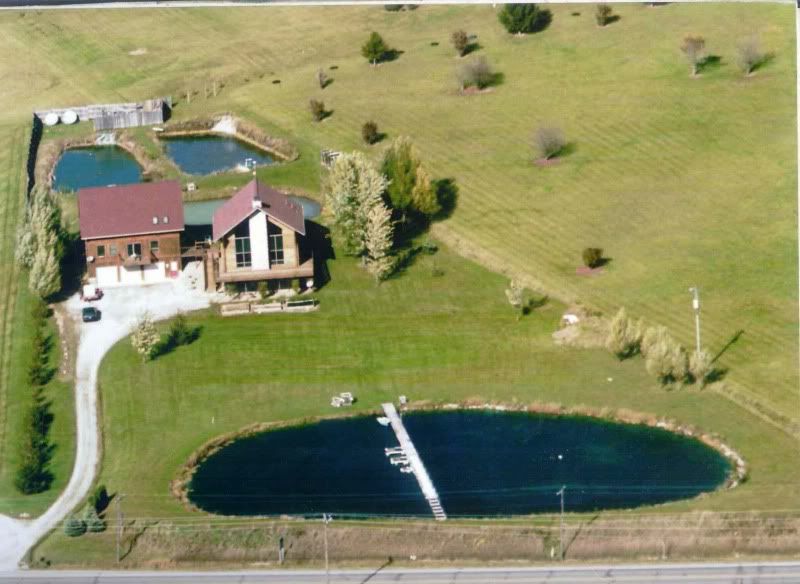
I am buying a property in Upstate NY with a quarter-acre artificial pond that is six years old. It is 16' deep with a 3-1 slope, spring-fed and with plenty of surface water runoff. One side of the pond has significant giant reed grass. Otherwise there is little structure in the pond itself.
I spoke with the builder/owner who stocked the pond with LMB only when the pond was built, and commented that (predictably) the fish are now stunted around 8-10".
I have been reading the site for a couple of weeks and have learned a lot. My goal is to get the pond into balance and grow some nice sized bass. Active maintenance (like feeding) is OK with me. I think the next step is to add a forage base in May when the temperature starts warming up, but would like some advice on how to do that with the starving, established bass population.
I'd really like to avoid bluegill as I don't like eating those and they can harass bass nesting. I'm thinking Fathead minnows would just get eaten and be gone inside a week. I'm planning to leave as much giant reed grass in the water as I can stand, to provide cover for the prey fish. I am leaning toward buying Golden Shiners as big as I can find them and hoping for the best.
Also wondering if it's practical, with a pond my size, to erect some kind of artificial submerged barrier (like a fence) for a year that would keep the bass out but allow the preyfish to go through. Or if it's reasonable to expect a GS population to survive.
Thanks!
|
|
|
|
|
Joined: Mar 2005
Posts: 22,033 Likes: 483
Moderator Hall of Fame 2014  Lunker
|
|
Moderator Hall of Fame 2014 Lunker
Joined: Mar 2005
Posts: 22,033 Likes: 483 |
Welcome to PB. You have picked a hard path. Start by taking out half the LMB in the pond. Without BG you will have a big job. GShiners need plankton for their offspring to eat. While a small pond (< 1 acre) can support some GShiners I am not sure it can support enough to overcome the LMB onslaught with enough survival to establish an ongoing population. Prior info from Mark Cornwell (he is a prof of fisheries in upstate NY- contact him for help) among others suggests it will be difficult. PS may work but would likely have the same problem. Tilapia would work but you are too far north for that to be a full year answer.
My advice is take out at least half the LMB ( more would be better). Then stock 150 adult BG , 100 adult PS and 250 adult GShiners. All pre spawn. All 3 of those should be big enough to avoid much of the LMB predation (assumes no big LMB > 14 inches). All 3 of those will eat yoy LMB fry which is a goal. You will not be managing for those adult fish but will instead be managing for their offspring to attempt to achieve balance. If successful you will know by the # and size of the offspring over 2-3 years. You will want at the beginning for there to be heavy predation by the BG , PS and GShiners on the LMB yoy. After that manage for balance by harvest. Feeding would help.
Last edited by ewest; 12/10/10 03:37 PM.
.gif) 
|
|
|
|
|
Joined: Apr 2002
Posts: 16,001 Likes: 1498
Moderator
Ambassador
Field Correspondent Lunker
|
|
Moderator
Ambassador
Field Correspondent Lunker
Joined: Apr 2002
Posts: 16,001 Likes: 1498 |
Ewest has a good option and good management ideas that can be used with my options. Consider this option. Try some yellow perch(YP) and golden shiners with the LMB. I usually don't suggest YP with LMB due to LMB with large mouths in smaller fairly barren ponds often prevent YP in the long term (5-10yrs) from recruiting new perch once the LMB get common and above 12"-15". Since your LMB are still small, adding some larger YP may work for awhile if you keep an eye on the balance and remove all larger LMB (>12"). Another option is to stock some pumpkinseed sunfish while the LMB are still smaller.
Before you add a forage species, I would also do as ewest suggests and make a concerted effort to remove at least 60%-90% of the existing LMB. Removing 50% may not be enough LMB removed depending on what you stock as new fish. This removal wont be a lot of bass. IMO you cant remove too many LMB to achieve your stated goals. Remaining bass should recruit & recover quickly. In bass only pond of 1/4 ac you should only have around 16-25 adult bass. Thin them heavily to take significant predation pressure off new forage fish to let new forage have a better chance to get established. Another option is to remove as many LMB as possible and replace with pellet fed LMB&YP. This will work okay until new recruited nonpelleting bass get big enough to hammer the YP into a reminant population (5-7yrs) of old larger adults. Another option in this small of a pond is torenovate and start over with smallmouth bass (or LMB) and a suitable forage fish. IMO smallies will do better and be easier to manage than LMB in a small pond such as yours.
Since your pond is small, I prefer catch all the LMB you can and then I prefer the renovation with rotenone and start over. A better fishery will be established faster if you renovate. If you stay with LMB the largest ones you can reasonably expect to grow without pellets is 1 or 2 at 18", 1-2 at 14-16" and 5-10 at 7"-12".
Hybrid stripped bass work well in a small pond, but I dont think NY allows them.
Keep us advised in this thread topic as tohow things work out. Thanks and welcome to our Pond Boss Forum Family.
Last edited by Bill Cody; 12/10/10 04:04 PM.
aka Pond Doctor & Dr. Perca Read Pond Boss Magazine -
America's Journal of Pond Management
|
|
|
|
|
Joined: May 2002
Posts: 3,973 Likes: 1
Ambassador
Field Correspondent Lunker
|
|
Ambassador
Field Correspondent Lunker
Joined: May 2002
Posts: 3,973 Likes: 1 |
How long ago were the bass stocked? WIth your goals I strongly suggest starting over. Either drain and poison or poison what you have. You have lost the early growth years of those bass. You wil save money by buying smalelr fish in less numbars than trying to establish forge of bigger size.
|
|
|
|
|
Joined: Apr 2002
Posts: 16,001 Likes: 1498
Moderator
Ambassador
Field Correspondent Lunker
|
|
Moderator
Ambassador
Field Correspondent Lunker
Joined: Apr 2002
Posts: 16,001 Likes: 1498 |
Everyone makes good points. Now you have to decide if you want to mess around trying to manage what you curently have or starting over. Since your goal is not real large bass (6-8 lbs), IMO you will learn more about fish management and you deal with more challenges overall if you work with what bass you now have. Challenges are learning experiences. Those bass are stunted but with with proper management it will take 2-4 yrs to get them to sizes at least 16" maybe 18" if they have ample forage. Although you could also grow the same size of LMB in 3-4yrs by starting over with completely new fish, plus your genetics will likely be at least some better by starting over. But it is hard to tell if the genetics of your current LMB are poor, average, or better. Growing a few large LMB (5-6+ lb) in 0.25 ac is definately a challenge.
The LMB population that you now have is pretty typical for LMB only in a small pond.
Last edited by Bill Cody; 12/10/10 11:07 PM.
aka Pond Doctor & Dr. Perca Read Pond Boss Magazine -
America's Journal of Pond Management
|
|
|
|
|
Joined: Mar 2005
Posts: 22,033 Likes: 483
Moderator Hall of Fame 2014 Lunker
|
|
Moderator Hall of Fame 2014 Lunker
Joined: Mar 2005
Posts: 22,033 Likes: 483 |
Quote "My goal is to get the pond into balance and grow some nice sized bass."
I did not go over the start over option. It could be the best option as you get to start with a clean slate. If you go that route then my choice would be FH , GShiners , PS and SMB with a bonus fish (YP , trout or WE). You did say bass which could be SMB rather then LMB. If this sounds like an interesting option then I suggest you get a back copy of PB mag containing Doc Cornwell's article on such a pond stocking.
JUL - AUG 06
8. THINKING SMALL �. SMALLMOUTH BASS, THAT IS. Cornwell describes some smallmouth habits, good forage items for SMB, feasibility of stocking SMB and LMB together. Case history of a SMB and LMB pond is included.
Thanks Bill for the archive index to PB mag articles.
Ewest: Cody is working on the 2010 Pond Boss Index. Look for it before Christmas.
Last edited by Bill Cody; 12/12/10 05:42 PM.
|
|
|
|
|
Joined: Jan 2009
Posts: 10,458 Likes: 3
Ambassador
Field Correspondent
Hall of Fame Lunker
|
|
Ambassador
Field Correspondent
Hall of Fame Lunker
Joined: Jan 2009
Posts: 10,458 Likes: 3 |
0.25 acres is fairly cheap to poison and start over. Which is what I would do...
Trying to keep a balance in a 0.25 pond is a nightmare! I would strongly look into bass that are pellet trained. In smaller ponds(less than a 1/2 acre), utilizing pellet trained fish is IMO the only way to go if you want quality fishing.
Poison the pond, purchase pellet trained bass, keep their numbers low and work hard on keeping their offspring from surviving. I'd remove all cover from the pond to increase predation on any bass offspring.
You can consider other species with low reproductive rates/success that are pellet trained as well to add with the bass.
Just my take on things, but I am far from an expert.
|
|
|
|
|
Joined: Apr 2002
Posts: 16,001 Likes: 1498
Moderator
Ambassador
Field Correspondent Lunker
|
|
Moderator
Ambassador
Field Correspondent Lunker
Joined: Apr 2002
Posts: 16,001 Likes: 1498 |
Comments are on the mark about not being able to grow very many sportfish in a small 1/4 ac pond. Using pellet trained fish will boost the number and size of adults providing you don't let them become overabundant. As I mentioned above using pellet trained stocker fish is good but one usually has to deal with their offspring who are not pellet trained and non-pellet eaters resort to feeding on small fish and invertebtates; skewing the small pond fishery toward fewer and smaller fish. Periodically restocking some pellet trained fish and harvesting the 'fish eaters' helps keep the average size and numbers higher.
Last edited by Bill Cody; 12/12/10 05:44 PM.
aka Pond Doctor & Dr. Perca Read Pond Boss Magazine -
America's Journal of Pond Management
|
|
|
|
|
Joined: Aug 2002
Posts: 20,043 Likes: 1
Hall of Fame Lunker
|
|
Hall of Fame Lunker
Joined: Aug 2002
Posts: 20,043 Likes: 1 |
I question a 1/4 acre pond would be 16 feet deep at only a 3:1 slope. Did you actually measure the depth? if so is it possible your pond is larger than 1/4 acre?
If pigs could fly bacon would be harder to come by and there would be a lot of damaged trees.
|
|
|
|
|
Joined: Apr 2002
Posts: 16,001 Likes: 1498
Moderator
Ambassador
Field Correspondent Lunker
|
|
Moderator
Ambassador
Field Correspondent Lunker
Joined: Apr 2002
Posts: 16,001 Likes: 1498 |
Actual depth does become an issue when calculationg how much fish toxicant to apply for the correct final concentration. Always make sure of the actual depth when applying rotenone to renovate a pond.
aka Pond Doctor & Dr. Perca Read Pond Boss Magazine -
America's Journal of Pond Management
|
|
|
|
|
Joined: May 2002
Posts: 3,973 Likes: 1
Ambassador
Field Correspondent Lunker
|
|
Ambassador
Field Correspondent Lunker
Joined: May 2002
Posts: 3,973 Likes: 1 |
I suggest draining pond at least partially before rotenone app. The fish seem to find areas of less toxic concnertration when given that depth.
|
|
|
Moderated by Bill Cody, Bruce Condello, catmandoo, Chris Steelman, Dave Davidson1, esshup, ewest, FireIsHot, Omaha, Sunil, teehjaeh57 |
|