Pond Boss Magazine
https://www.pondboss.com/images/userfiles/image/20130301193901_6_150by50orangewhyshouldsubscribejpeg.jpg
Advertisment
Newest Members
fiksegts2, Kirk78, Rgv, Kalispel, TokyoTim
19,114 Registered Users
Forum Statistics
Forums36
Topics42,113
Posts571,667
Members19,115
Most Online13,012
Jun 7th, 2026
Top Posters
esshup 29,788
ewest 22,033
Cecil Baird1 20,043
Bill Cody 15,995
Who's Online Now
1 members (Pond Star), 4,129 guests, and 146 robots.
Key: Admin, Global Mod, Mod
Previous Thread
Next Thread
Print Thread
Joined: Aug 2002
Posts: 20,043
Likes: 1
Hall of Fame
Lunker
Hall of Fame
Lunker
Joined: Aug 2002
Posts: 20,043
Likes: 1
I was seining fish the other day and noticed a perch that gave off a blue/green fluid that looks like a dye. It's very close to being the color of Aquashade. I've also seen this on a customer walleye when they thawed out. It's not very common but something I've seen a few times in the 25 years I've been a fish taxidermist. The first time I saw this I assumed it may have been dye coming off of a towel a walleye was wrapped in, however this was not the case.

I have a possible customer bringing in a "blue" walleye (lacks pigment that is basically silver with a blue back) that he says also has this. This seems to be prevalent in walleyes that come from Canadian waters.

Has anyone else see this and know why this would be part of the slime layer? Dr. Willis?

Last edited by Cecil Baird1; 09/28/10 08:45 AM.

If pigs could fly bacon would be harder to come by and there would be a lot of damaged trees.


Joined: Jan 2009
Posts: 29,788
Likes: 1295
Moderator
Ambassador
Field Correspondent
Lunker
Moderator
Ambassador
Field Correspondent
Lunker
Joined: Jan 2009
Posts: 29,788
Likes: 1295
Blue Perch??

and

Mysterious blue perch surface in Minnesota
From: http://www.twincities.com/mld/twincities/sports/outdoors/14117606.htm

BY CHRIS NISKANEN
Pioneer Press

Minnesota already lays claim to a mythical blue creature, Babe the Blue Ox.

Now, it can claim a new and puzzling scientific oddity, one sure to be the buzz at bait shops: the blue perch.

Since December, Minnesota ice anglers have landed at least four yellow perch, a common panfish species, that aren't yellow at all. These are bright blue with an iridescent glow. Startled anglers who have caught the mysterious fish have been sent scrambling to the Internet or the Department of Natural Resources for answers.

The trail eventually leads them to Dr. Wayne Schaefer, a University of Wisconsin-Washington County professor who has been studying blue-hued walleyes in a remote region of Canada since 2000.

Until this winter, Schaefer hadn't heard of blue perch in Minnesota. But he believes they share the same color variation as the Ontario blue walleyes. The blue perch are likely albino for yellow pigment � the key color element in their skin � and they have skin mucus containing a newly discovered blue protein.

Two blue perch were caught in Lake Mille Lacs this winter. Another came from Lake Winnibigoshish, and another came from Big Lake in Beltrami County, said Schaefer.

He operates a Web site, www.bluewalleye.com, where anglers are reporting their unusual catches.

Nothing about the blue coloring makes the perch unsafe to eat, nor do they have any contaminants, Schaefer said. The blue coloring isn't an apparent mutation, either, because their DNA resembles normal yellow-colored walleyes and perch.

"The blue walleyes are coming from the cleanest waters in Canada,'' said Schaefer, whose school is in West Bend, Wis. "It's not because of an environmental toxin, but it could be a response to an environmental change, such as more ultraviolet radiation hitting the Earth."

AS BLUE AS BLUE CAN GET

Whatever the case, Dick Bassing of Andover was startled when he pulled up a blue perch from Lake Mille Lacs on Dec. 18.

"When I first saw it, the silverish part of it really shown; it was really iridescent,'' he said. "But when I got it on the ice, it looked silverish and bluish." Three weeks later, the son of one of Bassing's friends, Mitch Stone, caught a slightly smaller but identical blue perch.

"How ironic is that?'' marveled Bassing. "Here I catch what is a once-in-a-lifetime fish, and someone else I know catches one, too. It really burst my bubble."

Gerald Albert, the DNR's fisheries biologist for Lake Winnibigoshish in Grand Rapids, also examined a large blue perch caught from the lake by a father and his two sons this winter.

Albert, who didn't recall the anglers' names, sent photos to Schaefer, who is coincidentally one of Albert's friends and occasional fishing partner.

"It was as blue as blue can get,'' Albert said of the fish. "I took some slime scrapings from the fish and sent them to Wayne, along with some pictures."

It was the first blue perch Albert has seen around Grand Rapids, where he has worked since 1989. He has netted and sampled thousands of yellow perch for DNR surveys.

"It would appear that the odds of catching one are really millions to 1,'' he said.

MYSTERY CONTINUES

The blue perch in Minnesota equally mystifies Schaefer, but he said similar fish have been reported in Wisconsin and Iowa.

He didn't rule out the possibility blue perch have always existed and are coming to light because of the Internet. But he does find the reports unusual, because until recently, most reports about blue-hued fish came from Canada.

For the past six years, Schaefer has been studying blue walleyes from waters near the towns of Ears Falls and Armstrong, Ontario. The blue walleyes, reported since the early 1900s, share the same lack of yellow pigment and unusual blue mucus.

Researchers hoped the Canadian walleyes were remnants of an extinct population of blue walleyes from Lake Erie, which disappeared in the 1950s. But genetic tests proved otherwise, Schaefer said.

However, their blue mucus is just as rare. The protein that causes it has never before been identified in nature, Schaefer said. "It seems like it is becoming more prevalent, and it's showing up farther south since I found it six years ago,'' he said.

Schaefer said he has recently discovered a small amount of blue pigment on many of the Lake Winnibigoshish yellow perch he has caught.

"I think it could be something quite important that we don't understand yet,'' he said. "Since it appears on the dorsal (back) areas of the fish, it could have some protective significance,'' he said. "But what's the source? We're trying to find that out."

Albert said the DNR doesn't have any plans to study the blue perch.

Bassing said he's having his blue perch mounted in special glass cases, along with two other normal perch he caught that day.

"The odds of catching a blue perch are like getting struck by lightning," Bassing said. "Since I've also been struck by lightning, I guess I really defy the odds."


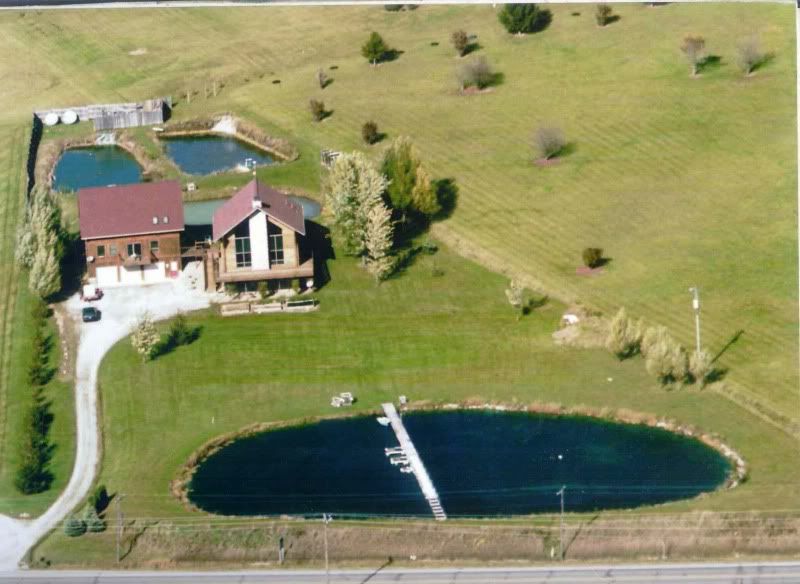
www.hoosierpondpros.com

[Linked Image from lh6.ggpht.com]
http://www.pondboss.com/subscribe.asp?c=4
3/4 to 1 1/4 ac pond LMB, SMB, PS, BG, RES, CC, YP, Bardello BG, (RBT & Blue Tilapia - seasonal).
Joined: Sep 2002
Posts: 2,587
D
Lunker
Lunker
D Offline
Joined: Sep 2002
Posts: 2,587
Cecil, I don't know anything more than what Scott posted. We had a few blue y. perch show up in SD last year, too. I will post a picture.


Subscribe to Pond Boss Magazine

From Bob Lusk: Dr. Dave Willis passed away January 13, 2014. He continues to be a key part of our Pond Boss family...and always will be.
Joined: Aug 2003
Posts: 544
J
Lunker
Lunker
J Offline
Joined: Aug 2003
Posts: 544
I can't say if they were truly "blue perch" I caught, but I have seen many similar colors of YP come from waters here in PA, lakes in Ontario and as far north as Chibougamau, Quebec it doesn't surprise me. I have often seen younger fish that exhibited that light coloring, I always thought it was partly due to environment or some fish getting more sun shine than others, seriously, minnows in a white bucket will bleach their colors and be lighter than those kept in darkness, stands to reason a fish that spent more time shallow would do the same.

Joined: Aug 2002
Posts: 20,043
Likes: 1
Hall of Fame
Lunker
Hall of Fame
Lunker
Joined: Aug 2002
Posts: 20,043
Likes: 1
Thanks all!


If pigs could fly bacon would be harder to come by and there would be a lot of damaged trees.


Joined: Jan 2006
Posts: 2,386
B
Ambassador
Field Correspondent
Lunker
Ambassador
Field Correspondent
Lunker
B Offline
Joined: Jan 2006
Posts: 2,386
I'm Blue with envy. Ooops. wrong color.


Do nature a favor, spay/neuter your pets and any weird friends or relatives.
Joined: Aug 2002
Posts: 20,043
Likes: 1
Hall of Fame
Lunker
Hall of Fame
Lunker
Joined: Aug 2002
Posts: 20,043
Likes: 1
DR. WAYNE SCHAEFER
BLUE WALLEYE STUDY UPDATE
January 31, 2010

1. Two factors contribute to the blue color in walleye:
a. lack of yellow pigment in the skin of the fish.
b. presence of blue pigment in the skin mucous of the fish.

2. We have identified the blue pigment in the mucous as a new protein never before described in the literature. We have named the pigment "Sandercyanin". Sander is the genus name for walleye and cyanin means blue in Greek.

3. Sandercyanin consists of a large lipocalin protein which carries "biliverdin". Biliverdin is a normal excretory product secreted in urine of all vertebrate animals. It forms from the breakdown of "heme", a blood protein.

4. Sandercyanin occurs in the mucous of walleye in many lake and river systems in Ontario, Quebec and Manitoba. It is equally present in both blue and yellow walleye in any given lake or river system.

5. Sandercyanin appears to be moving south across the Canadian-U.S. boarder into upper Minnesota and upper Michigan.

6. Sandercyanin does not harm the health or taste of the fish.

7. Sandercyanin is produced seasonally, with more in summer than winter. It is produced only on the dorsal (upper) part of the fish, above the lateral line. Specifically, Sandercyanin is produced on a line just posterior (toward tail) to each spine in the dorsal fins.

8. One factor that causes the breakdown of heme to biliverdin is exposure to ultraviolet (UV) radiation from the sun. The earth is normally protected from UV radiation by ozone in the upper atmosphere. In recent years ozone "holes" have been noted over both the north and south poles as a result of CFCs (chlorofluorocarbons) entering the atmosphere. In some species of animals, biliverdin is known to act as a photo-protectant.

9. It is possible that walleye in Canada use, as a sun screen, the very chemical which forms in their blood from exposure to too much sun. This conclusion is still only speculation but it is our best hypothesis.


If pigs could fly bacon would be harder to come by and there would be a lot of damaged trees.


Joined: Aug 2003
Posts: 544
J
Lunker
Lunker
J Offline
Joined: Aug 2003
Posts: 544
6. Sandercyanin does not harm the health or taste of the fish.

Thank good ness for that, I'd be heart broken....

Joined: Jul 2005
Posts: 4,598
Likes: 37
S
Lunker
Lunker
S Offline
Joined: Jul 2005
Posts: 4,598
Likes: 37
Originally Posted By: Cecil Baird1
8. One factor that causes the breakdown of heme to biliverdin is exposure to ultraviolet (UV) radiation from the sun. The earth is normally protected from UV radiation by ozone in the upper atmosphere. In recent years ozone "holes" have been noted over both the north and south poles as a result of CFCs (chlorofluorocarbons) entering the atmosphere. In some species of animals, biliverdin is known to act as a photo-protectant.

9. It is possible that walleye in Canada use, as a sun screen, the very chemical which forms in their blood from exposure to too much sun. This conclusion is still only speculation but it is our best hypothesis.


Interesting, the amount UV radiation can vary as much as 20% based on the solar sun spot cycle, with increasing sunspots activity in the current cycle we should see increased UV radiation over the next few years with the next solar maximum peaking in 2013. Keep in mind this is not expected to be a very strong solar cycle, in fact the the solar minimum we are just coming out was a century class event.


Link Copied to Clipboard
Today's Birthdays
adam black, JOTMCKIN, PondSmith
Recent Posts
Stop Feeding- Will Bass Return to Foraging ?
by Pond Star - 09/17/26 01:36 AM
Iron Ore Well Water
by Tbar - 09/16/26 04:12 PM
Gravel Pit Lake - Aeration ?
by WindowRock - 09/15/26 09:49 AM
Field and Stream Feeds?
by Bill Cody - 09/14/26 07:37 PM
Newbie from Colorado
by ewest - 09/14/26 03:34 PM
New Pond Update...
by ewest - 09/14/26 03:27 PM
Too much forage?
by Jst4Fun - 09/14/26 01:09 PM
Lotus variety of nice color
by gehajake - 09/13/26 02:07 PM
Billboard Tarp Pond
by jason7858 - 09/11/26 05:21 PM
LMB in 1 ac pond
by Terry Battisti - 09/11/26 04:10 PM
Previous lurker from Dayton, Ohio!
by ewest - 09/10/26 10:03 AM
Chestnut other trees for wildlife
by Scooter_Trash - 09/09/26 09:54 PM
Newly Uploaded Images
Uninvited crappie pictures
by fishwife, June 16
Chestnuts this afternoon
by Rangersedge, May 21
Trackhoe
Trackhoe
by Rangersedge, January 24
Thanksgiving RES
Thanksgiving RES
by Shorty, November 27
Nice 12 Inch BGxRES
Nice 12 Inch BGxRES
by Theo Gallus, June 1
F1 Bass stocked 6/24 caught 3/30/25
by lafarmpondguy, March 31

� 2014 POND BOSS INC. all rights reserved USA and Worldwide

Powered by UBB.threads™ PHP Forum Software 8.0.1

