|
Forums36
Topics42,113
Posts571,673
Members19,115
| |
Most Online13,561
9 hours ago
|
|
|
|
Joined: Jun 2007
Posts: 59
Lunker
|
|
Lunker
Joined: Jun 2007
Posts: 59 |
I walked around our pond yesterday and noticed something I haven't seen before. After searching/reading here, investigating some of the vegetation links, and Googling, I'm wondering if this is phytoplankton. If so, is it anything I should be concerned about at this point---since from what I've read, it can be beneficial to have? It first appeared Monday, and we'd had a thunderstorm Saturday that dumped an inch of rain. I don't have TONS of this bright green stuff, and some of it is very definitely suspended in the water. Where it's bunched up on the shoreline, I can't pick it up...it simply breaks up when I try. Overall, the pond looks good right now until you look close up at this stuff. What are your thoughts? THANKS for any/all input! One other thing... even though I think this this article may be talking more about commercial catfish ponds, the information was interesting. Do you experts agree with it? 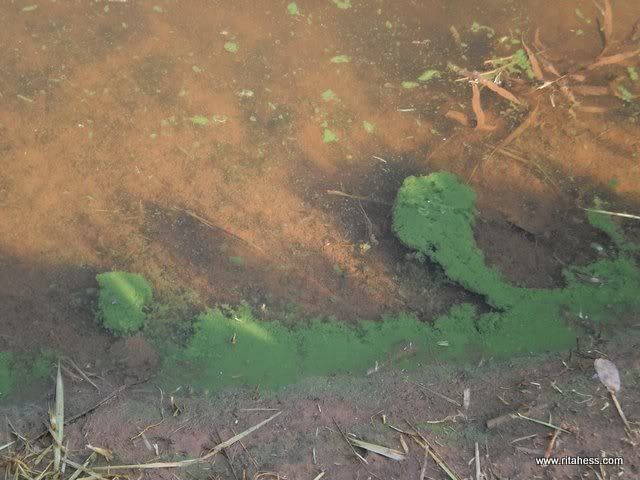 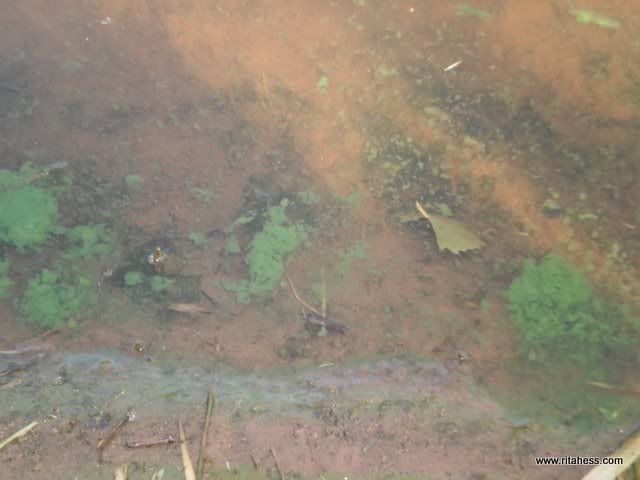 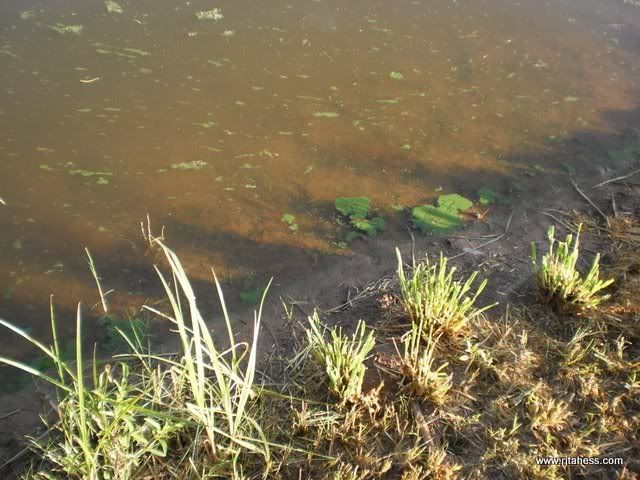 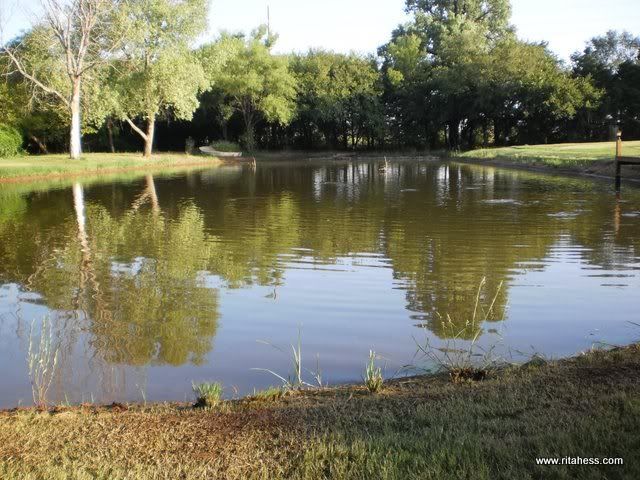
|
|
|
|
|
Joined: Jul 2006
Posts: 7,615 Likes: 7
Ambassador
Field Correspondent Lunker
|
|
Ambassador
Field Correspondent Lunker
Joined: Jul 2006
Posts: 7,615 Likes: 7 |
OW, that looks a lot like what was identified as Euglena on my pond. I posted photos that looked like that and Greg Grimes identified it and said it was harmless. Looks pretty gross though.
JHAP
~~~~~~~~~~
"My mind is a raging torrent, flooded with rivulets of thought cascading into a waterfall of creative alternatives."
...Hedley Lamarr (that's Hedley not Hedy)
|
|
|
|
|
Joined: Jun 2007
Posts: 59
Lunker
|
|
Lunker
Joined: Jun 2007
Posts: 59 |
Thanks, Jeff! Seems a lot of "pond crud" looks alike (at least to me!).
|
|
|
|
|
Joined: May 2002
Posts: 3,973 Likes: 1
Ambassador
Field Correspondent Lunker
|
|
Ambassador
Field Correspondent Lunker
Joined: May 2002
Posts: 3,973 Likes: 1 |
Jeff beat me to it. yes Euglena for sure. Ugly but harmless. Fiarly common in the dog day summers.
|
|
|
|
|
Joined: Jun 2007
Posts: 59
Lunker
|
|
Lunker
Joined: Jun 2007
Posts: 59 |
I'm breathing a sigh of relief. I like the word "harmless"!
You guys are awesome... THANKS!
|
|
|
|
|
Joined: Jul 2008
Posts: 1,099 Likes: 1
Lunker
|
|
Lunker
Joined: Jul 2008
Posts: 1,099 Likes: 1 |
i have something in my pond now that looks very similiar. water temp here is just below 60. reckon it is the same thing?
Scott Hanners
|
|
|
|
|
Joined: May 2002
Posts: 3,973 Likes: 1
Ambassador
Field Correspondent Lunker
|
|
Ambassador
Field Correspondent Lunker
Joined: May 2002
Posts: 3,973 Likes: 1 |
doubt you have euglena this time of year but if similiar and not watermeal then not anything to worry about.
|
|
|
|
|
Joined: Jul 2008
Posts: 1,099 Likes: 1
Lunker
|
|
Lunker
Joined: Jul 2008
Posts: 1,099 Likes: 1 |
greg, i talked to a friend of mine that has a similiar looking something on his pond in tyrone, ga. also this weekend i was out riding in the pine mtn/ warm springs area and saw a pond from a distance that was bright green looking.
my pond is really pondy smelling in the last month or so.
i am still concerned that a neighbor upstream may be dumping washing machine water out and it is running into my pond.
Scott Hanners
|
|
|
|
|
Joined: Dec 2010
Posts: 2
|
|
Joined: Dec 2010
Posts: 2 |
The green stuff is not euglena. Euglena has a red to pink color due to a pigment in the cells. What you have here is a blue green algae (cyano bacteria). Without microscopic analysis I can't tell the genus but it is most likely micrcysistis or anacysistis. Both types can produce foul odors as they decay. They also cause taste and odor problems in drinking water. They are also know toxin producers. They can be treated with copper based algicides. If the water is really green be careful because killing off too much of a bloom at one time can lead to the depletion of oxygen and a subsequent fish kill. Heavy blooms can also cause wide swings in oxygen levels which will stress fish, slow growth and possibly lead to a fish kill.
|
|
|
|
|
Joined: Apr 2002
Posts: 15,997 Likes: 1496
Moderator
Ambassador
Field Correspondent Lunker
|
|
Moderator
Ambassador
Field Correspondent Lunker
Joined: Apr 2002
Posts: 15,997 Likes: 1496 |
Euglena surface films can also be green and various hues. There are 2 - 3 species of Euglena that have red pigments; others are usually green. Safer and more enviornmentally friendly algacides esp for floating scums/films are various brands of peroxyhydrate (hydrogen dioxide) i.e. GreenClean, Phycomycin, Pak27. No chemical residue with these algacides.
For those interested Anacystis is the older scientific genus name for Microcystis, a colonial Cyanobacteria.
Last edited by Bill Cody; 12/17/10 02:07 PM.
aka Pond Doctor & Dr. Perca Read Pond Boss Magazine -
America's Journal of Pond Management
|
|
|
|
|
Joined: Mar 2005
Posts: 22,033 Likes: 483
Moderator Hall of Fame 2014  Lunker
|
|
Moderator Hall of Fame 2014 Lunker
Joined: Mar 2005
Posts: 22,033 Likes: 483 |
Thanks Bill always good to know ! Nothing - and I mean , nothing beats accurate info. We have both green and red here. We also have one that changes from green to red and back and is classified IIRC as red.
This from Wiki explains:
Euglena is a genus of unicellular protists, of the class Euglenoidea of the phylum Euglenozoa (also known as Euglenophyta). They are single-celled organisms. Currently, over 1,000 species of Euglena have been described. There are many to be discovered. Marin et al. (2003) revised the genus to include several species without chloroplasts, formerly classified as Astasia and Khawkinea. Some Euglena are considered to have both plant and animal features. Due to these dual characteristics, much debate has arisen to how they have evolved, and into which clade they should be placed. In binomial nomenclature, according to the five-kingdom classification scheme, euglena have been accurately placed into Kingdom Protista, more specifically into Subkingdom Protozoa, and even more specifically into Phylum Mastigophora, which use flagellum as a method of locomotion.
Form and function
A diagram of EuglenaEuglena is a protist that can both eat food as animals by heterotrophy; and can photosynthesize, like plants, by autotrophy. When acting as a heterotroph, the Euglena surrounds a particle of food and consumes it by phagocytosis. When acting as an autotroph, the Euglena utilizes chloroplasts, (hence green color) containing Chlorophyll a, Chlorophyll b, and some carotenoid pigments, to produce sugars by photosynthesis. Each chloroplast has three membranes, and exist in thylakoid stacks of three. The number and shape of chloroplasts within euglenozoa varies greatly due to environmental conditions and evolutionary history. Euglena are able to move through aquatic environments by using a large flagellum for locomotion. To observe its environment, the cell contains an eyespot, a primitive organelle that filters sunlight into the light-detecting, photo-sensitive structures at the base of the flagellum; allowing only certain wavelengths of light to hit it. This photo-sensitive area detects the light that is able to be transmitted through the eyespot. When such light is detected, the Euglena may accordingly adjust its position to enhance photosynthesis. The mobility of Euglena also allows for hunting capability, because of this adaptation, many Euglena are considered mixotrophs: autotrophs in sunlight and heterotrophs in the dark. Euglena also structurally lack cell walls, but have a pellicle instead. The pellicle is made of protein bands that spiral down the length of the Euglena and lie beneath the plasma membrane.
Euglena can survive in fresh and salt water. In low moisture conditions, a Euglena forms a protective wall around itself and lies dormant as a spore until environmental conditions improve. Euglena can also survive in the dark by storing paramylon granules in pyernoid bodies within the chloroplast.
Reproduction
Euglenas reproduce asexually by binary fission, and there has been no evidence of sexual reproduction. Reproduction includes transverse division and longitudinal division, which both occur in the active and encysted forms. Acidity and alkalinity have been known to affect reproduction and life spans of Euglenozoans. Life spans also greatly differ between each group of Euglenozoans.
Cody note: wouldn't it be cool if humans were more like Euglena and had blood with chloroplasts and we could be consumers (heterotrophs) or in the sunlight autotrophs (photosynthetic). Maybe with some genetic manipulation in a 100 yrs we could develop that feeding behavior; GMO at its best.
Last edited by Bill Cody; 12/17/10 02:15 PM.
.gif) 
|
|
|
Moderated by Bill Cody, Bruce Condello, catmandoo, Chris Steelman, Dave Davidson1, esshup, ewest, FireIsHot, Omaha, Sunil, teehjaeh57 |
|