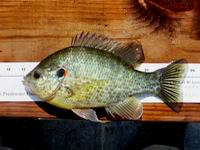
As GSH age they can be afflicted with an ovarian parasite, Pleistophora ovarie. This greatly reduces their spawning success. The parasite isn't found in all populations .... From my research, ... 3" GSH are usually second year fish in their first year of maturity and have not been affected by the parasite yet.
Thought you might be interested in this new info.
Journal of Aquatic Animal Health 2008; 20: 45-53 -- AFS
Vertical Transmission of Ovipleistophora ovariae (Microspora) within the Eggs of the Golden Shiner
Nicholas B. D. Phelps and Andrew E. Goodwin*
Aquaculture/Fisheries Center, University of Arkansas at Pine Bluff, Mail Slot 4912, 1200 North University Drive, Pine Bluff, Arkansas 71601, USA
Abstract
Fertilized eggs collected from broodfish infected by Ovipleistophora ovariae were tested by quantitative polymerase chain reaction (PCR) and found to be positive for the O. ovariae genome at 7.77 � 102 to 3.26 � 107 copies per microgram of host DNA. Fry hatched from these eggs contained from 1.37 � 102 to 9.89 � 106 copies of the O. ovariae genome per microgram of host DNA. Surface treatments of fertilized eggs with 150 mg formalin/L (used by farms as a fungicide) or a 1.5% solution of sodium sulfite (which removes the adhesive egg matrix) did not reduce vertical transmission to fry. Treatment of eggs with a 10% solution of bleach or a proprietary commercial DNA denaturant did not reduce the number of egg-associated copies of the O. ovariae genome. Histology of ovaries of infected fish demonstrated spores within the oocytes. However, no spores were observed by histology in positive fry hatched from infected eggs.
The PCR and histological demonstration of the presence of O. ovariae spores in oocytes and fry, and the failure of strong DNA denaturants to reduce egg-associated copies, give evidence that O. ovariae is vertically transmitted within eggs.Received: May 15, 2007; Accepted: September 15, 2007; Published Online: March 6, 2008


.gif)