|
Forums36
Topics42,112
Posts571,656
Members19,114
| |
Most Online13,012
Jun 7th, 2026
|
|
|
2 members (rjackson, catscratch),
2,869
guests, and
53
robots. |
|
Key:
Admin,
Global Mod,
Mod
|
|
|
|
Joined: Jul 2009
Posts: 4,318 Likes: 8
Ambassador Lunker
|
|
Ambassador Lunker
Joined: Jul 2009
Posts: 4,318 Likes: 8 |
Can someone please give me an answer to this simple question? What is the main difference between these two minnows? Everyone seems to prefer Golden Shiners instead of regular shiners? Is it because Golden Shiners spawn and regualr ones dont? Or are there other reasons? The reason I ask is because I have a bait shop near me that sells regular shiners by the pound. Are they ok to use in your pond for forage? Or should I stay away from them?
Thanks
Last edited by RC51; 01/29/10 09:30 PM.
The only difference between a rut and a Grave is the depth. So get up get out of that rut and get moving!! Time to work!!
|
|
|
|
|
Joined: Jan 2009
Posts: 29,788 Likes: 1295
Moderator Ambassador Field Correspondent  Lunker
|
|
Moderator Ambassador Field Correspondent Lunker
Joined: Jan 2009
Posts: 29,788 Likes: 1295 |
I'll wager that they are just small Golden Shiners. How much a pound are they? Can you take a close-up pic of one?
|
|
|
|
|
Joined: Mar 2005
Posts: 22,032 Likes: 483
Moderator Hall of Fame 2014 Lunker
|
|
Moderator Hall of Fame 2014 Lunker
Joined: Mar 2005
Posts: 22,032 Likes: 483 |
There are many shiner types. See link below for some. GShiners are the one species that is commercially raised in most locations. http://www.cnr.vt.edu/efish/families/cyprinidae.html
|
|
|
|
|
Joined: Jan 2009
Posts: 10,458 Likes: 3
Ambassador
Field Correspondent
Hall of Fame Lunker
|
|
Ambassador
Field Correspondent
Hall of Fame Lunker
Joined: Jan 2009
Posts: 10,458 Likes: 3 |
Golden shiner is the common name for Notemigonus crysoleucas. Golden shiners are by far the most commonly sold shiner baitfish in the country. So in a way they could be called a "regular" shiner. There is no species in the country with a common name of regular shiner though...
There are other species of shiner that are sometimes used as bait. Species like emerald shiner, spottail shiner and spotfin shiner. These species however are almost always wild caught and not farm raised. The vast majority of golden shiners are farm raised.
Keep in mind, when you buy bait from a bait shop, they do not hand sort their fish. When you buy "regular" shiners, you are in all likelihood buying golden shiners. However... Often mixed in with your golden shiners are other species. Small common carp, goldfish, FHM, small GSF, small BG, mudminnows, sticklebacks... The list goes on and on...
Buyer beware! Baitfish aren't often kept in the best conditions, so you may not be starting your pond off with the best quality of fish if you are using bait store bought fish.
|
|
|
|
|
Joined: Mar 2005
Posts: 22,032 Likes: 483
Moderator Hall of Fame 2014 Lunker
|
|
Moderator Hall of Fame 2014 Lunker
Joined: Mar 2005
Posts: 22,032 Likes: 483 |
CJ most of the bait shops that I see sell regular shiners are talking about common shiners. http://www.cnr.vt.edu/efish/families/commonshiner.html
Last edited by ewest; 01/30/10 09:42 AM.
|
|
|
|
|
Joined: Jan 2009
Posts: 10,458 Likes: 3
Ambassador
Field Correspondent
Hall of Fame Lunker
|
|
Ambassador
Field Correspondent
Hall of Fame Lunker
Joined: Jan 2009
Posts: 10,458 Likes: 3 |
Are you sure? I have never seen a common shiner for sale. Common shiners require moving water and a gravel substrate for spawning, typically spawning over the nests of chubs like the creek or river chub, so I would think they wouldn't be easy to culture and they are not found commonly in lakes, reservoirs or other areas where collecting large numbers of them would be easy. I catch them a lot when fishing sub par trout streams in PA for stocked trout. They are fairly common in the creek behind our hunting cabin.
|
|
|
|
|
Joined: Jan 2009
Posts: 29,788 Likes: 1295
Moderator Ambassador Field Correspondent Lunker
|
|
Moderator Ambassador Field Correspondent Lunker
Joined: Jan 2009
Posts: 29,788 Likes: 1295 |
Sticklebacks were very common in the crappie minnows that I used to buy for fishing. I'm not seeing them as often now. If RC51 could post a pic, that would help immensely in I.D.'ing the shiner.
|
|
|
|
|
Joined: Dec 2009
Posts: 6,692
Hall of Fame 2015 Lunker
|
|
Hall of Fame 2015 Lunker
Joined: Dec 2009
Posts: 6,692 |
Post a pic, I'll see if I can ID. Use to (try) raise bait fish for non-commercial purposes. I believe 34 or 38 different species. But the rules are that we have to use the official scientific name. Nothing like perch minnow, that covers everything in MI for Ice and YP and WE. Or regular shiner, what is a regular shiner! Something that takes fiber on a daily basis. Just Kidding! Just don't call them Shinners! My leg is starting to hurt! Your it 
|
|
|
|
|
Joined: Jan 2009
Posts: 10,458 Likes: 3
Ambassador
Field Correspondent
Hall of Fame Lunker
|
|
Ambassador
Field Correspondent
Hall of Fame Lunker
Joined: Jan 2009
Posts: 10,458 Likes: 3 |
I agree, if you want, purchase a few of each and take some decent pics to post on here... Then we'll know what species your buying.
|
|
|
|
|
Joined: Jan 2009
Posts: 10,458 Likes: 3
Ambassador
Field Correspondent
Hall of Fame Lunker
|
|
Ambassador
Field Correspondent
Hall of Fame Lunker
Joined: Jan 2009
Posts: 10,458 Likes: 3 |
Did a little research on common shiners. It does appear there is a small market for them being harvested from the wild for use as a bait fish. http://hatch.cehd.umn.edu/research/fish/fishes/common_shiner.html So it is possible they may also be referred to as "regular" shiners.
|
|
|
|
|
Joined: Mar 2005
Posts: 22,032 Likes: 483
Moderator Hall of Fame 2014 Lunker
|
|
Moderator Hall of Fame 2014 Lunker
Joined: Mar 2005
Posts: 22,032 Likes: 483 |
CJ some of those bait dealers (not talking about commercial outfits but small bait shops) don't know what they have. Its whatever they can catch or spawn. Some call every small silver shiner type fish a regular shiner. Some are common shiners . Of the small shiner type bait fish I see sold from these type stores the salesmen divide them into 3 groups , GShiners , Emerald shiners or regular shiners. The regular shines can be common shiners or any number of the silver fish on that link or even others. I will take some pics next time I go by one and we can try to id what they call regular shiners.
|
|
|
|
|
Joined: Oct 2007
Posts: 288
Lunker
|
|
Lunker
Joined: Oct 2007
Posts: 288 |
I wonder if you're having the same confusion I had before some nice folks here cleared it all up for me. Golden shiners aren't golden in color most of the time. That was what was throwing me off. If I'm remembering correctly what I was told, golden shiners are silver in color except during spawn or when they are very old. I was just expecting that golden shiners would be golden in color all the time so I couldn't wrap my head around the fact that my golden shiners were actually silver.  I trust you guys will correct me if I've gotten some of that wrong.
If you're too scared to throw that bait where the fish are, why did you tie it on? 
|
|
|
|
|
Joined: Jun 2005
Posts: 2,365
Lunker
|
|
Lunker
Joined: Jun 2005
Posts: 2,365 |
Our local bait shops sell fatheads. I call them skinnyheads, because they keep them in very cold water and don't feed them.
|
|
|
|
|
Joined: Feb 2005
Posts: 4,025 Likes: 2
Lunker
|
|
Lunker
Joined: Feb 2005
Posts: 4,025 Likes: 2 |
I think a common shiner would be a good choice since it is less likely to grow too large as sometimes the golden shiner does. Wish I had a local source for them.
|
|
|
|
|
Joined: Jan 2008
Posts: 8,883 Likes: 117
Chairman, Pond Boss Legacy award; Moderator; field correspondent Lunker
|
|
Chairman, Pond Boss Legacy award; Moderator; field correspondent Lunker
Joined: Jan 2008
Posts: 8,883 Likes: 117 |
I think a list of forage types, their characteristics, and stocking recommendations could serve as a useful reference guide for all of us considering establishing alternative forage species.
Thus far my experience with GSH has been favorable. My apex predator role is served by YP, HSB and SMB - all species with smaller gape. No LMB or CC in my ponds. I have GSH stocked in all my ponds and the adults [reaching 8-10"] will remain fairly safe from predation considering the gape issue. It's a good scenario for me as technically speaking I should have a self sustaining population of GSH when the adults are safe from predation and are able to reproduce consistently. I'm hopeful some of the adults will die from age or occasional predation and I don't end up with an overpopulation of adult GSH in my ponds. No expert has suggested this as a potential issue yet.
Here's a GSH scenario that isn't so favorable: IIRC one pond meister's experience with GSH were that they competed heavily with his BG for the same food niche of invertabrates, etc. and the BG size/growth/population suffered. Again, IIRC big BG were one of his goals, and the presence of GSH prevented acheiving that goal. For him, GSH had a negative impact.
Many men go fishing all of their lives without knowing that it is not fish they are after. ~ Henry David Thoreau ![[Linked Image from i1261.photobucket.com]](http://i1261.photobucket.com/albums/ii582/teehjaeh57/I_subscribe_zps69249d43.gif)
|
|
|
|
|
Joined: Jul 2009
Posts: 4,318 Likes: 8
Ambassador Lunker
|
|
Ambassador Lunker
Joined: Jul 2009
Posts: 4,318 Likes: 8 |
Hy Ya'll thanks for the replys. I don't have a picture at this point. I just wasn't sure if there was a problem using regualr shiners instead of Golden ones? I think the only difference is the regualr shiners are smaller? When I buy some more I will take a picture of one. I can get them for about 8 bucks a pound from them. Is that high? Sounds a little high to me but they are right around the corner. And they are just a small bait shop. The guy looked at me like I was nuts when I told him i wanted Golden Shiners? He said well we have small, medium and large shiners not sure about the golden part! 
The only difference between a rut and a Grave is the depth. So get up get out of that rut and get moving!! Time to work!!
|
|
|
|
|
Joined: Aug 2007
Posts: 3,135
Ambassador Lunker
|
|
Ambassador Lunker
Joined: Aug 2007
Posts: 3,135 |
Here's one from my pond last year, they always seem to have some golden color but that could have something to do with the acidic water. 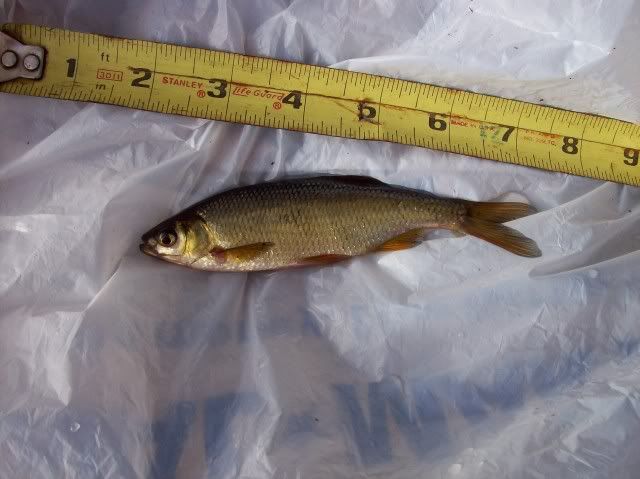
|
|
|
|
|
Joined: Jan 2008
Posts: 8,883 Likes: 117
Chairman, Pond Boss Legacy award; Moderator; field correspondent Lunker
|
|
Chairman, Pond Boss Legacy award; Moderator; field correspondent Lunker
Joined: Jan 2008
Posts: 8,883 Likes: 117 |
She's a beauty! AP do you have a sustaining population of GSH? What are your Apex Predators? GSH seem to have established themselves as permanent forage or do you supplementally stock adults?
Many men go fishing all of their lives without knowing that it is not fish they are after. ~ Henry David Thoreau
|
|
|
|
|
Joined: Aug 2007
Posts: 3,135
Ambassador Lunker
|
|
Ambassador Lunker
Joined: Aug 2007
Posts: 3,135 |
The first year of the pond 2006, it was stocked with 8lbs of adult GSH, and 5 lbs. of FH , every year after stocked with only trout.
After the first year the FH's were never seen again but the GSH have really thrived. The PS's came into the pond on their own from the siphon pipes supplying water to the pond.
It's fun to watch the minnows swarm near a large submerged branch, and the Trout will streak in and grab some.
|
|
|
|
|
Joined: Jan 2009
Posts: 10,458 Likes: 3
Ambassador
Field Correspondent
Hall of Fame Lunker
|
|
Ambassador
Field Correspondent
Hall of Fame Lunker
Joined: Jan 2009
Posts: 10,458 Likes: 3 |
I think a common shiner would be a good choice since it is less likely to grow too large as sometimes the golden shiner does. Wish I had a local source for them. Common shiners spawn over nests of chubs, usually creek chubs and will rarely make their own nests. They also require moving water and a gravel substrate. They are not tolerant of warm waters so the only time they are found in lakes is usually in the northern end of their range. They may survive in a pond, but wouldn't spawn which would make them less than desirable as a forage fish. I wonder if you're having the same confusion I had before some nice folks here cleared it all up for me. Golden shiners aren't golden in color most of the time. That was what was throwing me off. If I'm remembering correctly what I was told, golden shiners are silver in color except during spawn or when they are very old. I was just expecting that golden shiners would be golden in color all the time so I couldn't wrap my head around the fact that my golden shiners were actually silver. I trust you guys will correct me if I've gotten some of that wrong. You're 100% correct Al... Immature and non breeding golden shiners are typically silver. When they get bigger, they then get a more golden or brassy coloration and their paired fins will get an orangish hue to them. AP's picture is a classic mature golden shiner in breeding colors.
Last edited by CJBS2003; 01/30/10 06:19 PM.
|
|
|
|
|
Joined: Aug 2007
Posts: 3,135
Ambassador Lunker
|
|
Ambassador Lunker
Joined: Aug 2007
Posts: 3,135 |
With the size opening in the trap I use most of the GSH I get are atleast 3 inches, so they must be adults at that size, is that correct?
|
|
|
|
|
Joined: Jan 2009
Posts: 10,458 Likes: 3
Ambassador
Field Correspondent
Hall of Fame Lunker
|
|
Ambassador
Field Correspondent
Hall of Fame Lunker
Joined: Jan 2009
Posts: 10,458 Likes: 3 |
There are not all that many species of shiner that are adapted to living in ponds and can reproduce in them.
Golden shiners were picked as baitfish for a reason, they are very easy to produce in small ponds where they then can be harvested. This also means they will readily reproduce in a fishing pond. Most guys struggle to get them to take hold and maintain self sustaining populations because of the heavy predation LMB put on them and most ponds have steep banks precluding shallow water areas where golden shiners spawn and their young use as nurseries.
Species like emerald shiner do well in LARGE lakes, and probably could survive in ponds but wouldn't thrive and as far as I know have yet to be established in self sustaining numbers in a BOW the size of a pond.
Spottail shiners are also big water shiners, but I have had some luck establishing them in larger ponds, say over 4 acres. However, they require clean sandy areas to spawn. If your pond is mostly a clay, muck bottom they won't do well.
Spotfin shiners and the closely related satinfin shiner are probably the best shiners for pond stocking. They are crevice spawners and you can building artificial spawning devices for them to spawn on. Bill Cody showed me how to build one that seems to have worked good for me and him. Spotfin shiners are very common in most parts of the Midwest and the Northeast. And unlike golden shiners, they only reach 4" as a max so they may not cause the problems golden shiners may.
Other than those species mentioned, I am not aware of any other species of shiner adapted to pond life. There are several other species of small fish, like chubs, minnows and killifish which can be used as forage in ponds, but they are not shiners.
Bill Cody and I are working on a series of articles that will cover the alternative forage species for ponds that aren't typically available commercially. In depth details will be covered on collection methods, safety precautions, identification and which species would do best in different pond types. So keep subscribing to Pond Boss and keep an eye out for those articles!
|
|
|
|
|
Joined: Jan 2008
Posts: 8,883 Likes: 117
Chairman, Pond Boss Legacy award; Moderator; field correspondent Lunker
|
|
Chairman, Pond Boss Legacy award; Moderator; field correspondent Lunker
Joined: Jan 2008
Posts: 8,883 Likes: 117 |
AP
Not sure when GSH are sexually mature - if a 3" can be considered an adult, but know they can attain sizes up to 8-10". Not sure if sizes are different based on gender like FHM.
Many men go fishing all of their lives without knowing that it is not fish they are after. ~ Henry David Thoreau
|
|
|
|
|
Joined: Jan 2008
Posts: 8,883 Likes: 117
Chairman, Pond Boss Legacy award; Moderator; field correspondent Lunker
|
|
Chairman, Pond Boss Legacy award; Moderator; field correspondent Lunker
Joined: Jan 2008
Posts: 8,883 Likes: 117 |
There are not all that many species of shiner that are adapted to living in ponds and can reproduce in them.
Golden shiners were picked as baitfish for a reason, they are very easy to produce in small ponds where they then can be harvested. This also means they will readily reproduce in a fishing pond. Most guys struggle to get them to take hold and maintain self sustaining populations because of the heavy predation LMB put on them and most ponds have steep banks precluding shallow water areas where golden shiners spawn and their young use as nurseries.
Species like emerald shiner do well in LARGE lakes, and probably could survive in ponds but wouldn't thrive and as far as I know have yet to be established in self sustaining numbers in a BOW the size of a pond.
Spottail shiners are also big water shiners, but I have had some luck establishing them in larger ponds, say over 4 acres. However, they require clean sandy areas to spawn. If your pond is mostly a clay, muck bottom they won't do well.
Spotfin shiners and the closely related satinfin shiner are probably the best shiners for pond stocking. They are crevice spawners and you can building artificial spawning devices for them to spawn on. Bill Cody showed me how to build one that seems to have worked good for me and him. Spotfin shiners are very common in most parts of the Midwest and the Northeast. And unlike golden shiners, they only reach 4" as a max so they may not cause the problems golden shiners may.
Other than those species mentioned, I am not aware of any other species of shiner adapted to pond life. There are several other species of small fish, like chubs, minnows and killifish which can be used as forage in ponds, but they are not shiners.
Bill Cody and I are working on a series of articles that will cover the alternative forage species for ponds that aren't typically available commercially. In depth details will be covered on collection methods, safety precautions, identification and which species would do best in different pond types. So keep subscribing to Pond Boss and keep an eye out for those articles! I wanted to allude to this article you were working on but was I gave you my vow of silence. I can't wait for this to be published, though - are you covering shrimp, bivalves and other potential forage too? Will you make stocking recommendations, how to provide spawning habitat, and some sources for stocking? I would like to try spotfins at my place...need to know where to find them though.
Many men go fishing all of their lives without knowing that it is not fish they are after. ~ Henry David Thoreau
|
|
|
|
|
Joined: Jan 2009
Posts: 10,458 Likes: 3
Ambassador
Field Correspondent
Hall of Fame Lunker
|
|
Ambassador
Field Correspondent
Hall of Fame Lunker
Joined: Jan 2009
Posts: 10,458 Likes: 3 |
Yeah, by 3 inches GSH should be sexually mature. 3" GSH are actually the best spawners. As GSH age they can be afflicted with an ovarian parasite, Pleistophora ovarie. This greatly reduces their spawning success. The parasite isn't found in all populations and doesn't seem to affect any game fish. From my research, it is also found in wild goldfish. 3" GSH are usually second year fish in their first year of maturity and have not been affected by the parasite yet.
|
|
|
Moderated by Bill Cody, Bruce Condello, catmandoo, Chris Steelman, Dave Davidson1, esshup, ewest, FireIsHot, Omaha, Sunil, teehjaeh57 |
|





![[Linked Image from lh6.ggpht.com]](http://lh6.ggpht.com/_6_-SgakQ9co/S3Nx1jGAJWI/AAAAAAAABKU/DJIy4ZnF1t0/s800/I_subscribe.jpg)
.gif)