So, I call my septic contractor with the news about the soils analysis. He is immediately put out by the way it all played out. It became quickly apparent to me that I would have done much better by having him with us during the field inspection and soils analysis. OK, spilt milk. Now what?
My guy tells me he wants to get out to the site and take another look. The date is made.
He looks it over and still cannot believe how the soils guy bull dozed me right into a 2-tank pump system. He turns his focus on the area behind the house and is disappointed that the soils guy didn't suggest using that area.
-
He tells me that I want a conventional septic system if at all possible for simplicity of function and maintenance. Makes perfect sense to me, but how? He asks me why I don't want to put the tank and field behind the house. I thought that would be obvious. There isn't much real estate for a field and it's uphill from where a tank would be located. He kicks the dirt and chuckles. A little creativity can go a long way in achieving the system we seek. He suggests that I allow him to get the county health inspector to the sight to see what can be done. Whoa! Done deal; go for it. He does.
-
I get a phone call a couple weeks later. It's my contractor. He got the inspector out to the sight. He started verbally describing what the plan would be to salvage installation of a conventional system. It starts to confuse me a bit, and another date is set to meet at the site to lay it out.
It winds up that the inspector likes the area behind the house. It's close enough to the area that the soils guy approved out in the field so he will also approve the soils closer to the house. It also happens to be undisturbed soil; he likes that too. I'm still baffled on how he's going to work it into the uphill slope.
The inspector told him that we can't go down beyond 18" - 24" max. My contractor assures me that he can still sneak in a conventional field, reminding me that the tile and field does not have to be right up at the surface. He can artfully cheat it in with the proper slope, starting shallow nearer the house and going downhill and deeper as we move toward the uphill slope. I'm used to seeing septic fields as large, square'ish blocks. He laughs again, telling me they can be any shape that it takes to make it work. Mine will be very wide. The soil pipe will exit the gar/apt high and very near grade (to allow enough downhill trajectory as we move along thru the system).
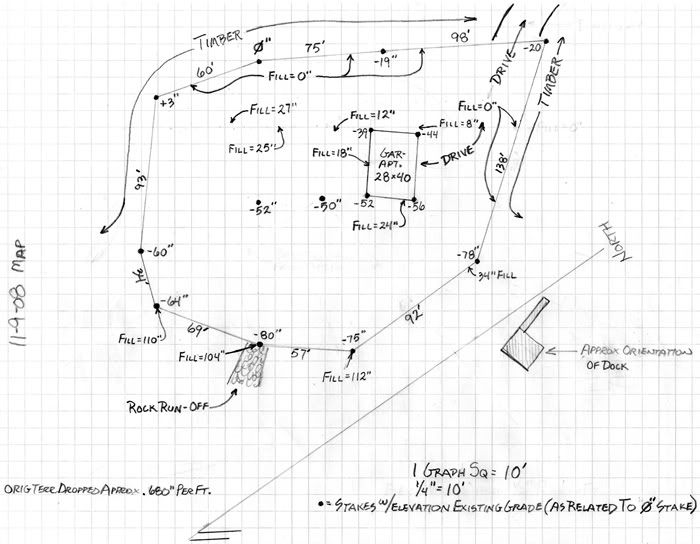 This map of the building site is fairly accurate for scale. The only change would be the footprint for the structure grew to 28 x 44. The bottom curvature of the site is the shoreline of the pond. This is the larger zone where I originally wanted the septic field. The new plan puts the field at the top, stretched out left and right, between the structures and the timber behind them.
 The tank will be buried between the garage/apt that we are building right now and the location of the future house. The field will be directly adjacent behind both buildings. The lay of the land and the uphill slope will force the field to not move very far in the uphill direction, but spread out to the left and right. We will have to pluck out a few more trees and open up the treeline at the back of the backyard area to make enough room, but he is confident it can be done.
The plan is to install a 1250 gallon tank with enough openings to allow for inlets from boths sides (to receive inflow from the gar/apt and also the future house). We will only hook up the gar/apt. Also, to save money, we will only install enough field to service the smaller gar/apt. The inspector wants 1200 sq ft of field for this beginner system (4 runs of 100' x 3' wide). The distribution box just past the septic tank will be selected as a type to allow expansion of the field size at a later date.
-
So....what did I learn? As always, work with a contractor that is known and has good reputation. Like my guy, he will know the right people and be able to secure the best possible results. If it costs a little more, pay the price to have him actively involved during the soils testing. I sure wish my guy was there for that one. Finally, don't assume knowledge of physics means the answers (and roadblocks) are obvious. Let the guy that has been doing it for years share a little bit of the art'sy end of getting a job done. He can bridge the gap between book smarts and street smarts.







