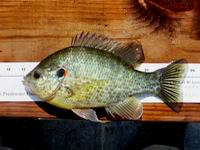
MDWFP fishery managers now have a tool that can be used to produce good and stable crappie fishing in small impoundments. The tool is a fish � a triploid hybrid crappie � the Magnolia crappie, and it is being produced at the North Mississippi Fish Hatchery.
Making Magnolia crappie
The Magnolia crappie is a cross between a male blackstripe crappie and a female white crappie. The blackstripe crappie is a color variant of the black crappie that occurs naturally in low numbers in some Mississippi impoundments. The blackstripe crappie � also called a blacknose crappie � is recognized by a narrow, dark stripe from the dorsal fin forward down the top of the head and continues on the underside of the head to the back of the mouth.
The hybrid offspring of the male blackstripe crappie and the female white crappie retains the black stripe. Using the blackstripe crappie as the male parent instead of a normally colored black crappie allows hybrids produced in the hatchery to be easily recognized.
But hybrid crappie can reproduce, so hybrids don�t accomplish the goal of controlled reproduction needed to effectively manage crappie in small impoundments. But the hatchery scientists have one more trick � they make the crappies triploid.
Crappie, as most fish, have two sets of chromosomes. This is the diploid condition, and diploid fish reproduce normally. Triploid crappie have three sets of chromosomes. Cellular processes necessary to produce viable eggs and sperm break down when there are three sets of chromosomes. It is the triploid condition that prevents the triploid hybrid crappie from producing offspring. The fish produce eggs and sperm and mate, but the fertilized eggs do not develop.
The triploid offspring are produced by stripping eggs from normal female white crappie and fertilizing them with sperm stripped from normal male blackstripe crappie. At exactly five minutes after fertilization, the eggs are put into a pressure chamber and exposed to 8,000 psi of pressure for two minutes. This interrupts the normal cellular processes, and results in the egg retaining an extra set of chromosomes. The fertilized egg, and the offspring that develops from it, have three sets of chromosomes, and cannot produce offspring.
Crappie reproduction is controlled only if all the stocked fish are triploid. Unfortunately, the procedure is not yet fool-proof. The percentage of offspring that are triploid has ranged from 60 percent to 100 percent, so work remains to further refine the process. Fish can be tested to see if they are triploid by taking a tiny blood sample from each fish. The process does not injure the fish, but is very labor intensive and limits the number of fish that can be stocked.
As the hatchery staff continues to refine their procedures, Magnolia crappie are being produced and will be stocked into some state fishing lakes. The MDWFP hatchery does not provide fish for private stocking.
Hard work and progressive thinking will produce great crappie fishing without creating populations of overabundant and small crappie of little interest to anglers.
By Hal Schramm


.gif)