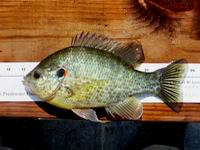
lmoore good post ! Here it is from the FS noted above who IMO is the HBG expert.
Evaluation of Male Bluegill X Female Green Sunfish Hybrids for
Stocking Mississippi Farm Ponds
MARTIN W. BRUNSON and H. RANDALL ROBINETTE
NorthA mericanJ ournalo f FisherieMs anagemen6t: 156-167, 1986
� Copyrighbt y the AmericanF isheriesS ociety1 986
" However, perhaps more important
to the angler is the presumed high catchability of
hybrid sunfish. This vulnerability to hook-and-line
capture has been alluded to by many authors
but relatively few experimental data exist to substantiate
such statements. Childers (1967) cited
one instance where a population of more than
10,000 BG x GS hybrids was decimated by anglers
during the first week of fishing"
"The total catch of
146 hybrids during the 2-h period was 21% of the
population. Catch per effort at Britt Pond was 22.4
fish/angler-hour, and the total catch of 403 fish
was 66% of the population. These high catch rates,
especially at Britt Pond, once again confirm the
aggressiveness and vulnerability of the BG x GS
hybrid, and point to the importance of strict control
of harvest in hybrid ponds. Especially significant
is the effect that poachers can have on a
hybrid population. A few hours of unauthorized
fishing could have a drastic effect on the fish population."
"The pond owner must be aware of the pros and
the cons of hybrid stocking. Hybrids should not
be stocked with other sunfish species. Management
must be intensive and should include catch
restrictions, record keeping, and subsequent restocking.
Hybrid sunfish ponds are primarily a
"trophy bream" situation and largemouth bass
growth may be less than optimum unless a supplemental
forage is made available. Security of the
pond from poaching is imperative. However, the
advantage of producing large easily caught sunfish
will, for many pond owners, outweigh the inconvenience
and expense of restocking, harvest regulations,
and pond security--especially for those
with commercially oriented ponds. The BG x GS
hybrid, when properly stocked into clean ponds
and managed correctly, provides an attractive alternative
to the bluegill for many pond situations
in Mississippi and probably in other southeastern
states as well."


.gif)