|
Forums36
Topics42,113
Posts571,680
Members19,115
| |
Most Online23,413
7 hours ago
|
|
|
|
Joined: Jan 2009
Posts: 10,458 Likes: 3
Ambassador
Field Correspondent
Hall of Fame Lunker
|
|
Ambassador
Field Correspondent
Hall of Fame Lunker
Joined: Jan 2009
Posts: 10,458 Likes: 3 |
I read the article, I think it's a bit over dramatic. GSF can be a problem, but IME when BG and LMB are stocked with them, within a few years they get out competed and make up a very small percentage of the pond's biomass. I have dealt with ponds that were nearly 100% pure GSF. After stocking LMB and BG, within 5 years, 8 out of 10 sunfish caught were BG. Within 10 years more than 9 out of 10 were BG.
Having large GSF or HBG in your pond concerns since you just stocked fingering BG and HSB. Those GSF/HBG will eat those fingerlings with gusto. HSB are fast, so they will give GSF a run for their money and BG got piles of spines, but GSF have big mouths.
I remember your post on the construction of your pond. It was excavated without any stream or creek flowing into it correct? If so, what is the stocking history of your pond? I am just curious how the GSF may have gotten into the pond...
|
|
|
|
|
Joined: Mar 2005
Posts: 22,033 Likes: 483
Moderator Hall of Fame 2014  Lunker
|
|
Moderator Hall of Fame 2014 Lunker
Joined: Mar 2005
Posts: 22,033 Likes: 483 |
I know Suttle Fish personally having done business with them before. They are an honest and valued hatchery and provide fish to several state agencies and universities for studies. They are good people. While I do not agree with them on somethings they are not high pressure with sales as they sell out their stock except brood fish every year. That is their opinion on GSF not HBG. Many agree with that opinion and their is much here on the subject. Here is a thread HBG pic/question - http://www.pondboss.com/forums/ubbthreads.php?ubb=showflat&Main=1341&Number=14459#Post14459IMO your pic is a HBG and is the reciprocal cross not usually sold by hatcheries (mGSF X fBG ). Probably a natural cross. HBG are 90% +- males and because of that do not reproduce in quantities sufficient to provide forage for LMB. The rare female HBG has low fecundity as well. They can be used in a put and take fishery but the LMB will not grow well because of the lack of food.
|
|
|
|
|
Joined: Jan 2009
Posts: 10,458 Likes: 3
Ambassador
Field Correspondent
Hall of Fame Lunker
|
|
Ambassador
Field Correspondent
Hall of Fame Lunker
Joined: Jan 2009
Posts: 10,458 Likes: 3 |
If you catch another one of those possible HBG/GSF flip back the gill flap and take a close up pic of the gill rakers... Then we'll know for sure whether it is a HBG or GSF.
|
|
|
|
|
Joined: May 2009
Posts: 743
Lunker
|
|
Lunker
Joined: May 2009
Posts: 743 |
http://www.suttlefish.com/trophy_bluegill.htmlNote that he says he doesn't like HBG; he lists several perceived shortcomings to them, then goes on to say that he recommends pond owners stock CNBG instead. As of this moment they have a page on their website devoted to HBG, though said page obviously conflicts with the one linked above; as of a couple weeks ago, the last time I looked at their page, they weren't selling HBG at all, hence my previous post. I have nothing whatsoever against them as a hatchery and only said to take their advice on this subject with a grain of salt as HBG are a widely-recommended fish.
|
|
|
|
|
Joined: Mar 2005
Posts: 22,033 Likes: 483
Moderator Hall of Fame 2014 Lunker
|
|
Moderator Hall of Fame 2014 Lunker
Joined: Mar 2005
Posts: 22,033 Likes: 483 |
From the article cited above :
"Dr. Marty Brunson has conducted extensive research concerning the Hybrid Bluegill from Mississippi State University, an expert in the field. He is the author of a paper on the Hybrid Bluegill titled �Managing Hybrid Sunfish in Mississippi Farm Ponds�. I ask you to read his article and make your own mind up on which Bluegill you want to stock in your pond. This is only fair to both sides that you look at all the facts first--then decide before investing your money and time."
That does not sound like a biased article to me . Plus he says clearly "I am very prejudiced" - his opinion. Some of what he states while true is a blanket statement which by its nature is dangerous in pond mgt. A little more looking would reveal the Dr. Brunson is one of the top HBG experts alive. He has written several peer reviewed studies for the AFS on HBG , was the Co-op Ext. PhD for fisheries ( FS professor at MSU) , was the lead writer/editor on the MS Fisheries Pond Mgt book which recommends HBG for put and take ponds. As I said I don't agree with all Suttle says often because he parrots what the old pond manuals contain often not considering that each situation as different and that new science - the cutting edge is changing. He does produce good fish which is what a hatchery is for.
.gif) 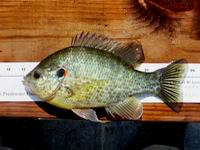
|
|
|
|
|
Joined: May 2009
Posts: 743
Lunker
|
|
Lunker
Joined: May 2009
Posts: 743 |
Sounds like I need to read that article by Dr. Brunson. I'm always up for learning more about bluegill of any strain.
|
|
|
|
|
Joined: May 2009
Posts: 191 Likes: 20
Lunker
|
|
Lunker
Joined: May 2009
Posts: 191 Likes: 20 |
Clay,
I wouldn't be too concerned with the HBG. I am no expert like the others on here, but I think the reason most dislike the GSF is that it competes with smaller LMB for food and can reduce growth in some situations. HBG grow very large very quick and are pretty good fighters on ultralight equipment. If you decide you don't want them in the pond, catch some and have a fish fry! From my experience they are not too picky with lures and you could catch a good portion of them out of your pond if you wished. I don't know hw good your fish Id skills are, but a big BG with yellow on hhe fins is almost always a HBG
|
|
|
|
|
Joined: Jan 2009
Posts: 10,458 Likes: 3
Ambassador
Field Correspondent
Hall of Fame Lunker
|
|
Ambassador
Field Correspondent
Hall of Fame Lunker
Joined: Jan 2009
Posts: 10,458 Likes: 3 |
If they are in fact HBG, if you have a decent LMB population through fishing by removing the original stockers, natural mortality and the LMB preying on the few offspring they produce, within 3-5 years, you'll see few to any HBG left.
|
|
|
|
|
Joined: May 2002
Posts: 3,973 Likes: 1
Ambassador
Field Correspondent Lunker
|
|
Ambassador
Field Correspondent Lunker
Joined: May 2002
Posts: 3,973 Likes: 1 |
we correct presence of gSF or HBG by stocking adult (4-5") bluegill. Over time speeds up the result of more bluegill and less gsf genetics.
|
|
|
|
|
Joined: Mar 2005
Posts: 22,033 Likes: 483
Moderator Hall of Fame 2014 Lunker
|
|
Moderator Hall of Fame 2014 Lunker
Joined: Mar 2005
Posts: 22,033 Likes: 483 |
lmoore good post ! Here it is from the FS noted above who IMO is the HBG expert.
Evaluation of Male Bluegill X Female Green Sunfish Hybrids for
Stocking Mississippi Farm Ponds
MARTIN W. BRUNSON and H. RANDALL ROBINETTE
NorthA mericanJ ournalo f FisherieMs anagemen6t: 156-167, 1986
� Copyrighbt y the AmericanF isheriesS ociety1 986
" However, perhaps more important
to the angler is the presumed high catchability of
hybrid sunfish. This vulnerability to hook-and-line
capture has been alluded to by many authors
but relatively few experimental data exist to substantiate
such statements. Childers (1967) cited
one instance where a population of more than
10,000 BG x GS hybrids was decimated by anglers
during the first week of fishing"
"The total catch of
146 hybrids during the 2-h period was 21% of the
population. Catch per effort at Britt Pond was 22.4
fish/angler-hour, and the total catch of 403 fish
was 66% of the population. These high catch rates,
especially at Britt Pond, once again confirm the
aggressiveness and vulnerability of the BG x GS
hybrid, and point to the importance of strict control
of harvest in hybrid ponds. Especially significant
is the effect that poachers can have on a
hybrid population. A few hours of unauthorized
fishing could have a drastic effect on the fish population."
"The pond owner must be aware of the pros and
the cons of hybrid stocking. Hybrids should not
be stocked with other sunfish species. Management
must be intensive and should include catch
restrictions, record keeping, and subsequent restocking.
Hybrid sunfish ponds are primarily a
"trophy bream" situation and largemouth bass
growth may be less than optimum unless a supplemental
forage is made available. Security of the
pond from poaching is imperative. However, the
advantage of producing large easily caught sunfish
will, for many pond owners, outweigh the inconvenience
and expense of restocking, harvest regulations,
and pond security--especially for those
with commercially oriented ponds. The BG x GS
hybrid, when properly stocked into clean ponds
and managed correctly, provides an attractive alternative
to the bluegill for many pond situations
in Mississippi and probably in other southeastern
states as well."
|
|
|
|
|
Joined: May 2009
Posts: 191 Likes: 20
Lunker
|
|
Lunker
Joined: May 2009
Posts: 191 Likes: 20 |
I get lucky every once in a while. 
|
|
|
|
|
Joined: Feb 2008
Posts: 97
Lunker
|
|
Lunker
Joined: Feb 2008
Posts: 97 |
Well, it appears that I hit on a popular, if not controversial, subject. Last week I installed a second fish feeder so I have two now which should give everybody ample time to get big and fat. We have been fishing a few times lately and here are some more pictures. While I have read every post on this thread, I am afraid I am no more clear on what I have and what I SHOULD have in my pond. For whatever reason, this past weekend we caught a lot more of the fish that resembled the GSF than the HBG. Here is a pic of what most of the fish looked like: PHOTO #1 - Small dot on back of gills  PHOTO #2 - No significant dot on gills  PHOTO #3  PHOTO #4 - Good comparison of a couple of fish 
|
|
|
|
|
Joined: Sep 2003
Posts: 14,300 Likes: 450
Moderator Ambassador Field Correspondent Hall of Fame 2014 Lunker
|
|
Moderator Ambassador Field Correspondent Hall of Fame 2014 Lunker
Joined: Sep 2003
Posts: 14,300 Likes: 450 |
I'm no expert by any stretch, but I'm not sure any of these fish look like green sunfish.
The fish in the third pic looks to have some HBG in it?
Excerpt from Robert Crais' "The Monkey's Raincoat:"
"She took another microscopic bite of her sandwich, then pushed it away. Maybe she absorbed nutrients from her surroundings."
|
|
|
|
|
Joined: May 2004
Posts: 14,676 Likes: 509
Moderator Lunker
|
|
Moderator Lunker
Joined: May 2004
Posts: 14,676 Likes: 509 |
They look to me to have as much or more BG in them than anything else.
"Live like you'll die tomorrow, but manage your grass like you'll live forever." -S. M. Stirling ![[Linked Image from i.pinimg.com]](https://i.pinimg.com/736x/ed/b5/e7/edb5e7f935843b996cf52be593c9ebd2--smoothie-smooth-collie.jpg)
|
|
|
|
|
Joined: Mar 2005
Posts: 22,033 Likes: 483
Moderator Hall of Fame 2014 Lunker
|
|
Moderator Hall of Fame 2014 Lunker
Joined: Mar 2005
Posts: 22,033 Likes: 483 |
Mostly BG but could have some HBG/GSF genes in them . Not GSF though.
|
|
|
|
|
Joined: Jan 2009
Posts: 10,458 Likes: 3
Ambassador
Field Correspondent
Hall of Fame Lunker
|
|
Ambassador
Field Correspondent
Hall of Fame Lunker
Joined: Jan 2009
Posts: 10,458 Likes: 3 |
|
|
|
|
|
Joined: May 2009
Posts: 743
Lunker
|
|
Lunker
Joined: May 2009
Posts: 743 |
I second (or third) that they're all bluegill. Contestant #3 might have just a teensy bit of HBG in him; maybe his mom saw a picture of one in a magazine while the regular-strain male bluegill was milting the nest. But I'd be more inclined to say he's one of your new arrival CNBG.
With two feeders running on a pond that size, in TX, you can grow some monster bluegill. This time of year you should feed at least twice a day; I have all my feeders running three times a day and the bluegill are eating like the apocalypse is tomorrow and someone sent them advance notice.
|
|
|
|
|
Joined: Feb 2009
Posts: 259
Lunker
|
|
Lunker
Joined: Feb 2009
Posts: 259 |
I would agree, All look like bluegill to me.
|
|
|
|
|
Joined: Feb 2008
Posts: 97
Lunker
|
|
Lunker
Joined: Feb 2008
Posts: 97 |
I am sure you guys are right. Maybe I am getting too wrapped up in the color instead of their body shape. I saw where a fish's color was largely influenced by the water color. Maybe this explains why the fish in picture #3 are so different. Maybe one was a fish that has spent its entire life in my pond and the other one is one of my recent additions. That being said, I still think that there is a difference because of the different shaped forehead and mouth.
|
|
|
|
|
Joined: Oct 2005
Posts: 1,285 Likes: 1
Lunker
|
|
Lunker
Joined: Oct 2005
Posts: 1,285 Likes: 1 |
They all appear to be standard BG to me too. The HBGxBG crosses that have come from my pond still have yellow tips on the fins. Of course my HBG are GSFxBG. Could there be a little CNBG in Makoclay's third BG bottom pic? HBG 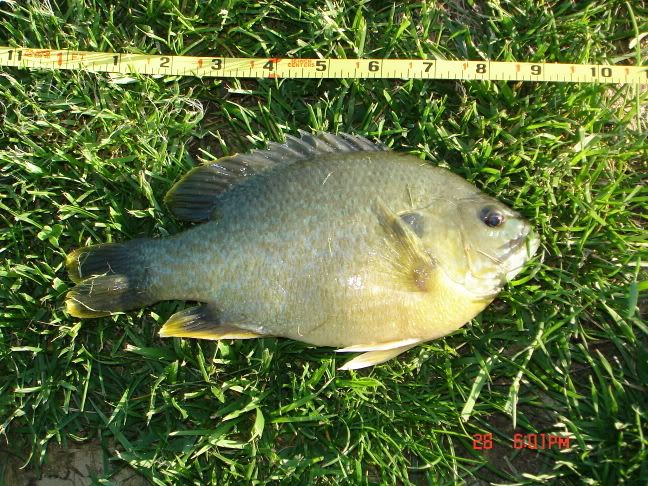 Standard BG (looks a lot like Makoclay's) 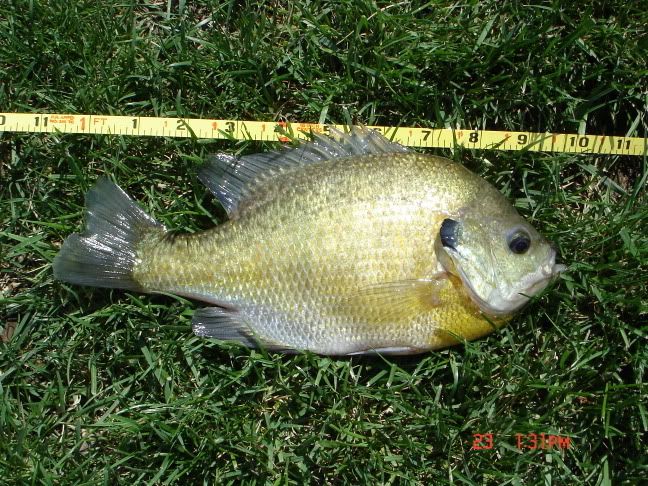 HBGxBG 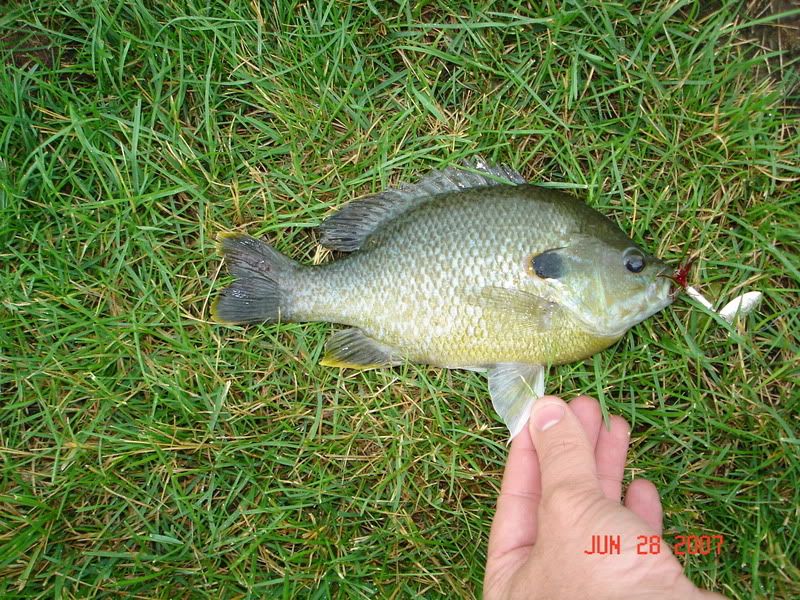
 "The greatest enemy of knowledge is not ignorance, it is the illusion of knowledge." Stephen W. Hawking
|
|
|
|
|
Joined: May 2009
Posts: 743
Lunker
|
|
Lunker
Joined: May 2009
Posts: 743 |
I thought the same thing about that third fish possibly having some CNBG in it, Ryan. Another year should tell the tale either way.
|
|
|
|
|
Joined: Mar 2005
Posts: 22,033 Likes: 483
Moderator Hall of Fame 2014 Lunker
|
|
Moderator Hall of Fame 2014 Lunker
Joined: Mar 2005
Posts: 22,033 Likes: 483 |
That 3rd fish is a little different. I don't see any CNBG characteristics in it (ones other than those in regular BG). No yellow/orange fin coloration , no wide bars , no copper band , no white/light pencil edges to the fins and can't count the fin rays. It looks like there is some non-BG traits in the color pattern but I don't know what. PHOTO #3
Last edited by ewest; 08/21/09 02:14 PM.
|
|
|
|
|
Joined: Oct 2005
Posts: 1,285 Likes: 1
Lunker
|
|
Lunker
Joined: Oct 2005
Posts: 1,285 Likes: 1 |
The shape of the nose of this one looks quite a bit different than the BG around here, more like the CNBG posted by others but there is a huge variance in profiles and colors even in local waters and it very well might just be the angle or lighting. 
"The greatest enemy of knowledge is not ignorance, it is the illusion of knowledge." Stephen W. Hawking
|
|
|
|
|
Joined: Sep 2003
Posts: 14,300 Likes: 450
Moderator Ambassador Field Correspondent Hall of Fame 2014 Lunker
|
|
Moderator Ambassador Field Correspondent Hall of Fame 2014 Lunker
Joined: Sep 2003
Posts: 14,300 Likes: 450 |
I thought I saw a little bit of those nose & gill plate striations (sp?) or markings that you see on some hybrids. I thought maybe with the more murky water, the colors weren't popping as much.
Excerpt from Robert Crais' "The Monkey's Raincoat:"
"She took another microscopic bite of her sandwich, then pushed it away. Maybe she absorbed nutrients from her surroundings."
|
|
|
|
|
Joined: Jan 2009
Posts: 10,458 Likes: 3
Ambassador
Field Correspondent
Hall of Fame Lunker
|
|
Ambassador
Field Correspondent
Hall of Fame Lunker
Joined: Jan 2009
Posts: 10,458 Likes: 3 |
Take a photo of the gill rakers of suspect fish. That can really help in identifying parentage.
|
|
|
Moderated by Bill Cody, Bruce Condello, catmandoo, Chris Steelman, Dave Davidson1, esshup, ewest, FireIsHot, Omaha, Sunil, teehjaeh57 |
|







