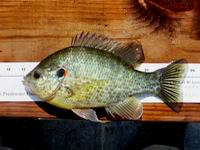
It has been shown in study after study that fish like BG , LMB , HSB etc in pond type environs do best when they get fish based protein/lipids (fish meal/oil)rather than other types especially plant based protein. For grazing fish like CC , tilapia , GC , GShiners the source is not so important.
I have found also that BG ect more readily eat pellets containing fish products. Plus the more you rely on pellets (aggressive feeding program) the more important this difference makes. So check the contents before you buy.
Here are a few bits of info.
However, the use of low-protein
diets has several complications. Such diets generally
contain high levels of carbohydrates, which
are often poorly utilized by fish (Wilson 1994) and
add to the quantity of undigested material entering
the culture system.
Physiologically, fish are affected
by variations in water temperature in two
ways (Hochachka and Somero 1984). First, temperature
determines the rate of chemical reactions,
and secondly, temperature dictates the point of
equilibrium between the formation and disruption
of the macromolecular structures in biological
membranes. Structural flexibility, therefore, is a
requirement for integrity of biological membranes
(Hazel 1993).
As environmental
temperatures decrease, the invariable response is
an increase in fatty acid unsaturation (Johnston and
Roots 1964; Caldwell and Vernberg 1970; Hazel
1979; Cossins and Prosser 1982). Conversely, as
ambient temperatures increase, phospholipid saturation
must also increase to avoid excess fluidity.
The dynamics of lipid composition of cells occurs
in order to maintain a constant fluid matrix for
enzymes associated with membranes (Greene and
Selivonchick 1990). Different species of fish differ
in their patterns of fat deposition and mobilization,
which in turn affects the temperature range in
which the species can grow and survive.
Diets influence the fatty acid composition in several
species of fish (Henderson and Tocher 1987;
Lovell 1989; Seo et al. 1994), and the ability of a
fish to alter its lipid composition ...is one factor that determines survival
In these fish, the fat
apparently hardens in the colder water, causing the
fat-impregnated muscles to stiffen and the fish to
become exhausted and lose movement.


.gif)