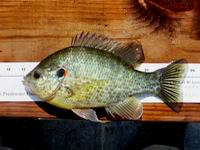
Here you go CJ. There is more but will let you digest this first.
Use of the Asiatic Clam, Corbicula leana Prime,
in Toxicity Tests -The Progressive Fish-Culturist 1976;38:10�10
Ralph M. Burress and Jack H. Chandler Jr.,
Southeastern Fish Control Laboratory
C. leana is the most resistant of the bivalves we have
exposed to fishery chemicals and is more resistant than
most invertebrates. Any toxic substance applied to
water which kills C. leana might eliminate most other
invertebrates.
This exotic clam will probably continue to invade
and to thrive in other streams and may ultimately
crowd out indigenous mollusks -- especially where
water quality is deteriorating. C. leana has created
economic problems for industry by plugging water
lines, blocking valves, and contaminating gravel. Consequently
we encourage its use as a test organism, not
only because it is a highly satisfactory test animal but
also because such tests may lead to the discovery of a
chemical method for controlling its spread.
Modified Venturi Suction Sampler for Collecting
Asiatic Clams --The Progressive Fish-Culturist
Volume 41, Issue 3 (July 1979) pp. 121�123
Jack S. Mattice
Environmental Sciences Division, Oak Ridge National Laboratory
and
Wheldon Bosworth
The Asiatic clam, Corbicula sp., has been exl�anding
its range in the United States at a rapid rate since the
first record of its presence in 1938 (Burch 1944), and has
become a major fouling organism and a common
member of the freshwater benthic community in many
areas. The early emphasis on documenting the invasion
of the United States by this organism (Sinclair and Isom
1963; Dundee and Harman 1963; Britton and Murphy
1977) has shifted toward investigation of its life history,
distributional limits, population biology, and community
interactions. Because such studies generally require
accurate density estimates, adequate sampling
techniques that are useful in a variety of substrates
would be helpful. Density estimates of Corbicula have
previously been made by using a variety of gear types
and techniques, including the widely used Ekman (Fast
1971; Rinne 1974) or Peterson grabs (Sinclair and Ingram
1961; Lenat and Weiss 1973; Aldridge and Mc-
Mahon 1976), specialty gear such as that used for sampling
soft sediment bars in the Delta-Mendota canal (Prokopovich
1966), or by handpicking an area of bottom in
shallow water (Anon. 1976) or recently exposed by reservoir
drawdown (Rinne 1974). None of these sampling
techniques, however, is capable of quantitative
sampling over the full range of depths and substrate
types where Corbicula is found (Gardner et al. 1976),
and all are particularly poor at sampling rock and
gravel, gravel, or cobble substrates (Kajak 1971) where
the density of clams may be highest (Sinclair and Isom
1963; Clench and Stansbery 1969; O'Kane 1976).
Corbicula as a Biological Filter and Polyculture Organism in
Catfish Rearing Ponds --
The Progressive Fish-Culturist
Article: pp. 136�139
JOSEPH K. BUTTNER 1
Department of Zoology and
Fisheries Research Laboratory
Southern Illinois University
Abstract.--Corbiculafi uminea, an introducedA sian
clam, was stockedw ith channelc atfish( Ictalurusp unctatus)
in Illinois culture ponds. Survival of the stocked
clams was 36-79% over summer, but reproduction was
poor and the populationsd eclined.N everthelessp, onds
with Corbicula had less dissolved oxygen depletion, lower
turbidity,a nd greaterp rimaryp roductiont han ponds
without the clam. Growth of channel catfish was unaffectedb
y the presenceo r absenceo f clams.C orbicula
fiumineah asp otentialv aluea s a polycultureo rganism
and as a biological filter where water temperatures do
not exceed 30�C.
�
Corbicula fluminea (a clam introduced from
Asia) has been viewed commonly as a liability in
the United States (Sinclair and Isom 1963; Eng
1979). However, many of its features indicate potential
as a biological filter and polyculture organism.
Corbicula can survive, grow, and reproduce
in fish ponds (Buttner and Heidinger 1980; Buttner
1981; Buttner, in press). It is more tolerant of commonly
used aquaculture chemicals than most fishes
(Chandler and Marking 1979). Corbicula exhibits
high fecundity, has a prolonged period of
reproduction, and lacks the parasitic glochidia stage
characteristic ofunionids (Sinclair and Isom 1963;
Britton et al. 1979). Corbicula has a high filtration
rate (Buttner and Heidinger 1981), can effectively
harvest detritus, bacteria, and phytoplankton (Sinclair
and Isom 1963), and exhibits rapid growth
(Britton et al. 1979; Buttner and Heidinger 1980).
The soft tissue of Corbicula is approximately 45%
protein by dry weight (Haines 1979), and commercial
markets exist for the clam as fish bait, for
use in the aquarium trade, as food for domesti
cared animals, and for human consumption (Chen
1976; Sickel et al. 1981; Britton and Sickel 1982).
The potential of Corbicula as a biological filter
and polyculture organism was evaluated, and the
results are presented in this paper.
Methods
Combinations of clams and channel catfish (Ictalurus
punctatus) were evaluated in four 0.06-
hectare earthen ponds located in Jackson County,
Illinois, during 1977 and 1979. During both years
two test ponds received Corbicula and two control
ponds received no Corbicula; fingerling channel
catfish were stocked in all four ponds. In 1977,
clams of 10 to 42 mm shell length were stocked
in two ponds at 828 and 1,010 kg/hectare; in 1979,
clams were again stocked in the ponds at 1,222
and 1,717 kg/hectare. In April 1977, each of the
four ponds was stocked with 300 channel catfish
fingerlings averaging 49 g; in May 1979, each pond
again received 302 fingerlings averaging 60 g. In
both years, catfish were fed number 6 Purina Trout
Chow at 2% body weight daily, 6 d/week. Feeding
rates were adjusted weekly and all ponds received
equivalent quantities of feed. Dissolved oxygen,
net diurnal production, water temperature, pH,
turbidity, alkalinity, and nitrogenous wastes were
monitored; survival and reproductive success of
Corbicula were determined; and effect of Corbicula
on catfish survival, growth, and feed conversion
was examined (Buttner 1981; Buttner, in press).
Alkalinity averaged 84 mg/L and pH averaged 7.4.
Water temperature at dawn averaged 25�C (range
15-32�C) and at dusk averaged 28�C (range 18-
34�C); dissolved oxygen at dawn approximated
50% saturation and by late afternoon approached
or exceeded 100% saturation. Ponds were harvested
and drained in October 1977 and 1979.
Unless stated otherwise, all analyses were conducted
using the GLM package of the Statistical
Analysis System (Helwig and Council 1979).
Results and Discussion
Corbicula survived and reproduced in catfish
ponds, but recruitment was not sufficient to mainrain
stock density. Survival of stocked Corbicula
averaged 36% in 1977 and 79% in 1979. Reproductive
successo f Corbiculaw as indicated by the
presence of several larval clams less than 0.02 mm
in shell length, identified from 10 zooplankton collections
taken between August and October 1979.
Survival of larval Corbicula was poor and very
few young-of-the-yearc lamsw ere collecteda t harvest.
Adult Corbicula survived Karmex at 1 mg/L,
used to control aquatic vegetation; Batex at 0.25
mg/L, used to eliminate crayfish; and rotenone at
2 mg/L, used to kill contaminant fish.
No significant differences (P > 0.05) in survival
or growth of channel catfish were observed between
ponds with and without Corbicula, but �vater
quality was improved in ponds with Corbicula
(Table 1). Dissolved oxygen at dawn was greater,
incidence of dissolved oxygen below 3 mg/L was
lower, rate of primary production was higher, and
turbidity was lower in ponds with Corbicula. Nitrogenous
wastes were sometimes greater in ponds
with Corbicula. Trends were similar in both 1977
and 1979.
Habel (1970) and Busch (1974) observed that
Corbicula clams, stocked at 6,860 to 40,860 kg/
hectare in 0.0007-hectare pools, were associated
with decreasedt urbidity, increasedc hannel catfish
survival, and increased mean weight of catfish.
More recently, Haines (1979) observed that turbidity
of sewage effluent was lower in the presence
of Corbicula. However, as in the present study,
clam mortality was high and probably was related
to an intolerance to elevated temperatures and low
oxygen. Corbicula uptake of oxygen decreases
greatly between 25 and 30�C; at these temperatures
the rate of uptake at 70% oxygen saturation is half
that in waters at 100% saturation (Mattice and Dye
1979; McMahon 1979). Water temperatures in excess
of 33�C produce mortalities (McMahon and
Aidridge 1976).
Based on these observations, the greatest potential
of Corbicula as a biological filter and polyculture
organism would be in systems with cooler
temperatures and higher dissolved oxygen than
commonly found in channel catfish ponds. The
clam should be introduced only in waters where
temperatures rarely exceed 30�C and dissolved
oxygen is greater than 50% saturation. In such a
system, Corbicula could be stocked on the substratum
of earthen ponds or possibly in cages suspended
in slowly circulating water. Corbicula may
be useful in promotion of water quality in discharge
canals, after secondary treatment of sewage,
or in the effluent of fish raceways. Polyculture with
cool water fishes such as striped bass (Morone saxatilis),
walleye (Stizostedion vitreum), sauger (S.
canadense), and yellow perch (Perca fiavescens)
may be possible because optimum temperatures
for these species range from 22�C to 28�C (Hokansen
1977; Coutant and Carroll 1980). These
temperatures more closely approximate the optimal
temperature for Corbicula than does the optimal
temperature for channel catfish (30�C: NRC
1977). Prior to extensive use of Corbicula in polyculture
systems, its effect on nitrogenous wastes
should be identified.
Acknowledgments
I would like to acknowledget he assistancep rovided
by the Department of Zoology and the Fisheries
Research Laboratory, Southern Illinois University
at Carbondale. The study was supported,
in part, by a grant from Sigma Xi, the Scientific
Research Society.
References
Britton, J. C., D. R. Coldiron, L. P. Evans, Jr., C. Go*
lightly, K. D. O'Kane, and J. R. TenEych. 1979.
Reevaluation of the growth pattern in Corbiculafiuminea
(Miiller). Pages 177-192 in J. C. Britton, editor.
First international Corbicula symposium. Texas
Christian University, Fort Worth.
Britton, J. C., and J. B. Sickel. 1982. From the editor.
Corbicula Newsletter 7:2.
Busch, R.L. 1974. Asiatic clam, Corbicula manilensis
Philippi, as biological filters in channel catfish Ictalurus
punctatus (Rafinesque) cultures. Master's
thesis. Auburn University, Alabama.
Buttner, J. K. 1981. Asiatic clam in channel catfish
rearing ponds: its biology and its effect on water
quality. Doctoral dissertation. Southern Illinois
University, Carbondale.
Buttner, J. K. In press. Biology of Corbicula in catfish
rearing ponds. J. C. Britton, editor. Second international
Corbicula symposium. Little Rock, Arkansas.
Buttnet, J. K., and R. C. Heidinger. 1980. Seasonal
variations in growth of the Asiatic clam, Corbicula
fluminea, in a southern Illinois fish pond. Nautilus
94:8-10.
Butmet, J. K., and R. C. Heidinger. 1981. Filtration
rate of the Asiatic clam, Corbiculafiuminea. Transactions
of the Illinois State Academy of Science 74:
13-17.
Chandler, J. H., Jr., and L. L. Marking. 1979. Toxicity
of fishery chemicals to the Asiatic clam, Corbicula
fiuminea. Progressive Fish-Culturist 41:148-150.
Chen, T.P. 1976. Culture of the freshwater clam, Corbicula
fiuminea. Pages 107-110 in Aquacultural
practices in Taiwan. Page Brothers, Norwich, England.
Coutant, C. C., and D. S. Carroll. 1980. Temperatures
occupiedb y ten ultrasonic-taggeds triped bass in
freshwater lakes. Transactions of the American
Fisheries Society 109:195-202.
Eng, L.L. 1979. Population dynamics of the Asiatic
clam, Corbiculafiuminea (Miiller), in the concretelined
Delta-Mendota canal of central California.
Pages 40-68 in J. C. Britton, editor. Proceedings
first international Corbicula symposium. Texas
Christian University, Fort Worth.
Habel, M.L. 1970. Oxygenc oncentrationt, emperature
tolerance, and filtration rate of the introduced Asiatic
clam Corbicula manilensis from the Tennessee
River. Master's thesis. Auburn University, Alabama.
Haines,K .C. 1979. The useo f Corbiculaa sa clarifying
agenti n experimentalt ertiary sewagetr eatmentp rocess
on St. Croix, U.S. Virgin Islands. Pages 165-
176 in J. C. Britton, editor. Proceedings first international
Corbicula symposium. Texas Christian
University, Fort Worth.
Helwig, J. T., and K. A. Council. 1979. SAS user's
guide. SAS (Statistical Analysis System) Institute,
Raleigh, North Carolina.
Hokanson, K. E.F. 1977. Temperature requirements
of some percids and adaptations to the seasonal temperature
cycle. Journal of the Fisheries Research
Board of Canada 34:1524-1550.
Mattice, J. S., and C. C. Dye. 1976. Thermal tolerance
of the adult Asiatic clam. Corbicula Newsletter 2: 8.
McMahon, R. F. 1979. Response to temperature and
hypoxia in the oxygen consumption of the introduced
Asiatic freshwater clam Corbicula fiuminea
(Miiller). Comparative Biochemistry and Physiology
A, Comparative Physiology 63:383-388.
McMahon, R. F., and D. W. Aidridge. 1976. Respiratory
responsesto temperature and low oxygent ension
in Corbicula manilensis, Philippi. Corbicula
Newsletter 1:6.
NRC (National Research Council). 1977. Nutrient requirements
of warmwater fishes. NRC, Subcommittee
on Warmwater Fishes, National Academy of
SciencesW, ashington,D .C.


.gif)