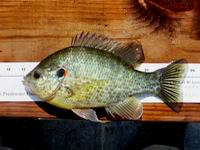
Here is a little of the negative info on gams. IIRC one study listed several minnow species and BG and GSF as being as effective as gams.
The use of Gambusia as a biological control in an attempt to control mosquito populations has never been proven to be more effective than our native species would be, or already are. "It is arguable whether Gambusia offer better control than some native fishes" (cited in Courtenay & Meffe, 1989). Even the natural presence of native mosquito-larvae eating insects such as backswimmer (Anisops spp.), and carnivorous water-beetles (Coleoptera spp.) etc. have been recorded as being considerably more effective than introduced Gambusia which then destroy these natural bio-controls (Hoy et al., 1972). New Zealand�s foremost expert on our country�s freshwater fishes, McDowall (1990) has written "Mosquitofish were introduced into New Zealand with the intention of using them to control mosquitoes, but their effectiveness and superiority over native fishes has never been demonstrated." Even more simply, Rupp, (1996) asks "if Gambusia is so effective as a predator, how is it there are so many mosquitoes in areas that are its native habitat?"
Indeed, the use of native fishes as a superior control without the ecological repercussions of an introduced pest is recognised by both the American Mosquito Control Association, and the World Health Organisation (WHO). A recent feature in the journal of this former organisation which specialises in the control of mosquito problems around the world, damned the use of Gambusia as biological control (Rupp, 1996) promoting the use of country�s native fish species instead. This journal also features many regular article outlining research that supports the use of native fish species as alternative methods for control, typically finding them superior as control agents to Gambusia.
1993 Dennis C. Haney of the National Biological Survey of the U. S. Department of the Interior wrote (personal comment): "I think you will find that there is little or no evidence for Gambusia being particularly effective in controlling mosquito larvae. In fact, almost all the evidence indicates that Gambusia is no better at controlling larvae than are native fish."
Myers, writing in 1965, noted some 30 years previously "the crew of the California State Fish and Game Department's black-bass hatchery at Friant had to discontinue using Gambusia as a 'forage fish' with which to feed the bass. Gambusia was destroying a large proportion of the young bass!" He also reported removing Gambusia from a pond shared with goldfish and seeing the goldfish population double and redouble in 2 years.
Gambusia does not specialize in mosquito larvae and pupae (Harrington and Harrington 1961; Myers 1965; Washino and Hokama 1967, Meisch 1985).
Live-bearers are supposedly easier to raise than egg layers; the fry are larger, free swimming, and feeding at birth; they grow more quickly and become predators faster. However, in this writer's experience, egg-laying minnows (Pimephales promelas "Rosy") produced thousands of fry in a 10-foot garden pond over the course of a summer with minimal parental predation.
Although widely introduced as mosquito control agents, recent critical reviews of the world literature on mosquito control have not supported the view that Gambusia are particularly effective in reducing mosquito populations or in reducing the incidence of mosquito-borne diseases (Courtenay and Meffe 1989; Arthington and Lloyd 1989). Because of their aggressive and predatory behavior, mosquitofish may negatively affect populations of small fish through predation and competition (Myers 1967; Courtenay and Meffe 1989). In some habitats, introduced mosquitofish reportedly displaced select native fish species regarded as better or more efficient mosquito control agents (Danielsen 1968; Courtenay and Meffe 1989).
Introducing mosquitofish also can precipitate algal blooms when the fish eat the zooplankton grazers (Hurlbert et al. 1972), or in an increase in the number of mosquitoes if the fish eat the invertebrate predators (Hoy et al. 1972).
Katz designed a series of experiments that showed conclusively that the little mosquito fish also has a real taste for the tadpoles and eggs of spawning amphibia. In one experiment, he found twice as many Gambusia with undigested tadpoles in their stomachs as those that had fed on larvae, but in most cases the fish had fed on both. Since the Gambusia breed almost all year, producing dozens of live young on a monthly basis, and the amphibia breed only once a year, there isn't really any doubt of the outcome, Katz says.


.gif)