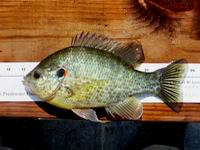
Rick :
HBG are a tool to be used in the proper circumstances if they meet your goals for the pond. IMO they are best used as a put and take species and not as a long term breeding population for forage purposes.
It sounds like you don't have any predators in the pond. Here is a little info in these links. It is best to think about your goals and them make other choices based on those.
Here is a long HBG thread with pics.
http://www.pondboss.com/ubb/ultimatebb.php?ubb=get_topic;f=5;t=000439;p=1 The info below is from that thread.
HBG turning into GSF has no science behind it to my knowledge. That is where I lost your train of thought. HBG offspring, because of outbreeding depression, can (may) be undesirable depending on ones goals, but they can not change their genes to those of a GSF.
There are many good uses of HBG depending on ones goals. Many of the studies are positive in nature on the uses of HBG as a tool in the right circumstances. This is reflected in some of the State pond mgt. books which suggest uses like yours (with HBG).
I know I have posted this before but the studies are in conflict wrt the ability of HBG to backcross with either parental species. One says yes one says no. Both were well done studies and some very good scientists were involved and so far there is no answer for the different results. Some of us have even contacted fisheries geneticist PhDs at the highest level who have written on sunfish genetics and they have no answer as most have not studied HBG cross genetics.
Stop and think about that. If HBG can not backcross with parentals then they can not ever create or get genetically close producing GSF , even through repeated spawning attempts with GSF. If they can backcross then through repeated crossing of HBG with GSF for generations the population as a whole will have a higher content of GSF genes.
To keep it straight in my mind I divide this topic in 2 parts for genetic purposes.
Part One -- each type BG , GSF and HBG are a separate thing, each with their on genetics , traits, abilities, benefits and problems. Each separate and different .
Part two -- HBG are a cross (a genetic change) and as such have the potential for both hybrid vigor and outbreeding depression. Both of these are present in HBG. Big mouth - fast growth start and most important aggressive (easy to catch) and skewed sex ratio in the F1 cross. As time , generations pass outbreeding depression works to lessen hybrid vigor and can (may) lead to offspring that have traits worse than either parental species. In time they may become "unwanted" but not because they are BG or GSF (or seem to have their traits) but because they are Fx HBG that have experienced outbreeding depression and the resulting negative genetic traits.
Recall that small size and/or stunting/ overpopulating is common to a number of lepomis not just GSF. I know that one or more of these traits are common in GSF , PS , BG , and others as well.
ML has GG and I don't know if they are HBG or not. Yes you can have different %s of parental species gene sequences ( BG , RES and GSF for example) but its how they mix and match up (if they are viable/live) that counts. To my knowledge science does not know ( I have not seen it written) what traits come from where and in what % and combinations with HBG or other lepomis crosses. Much left to learn. That is why I am interested in DIED's HBG situation -- are they continuing F1 HBG or are they Fx HBG.
I hope this helps somewhat.


.gif)